
The previous weekly analysis established a crystal clear baseline:
- Market participation had evaporated, reflected in synchronized weekly volume contractions exceeding -2 standard deviations relative to each asset history and across asset classes.
- At the same time, stress originated in the fixed-income complex via the MOVE index, while the options market (VVIX) began pricing forward uncertainty that spot realized volatility in equities failed to acknowledge.
This mid-week update tests that thesis against fresh structural data.
- The liquidity drought remains absolute, but internal divergences are fracturing the broader narrative.
- The market is not moving in a uniform block; cross-asset flows reveal distinct stress points and localized compression setups that dictate tactical adjustments.
Macro & Volatility and Capital Flow Dynamics
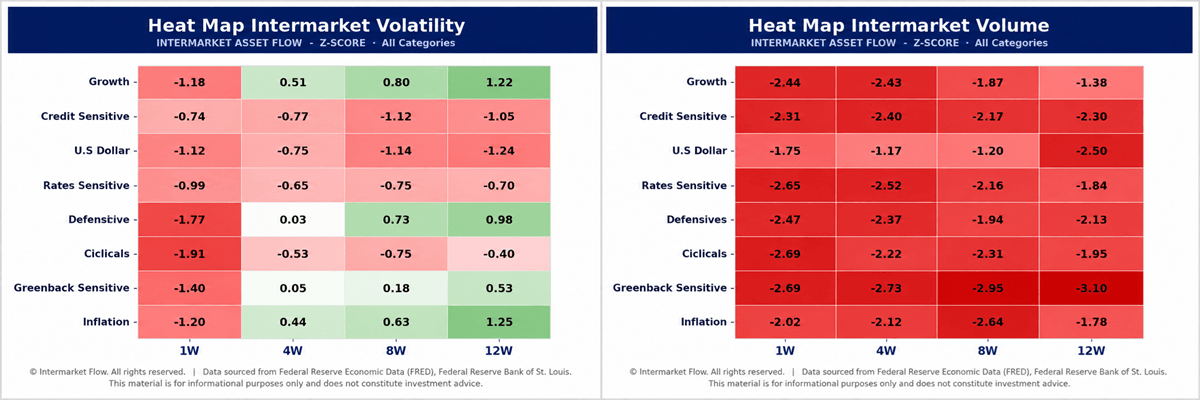
- Volume Collapse and Liquidity Vacuum: Short-term volume readings across defensive, cyclical, rate-sensitive, and growth sectors continue to sink well below historical averages. This widespread withdrawal confirms a “Hands-Out” regime where neither buyers nor sellers hold directional conviction.
- The Fixed-Income Transmission Bridge: The MOVE index continues to lead the volatility complex, signaling sustained stress originating in rates.
- The options pricing bridge (VVIX) reacts to this bond market friction, while equity-market realized volatility lags behind.
The Asymmetry of Protection: Because realized volatility remains compressed while forward-looking options metrics price pressure, protection remains cheap. Waiting for realized volatility to break out guarantees a higher cost of convexity.
Equity volume contraction trading
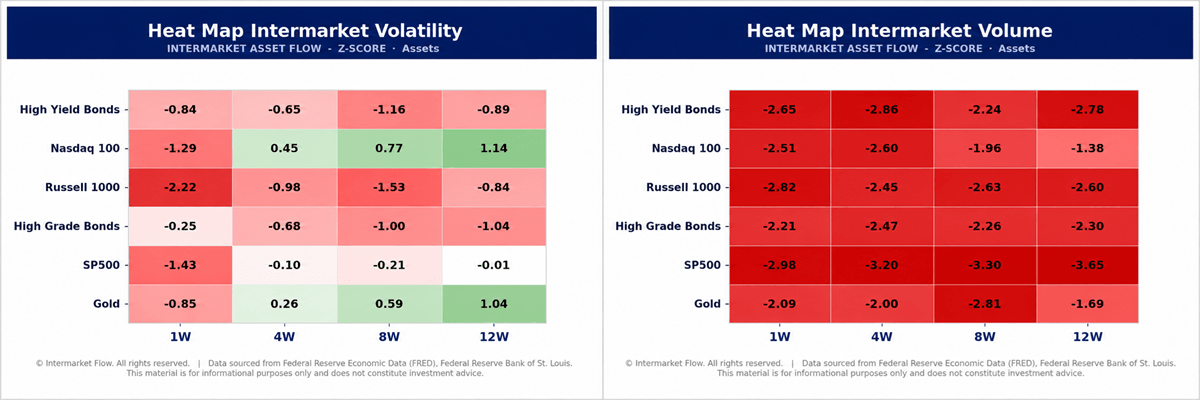
- Asset-Level Behavior: High-yield bonds, the S&P 500, and mid-cap structures show deep volume contraction .
- However, asset classes like the Nasdaq and Gold diverge by attempting to decompress volatility at the 4-week window, breaking the uniformity of the short-term collapse.
Market regime analysis
- While 1-week data shows broad-based volume destruction across all categories—led by cyclicals and defensives—the 4-week window highlights a structural split.
- Growth and inflation assets are showing early signs of volatility normalization, whereas credit-sensitive and rate-sensitive clusters remain deeply depressed.
Equity Structure & Internal Stress
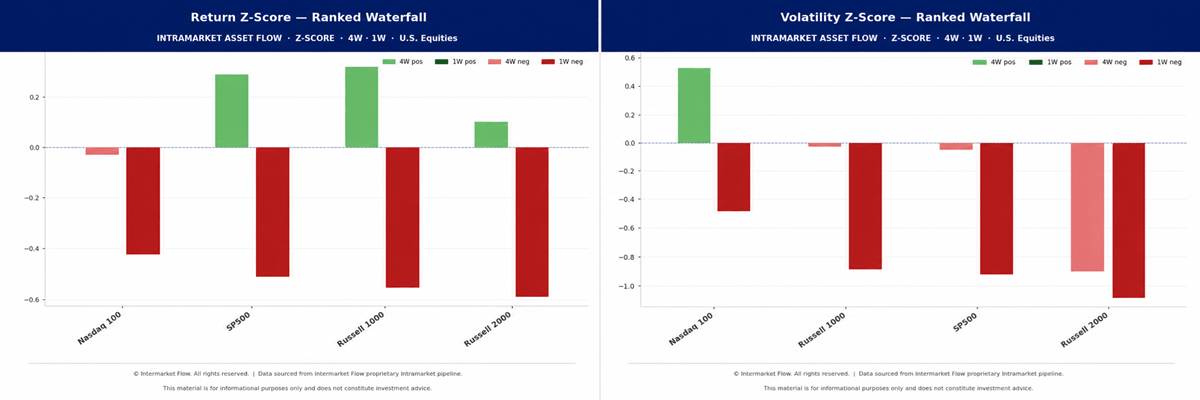
- Cross-Index Volatility Compression: Realized volatility across major equity benchmarks (SPY, QQQ, and IWM) has compressed into a tight band, masking the underlying divergence in factor sensitivities.
- The Russell Complex Vulnerability: The Russell 1000 and 2000 experienced the sharpest weekly volatility compression alongside severe volume contraction. Within a defensively biased market, small caps present the cleanest statistical vulnerability to a directional adjustment.
Main Conclusions
- The Hands-Out regime is deepening. Participation continues to contract across asset classes, with no sustained directional control from either Risk On or Risk Off.
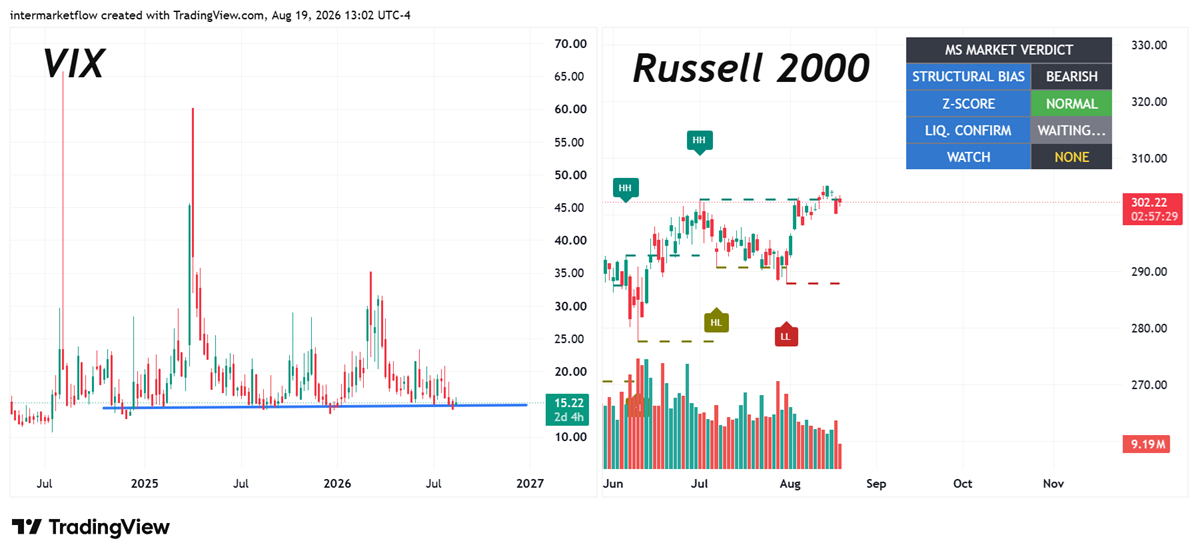
- Rates volatility is beginning to transmit into the equity volatility complex. MOVE remains elevated, while VVIX is adjusting faster than VIX, suggesting that the repricing process is progressing through volatility expectations before fully reaching realized equity volatility.
- The market remains directionless, but with a defensive bias. That bias is visible both in the persistence of the Hands-Out regime and, more clearly, in the deeper volatility compression concentrated in Risk On assets relative to defensive exposures.
- The strongest asymmetry is concentrated in naturally higher-volatility assets. When volatility compresses most aggressively in assets that normally carry higher volatility, the potential mean-reversion adjustment becomes more significant.
- This creates both volatility mean-reversion opportunities and a directional framework for expressing downside risk where compression, weak participation, and defensive bias overlap.
Tactical Execution Plan
- Hedging: Secure downside protection immediately while options pricing remains disconnected from fixed-income stress signals. This is the setup now.
- Long Volatility: Extreme realized-volatility compression, together with the recent acceleration in MOVE and VVIX, keeps the mean-reversion setup in volatility attractive.
- Timing remains critical. The trade should only be activated once weekly volume recovers toward at least -1.5σ, signaling that participation is beginning to return alongside the volatility adjustment. Until then, the setup remains favorable, but not fully confirmed.
- Short Exposure: Target tactical short or mean-reversion structures strictly within assets exhibiting extreme volume starvation and suppressed volatility, such as the Russell index complex. Timing for this trade requires weekly volume to recover toward at least -1.5σ beforehand.
Call to Action
- Do not wait for realized volatility to break out before adjusting portfolio sensitivity. Secure protection while the cost of convexity remains disconnected from fixed-income stress.
Read our foundational framework on Intermarket Flow Methodology to understand how we track Z-Scores and capital flows. Subscribe to Intermarket Flow to receive our complete quantitative breakdown and real-time execution alerts every Wednesday and Sunday.
Intermarket Flow
OR
UPGRADE
Free trial has expired.
If you believe this is an error, please contact the administrator.
If you believe this is an error, please contact the administrator.
OR
UPGRADE