
Market Regime
Although the Sunday report typically seeks a broader outlook, generally framed within a monthly time frame, we are making an exception this week; the capital flows observed over the past few days are highly illustrative and confirm our prior structural conclusions.
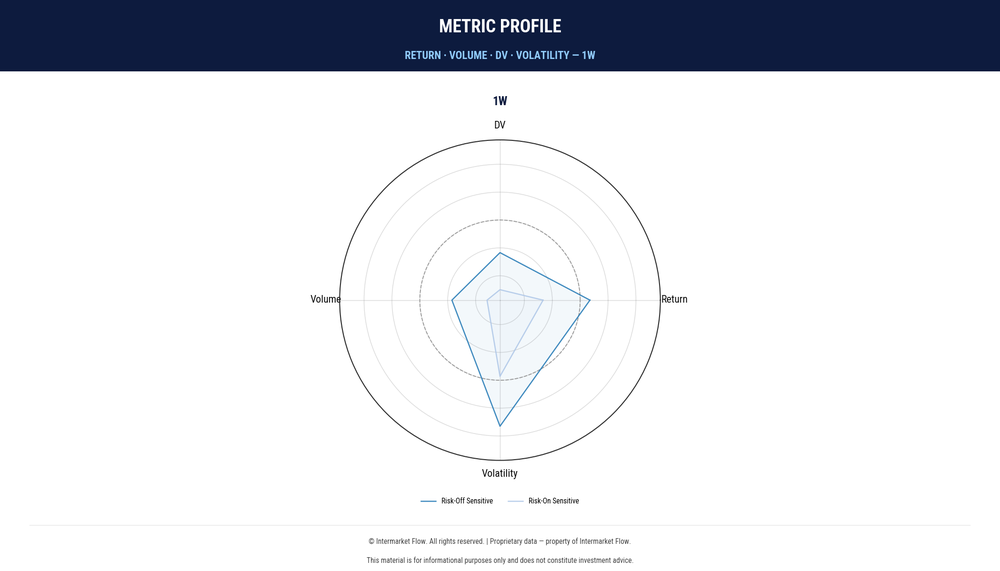
In the weekly time frame, assets within the Risk-Off profile:
- Received higher volume.
- Expanded volatility.
- Generated significantly higher returns.
Volume: the missing leg
The entire ecosystem of regimes—across weekly, monthly, bi-weekly, and quarterly time frames—persists in a state of constant volume contraction. Within this environment, the aforementioned shifts occurred.
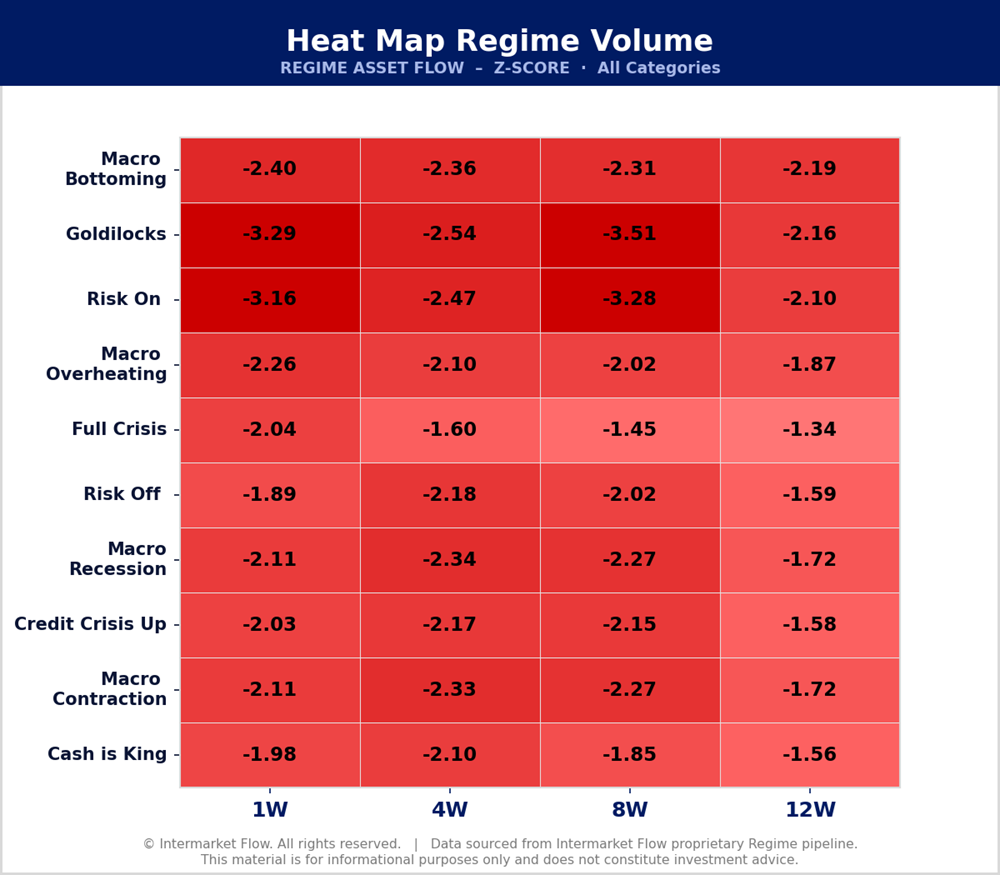
The permanent Hands-Off regime that we have been observing for some time now generates two operational situations. On one hand, the lack of volume makes final confirmation of the stage impossible. In parallel, it is precisely this Hands-Off regime that sends a powerful but unconfirmed, message.
Returns and Volatility by Regime per Time Frame
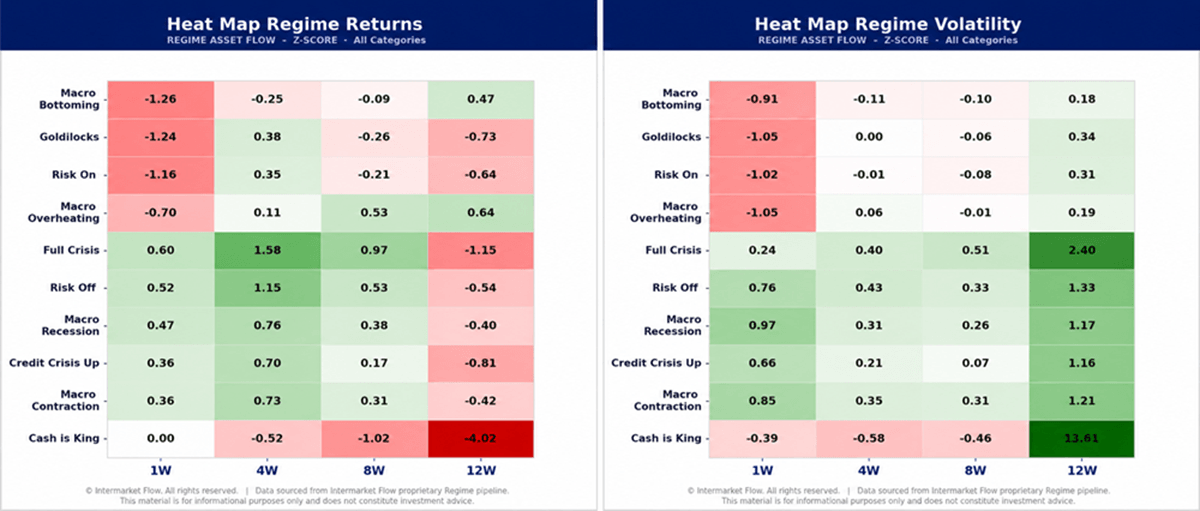
- The four regimes with the weakest returns are precisely those exhibiting the highest volatility compression. Asymmetry → Opportunity.
- Regimes associated with Risk-Off positioning exhibit a consistent trend of rising returns and increasing volatility across multiple time frames.
- The intermediate, neutral stance—Cash is King—remains at zero return with compressing volatility.
The bias is clear and has been consistent across recent reports. While volume lacks confirmation, the increase in volatility—characterized by high price sensitivity and low market depth—alongside positive returns, suggests an underlying “silent” accumulation, technically defined as bullish divergence.
Capital Allocation
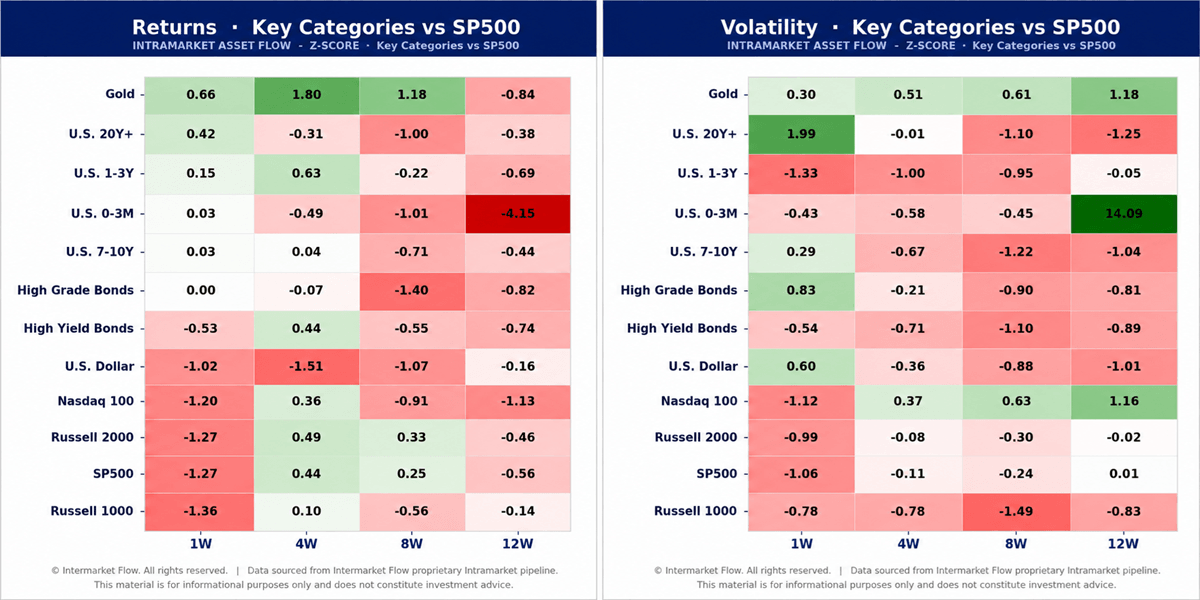
- Return and volatility remain correlated.
- Risk-Off assets maintain positive performance.
- Risk-On assets exhibit negative signs, underperforming returns, and deeper volatility compression.
To deepen the reading and evolution, it is advisable to observe all time frames. It is there where the message takes on relevance.
Textbook Volatility transmision
- Fixed income volatility began to propagate four weeks ago, gradually transmitting to equities. Equities now show an accelerating volatility rate of change from absolute compressed levels.
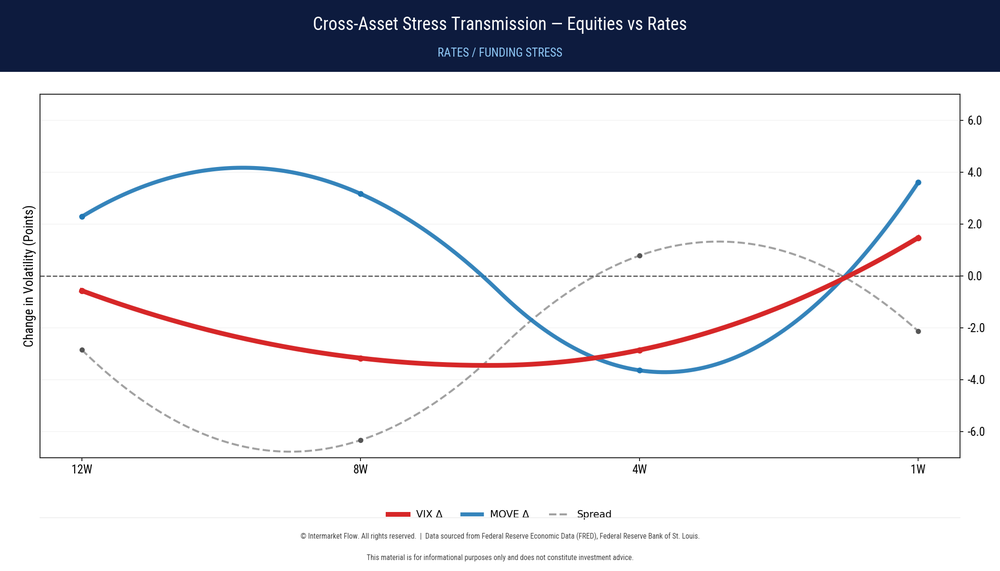
- This transmission dynamic, drives changes in the volatility rates of change, across all asset classes, with particular significance in equities.
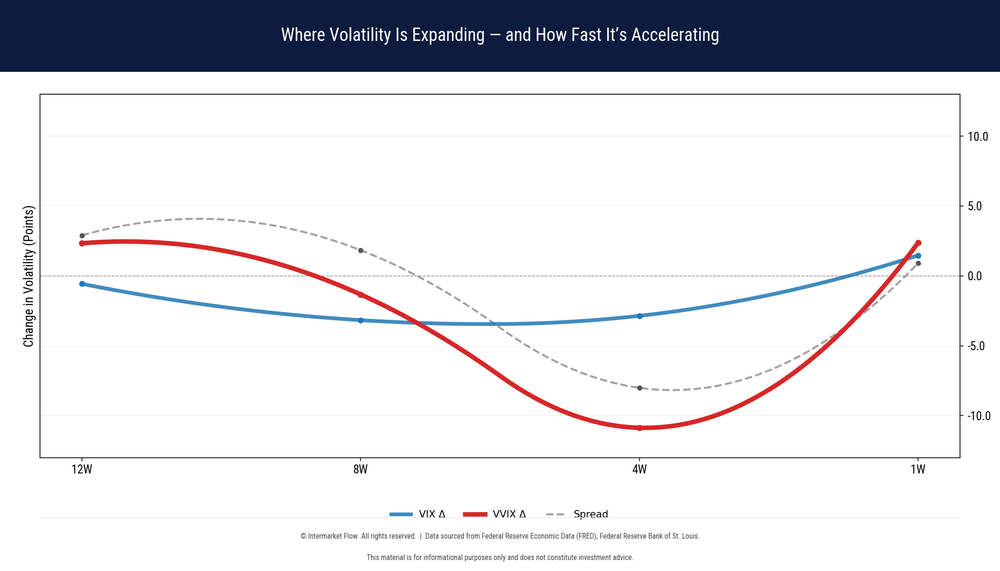
- Our previous report highlighted how volatility compression asymmetry disproportionately affected the most volatile segment of the spectrum; this trend began to shift this week.
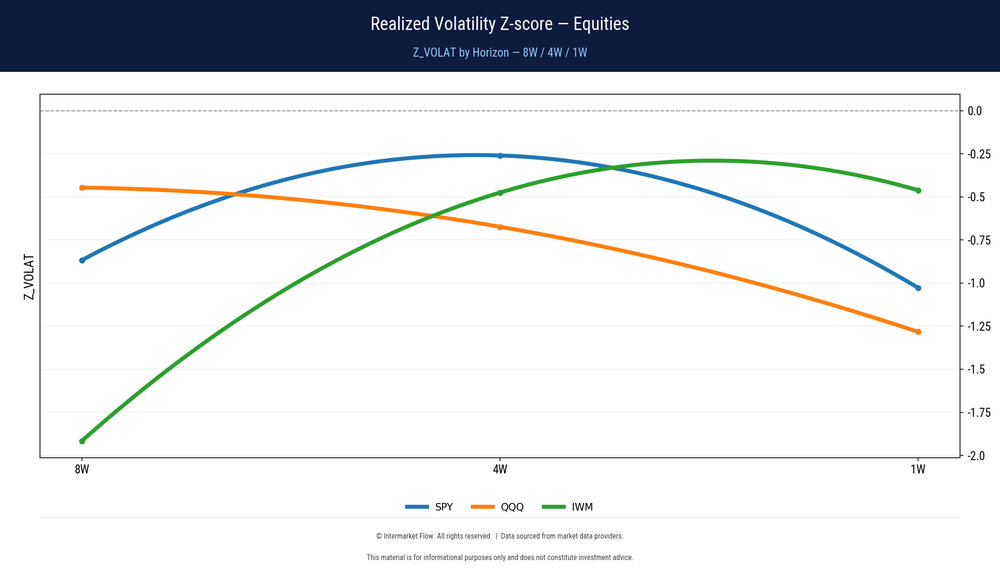
- Following established theoretical order, the Nasdaq is the next logical candidate for volatility adjustment. Trading implications.
Main Conclusions
- The weekly time frame exhibited clear directional movements across the intermarket.
- The Risk-Off profile accentuates a bias that has been sustained over several time frames.
- In a context of positive returns, high volatility, and significant price sensitivity, the data indicates a scenario of accumulation rather than distribution.
- Risk-On assets reflect the inverse.
- Low intermarket volume remains a notable, missing confirmation component.
- Volatility adheres to a textbook path, with statistically significant manifestations in a clear sequence: Bonds → Equities → Russell, with Nasdaq pending.
- Market action in gold confirms the aforementioned conclusions.
Course of Action
This section requires careful interpretation, contingent upon the reader’s investment time horizon.
Portfolio & Holder Level
- We have recommended risk-hedging strategies for several weeks, given the existing asymmetry between asset prices and VIX values.
- Risk assets, particularly equities, currently offer a poor risk-reward ratio, with limited upside potential against the risk of sharp declines before the primary trend resumes. Zero exposure.
- While confirming volume is absent, delaying action at the portfolio level, risks arriving too late and paying a high price for something you should already hold.
Traders
- Volatility remains the most actionable trade, with the Nasdaq providing the most efficient vehicle for expression.
- Short-term directionality is not bullish.
- Timing a grinding higher market requires volume reaction on ups and downs until an important technical break with volume.
- Favor mean-reversion, contrarian setups with position sizes below standard levels. Expect heightened volatility in the coming weeks.
All strategies require volume confirmation. A Sigma of at least −1 is required to initiate positioning.
Continuous Institutional Access: Do not rely on fragmented conclusions. Subscribe to Intermarket Flow to receive bi-weekly quantitative flow and market regime analysis, designed for portfolio managers and traders who operate on hard data rather than narratives.
Intermarket Flows
If you believe this is an error, please contact the administrator.