
Hands-Out Regime: Why Capital Preservation Is the Market’s Primary Mandate
- The Mid-Week Report setup was built on a persistent Hands-Out environment.
- This report tests that thesis across macro conditions, volatility, rates, capital flows and technical structure.
The evidence is consistent:
- This is neither Risk-On nor conventional Risk-Off.
- Capital is not rotating decisively into defensives; it is withdrawing from risk exposure.
- Protecting capital—not rotating it—remains the market’s primary mandate.
Risk Propensity: A Persistent Hands-Out Regime
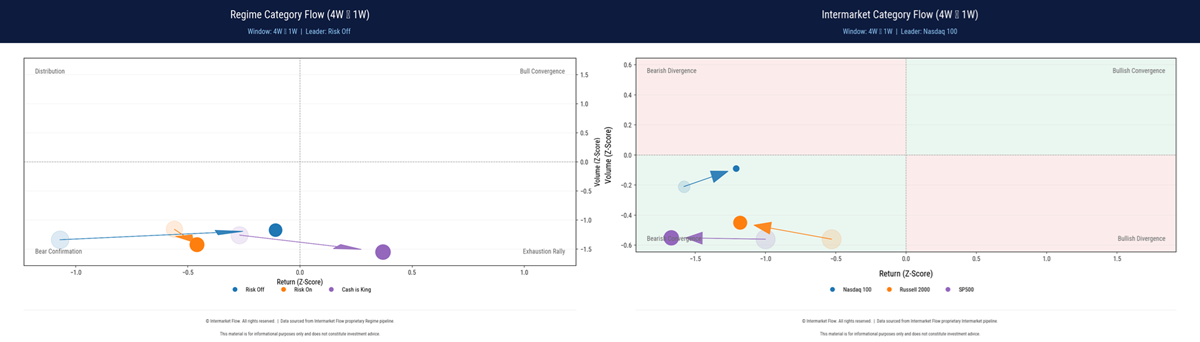
Reading Framework
- Arrows track the transition from 4W to 1W. Each point combines return and volume Z-scores normalized within its respective timeframe.
- Rightward movement indicates stronger returns; upward movement indicates stronger volume.
- Returns without volume confirmation are fragile.
- Z-scores measure distance from historical norms: 0σ is normal, ±1σ is meaningful, and ±1.5σ or more is statistically unusual.
Market Risk Regime: Thin Participation, Fragile Prices
- Depressed Volume: Relative volume remains between −1.2σ and −1.6σ across the major regimes. With participation this weak, prices become increasingly sensitive to marginal capital flows.
- Cash Leads: Cash Is King continues to dominate, with improving 1W returns despite deteriorating participation. Risk-Off improves modestly, while Risk-On remains directionally weak and unsupported by volume.
- Equity Weakness: The Nasdaq 100 shows a modest improvement, but the S&P 500 and Russell 2000 remain in bearish convergence. Equity return Z-scores range from approximately −1.0σ to −1.7σ, without broad volume confirmation.
The Trap
- In a thin market, statistically significant price movements can develop without genuine participation. This increases the risk of false breakouts, overshooting and abrupt reversals.
Intermarket Regime: Capital Preservation and Stores of Value
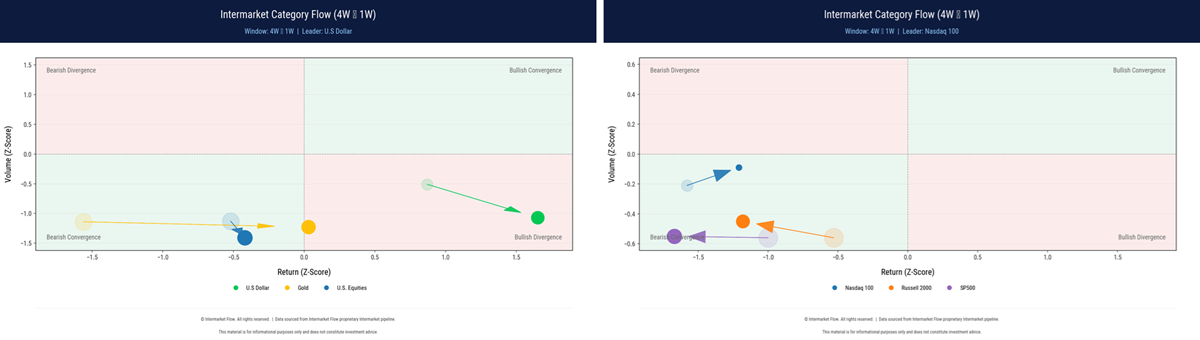
- U.S. Dollar Leadership: The Cash Is King thesis is most visible in the U.S. dollar. Its return Z-score accelerates from approximately +0.9σ to +1.6σ, while volume deteriorates toward −1.0σ. Directional strength is clear, but participation remains weak.
- Gold’s Role: Gold sits outside the Cash Is King regime, but its recovery from approximately −1.6σ to neutral returns reinforces the broader Hands-Out thesis. Price behavior favors liquidity and stores of value over risk expansion.
- The Distinction: Defensive assets are improving without broad volume confirmation. This supports a capital-protection mandate—not a panic-driven Risk-Off event.
Macro Perspective: Contraction Aligns better with Hands-Out Risk regime
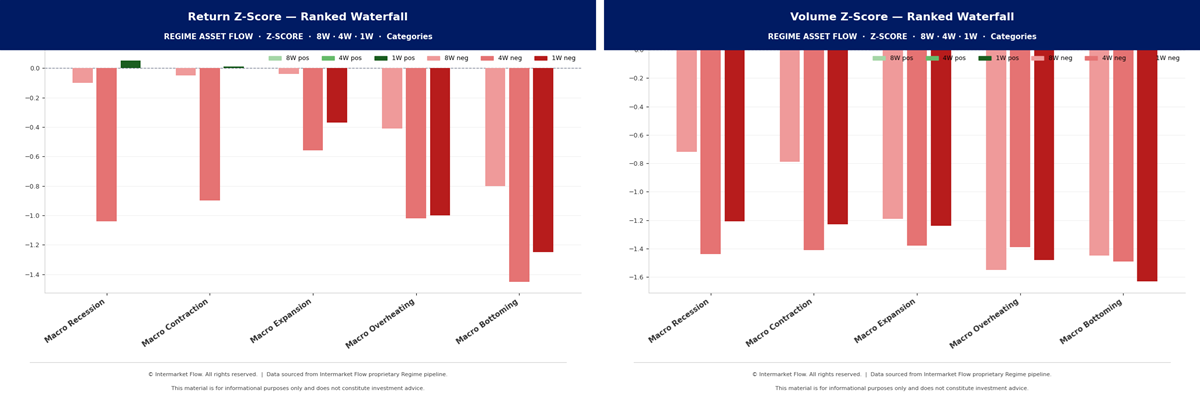
- Relative Resilience: Macro Recession and Macro Contraction improve from approximately −1.0σ at 4W to neutral or slightly positive returns at 1W. Expansion, Overheating and Bottoming remain negative.
- Weak Participation: Weekly volume remains between approximately −1.2σ and −1.6σ across the entire macro spectrum, with limited change from the 4W readings.
- The Interpretation: Contractionary regimes are performing less poorly because they sit closer to Hands-Out on the risk-appetite spectrum than expansionary regimes. This reflects market positioning—not confirmation of an economic recession yet.
Volatility Regime: Expectations Near The Floor Again
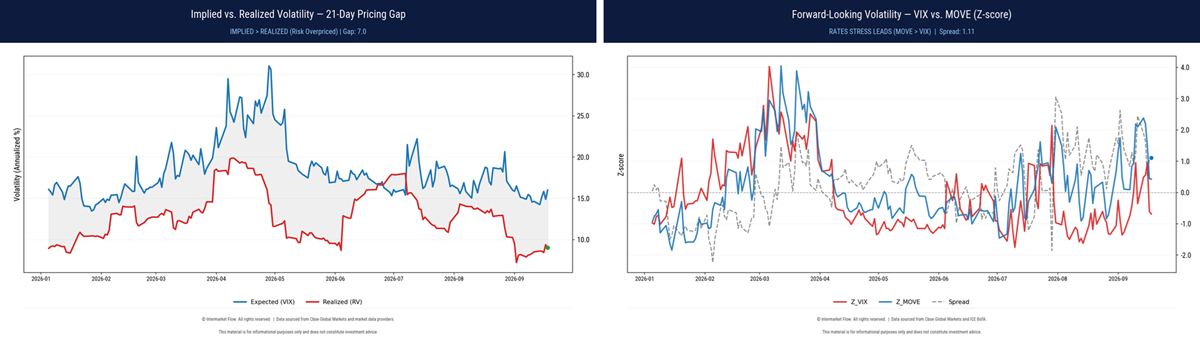
Reading Framework: The left panel compares realized equity volatility with the volatility expected by the market at each point in time.
- Equity Volatility: Realized volatility is near its 52-week low, while current 30-day implied volatility is also close to the bottom of its annual range.
- Rates Volatility: MOVE has fallen sharply. Unlike in the Mid-Week Report, the market is no longer pricing an imminent volatility adjustment, although MOVE remains approximately 1.1σ above VIX.
- Persistence Check: This is a meaningful change from the Mid-Week Report, but both VIX and MOVE are noisy daily series. The signal requires persistence.
Yield Curve: Higher Rates, Unadjusted Valuations
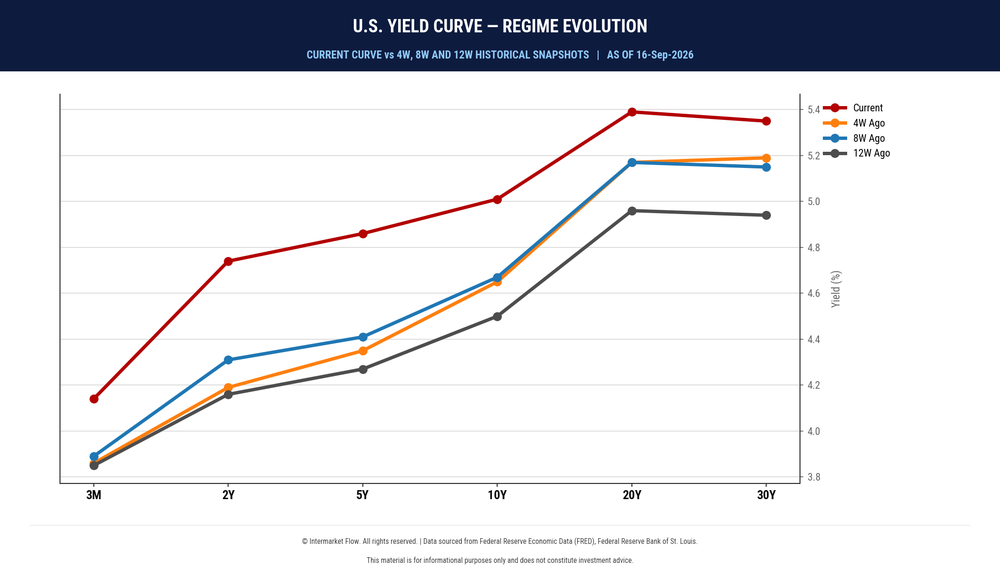
- Largest Displacement: The current curve shows the largest upward shift across the 4W, 8W and 12W snapshots.
- Front-End and Belly Pressure: Yields rose across every maturity, but the adjustment was concentrated in the 2Y and 5Y, which increased by approximately 50–55 basis points, versus 15–20 basis points at the long end.
- Bear Flattening: The entire curve moved higher while shorter and intermediate maturities rose faster, producing a clear bear-flattening structure.
- Valuation Asymmetry: The cost of capital has increased without a proportional adjustment in equity valuations. Higher discount rates reduce the present value of future cash flows, while higher financing costs compress margins and increase refinancing risk.
Most Exposed Profile
The pressure is concentrated in companies with weaker balance sheets, more fragile margins and greater dependence on external funding—particularly small caps, highly leveraged businesses and private-credit-dependent companies.
Signals Accumulating Across Recent Reports
Taken together, recent reports show an increasingly consistent intermarket message:
- Bonds: Capital has been leaving the bond complex for months, not merely during the latest repricing.
- Equities: Prices remain supported by weak participation and adjustment mechanisms originating in derivatives markets rather than broad underlying demand.
- Dollar and Gold: Both continue to improve directionally, reinforcing the preference for liquidity and stores of value, although volume confirmation remains weak.
- Risk-On Fragility: The Risk-On spectrum carries higher relative volatility and a materially weaker return-volume structure than Risk-Off.
Volume remains the missing confirmation.
Course of Action: Capital Preservation / Short Risk
Vehicle selection depends on each trader’s, investor’s or portfolio manager’s risk tolerance and investment horizon.
- Preferred Vehicle: The Russell 2000, discussed in the Mid-Week Report, remains the clearest equity vehicle.
- Structural price Vulnerability: It combines the weakest technical price structure with more fragile margins, weaker balance sheets, greater dependence on credit and higher sensitivity to refinancing costs.
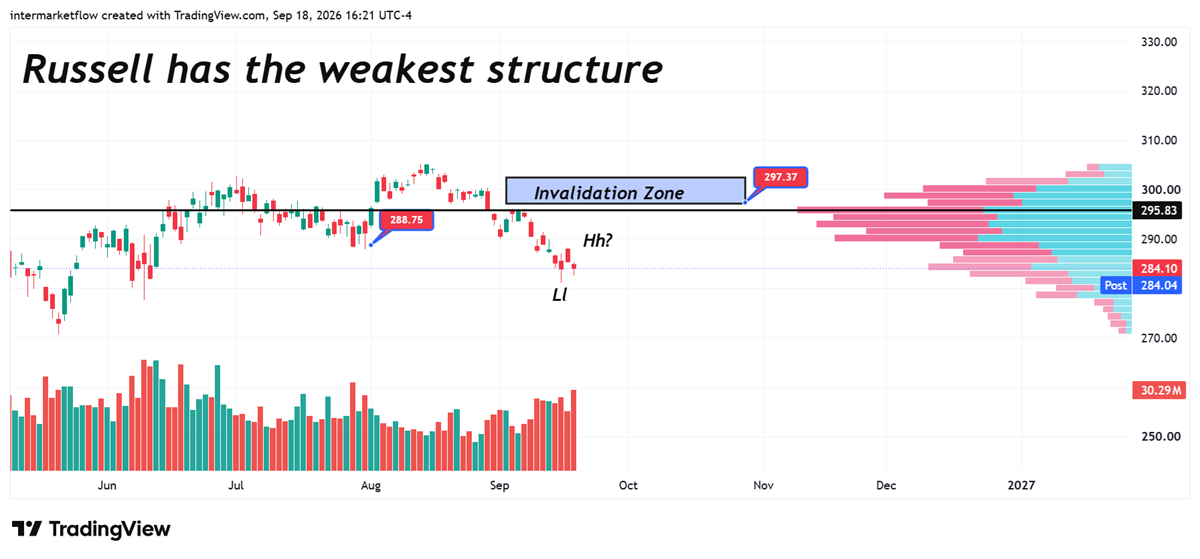
This is the follow-up to the chart included in the Mid-Week Report.
Technical Confirmation: IWM and HYG
- The Russell 2000 has printed a lower low and remains below 288.75. Confirmation requires
- Failure of the current rebound to establish a higher high.
- An increase in volume as selling pressure develops.
Invalidation Zone: Clearly defined in IWM at $297.30.
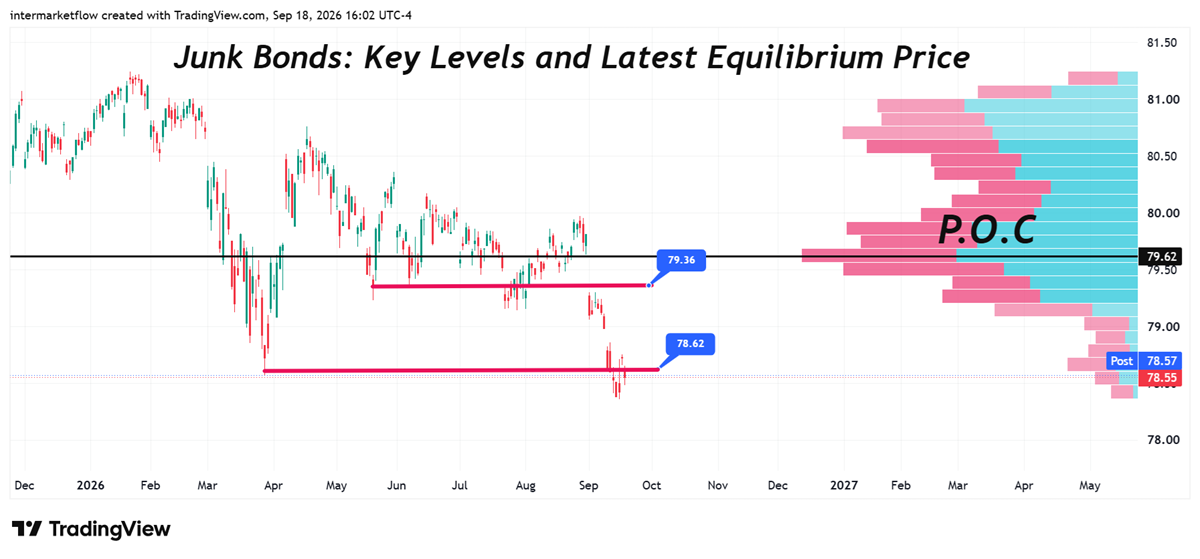
Furthermore, continued weakness in HYG below the $78.62–$79.36 range would provide additional intermarket confirmation.
Further Reading: Beyond the Media’s Oversimplified Yen Carry Trade Narrative
For readers who want to go beyond the broad—and often oversimplified—media references to the yen carry trade, this piece from our archive examines its different methodologies, participants and key variables in detail.
Intermarket Flow
KEEP RECEIVING THE FULL REPORTS!!!
Subscribe monthly and cancel anytime.
If you believe this is an error, please contact the administrator.