FOMC and Credit determines today’s market approach to FED session with a level of conviction that borders on complacent arrogance. A “no change” decision on rates is no longer news—it is a fully priced, non-event. It carries no marginal informational value and, therefore, no capacity to move price.
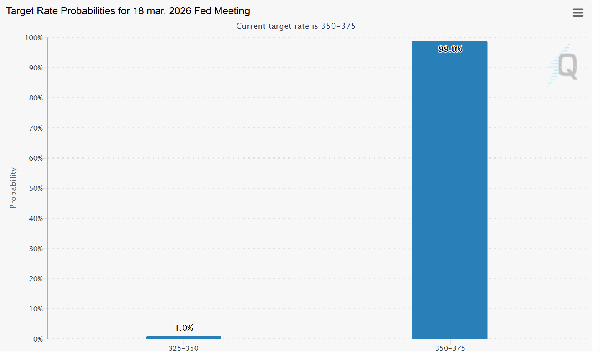
The real source of volatility is not the decision itself, but Powell’s rhetoric—and, more importantly, the market’s ability to confront and internalize a concept it has systematically chosen to ignore: real restriction that has been in place for an extended period of time.
FOMC and Credit: Risk Asymmetry
The state in which the market enters this catalyst creates a clear risk asymmetry, where the outcome becomes, for all practical purposes, a near certainty.
Verdict
This is a textbook “sell the news” setup. Absolute certainty is precisely what creates the imbalance of risks. A more hawkish Fed will trigger a sharper correction.
A more benign Fed may ultimately lead to the same outcome—not because the news is not positive, but because the market has yet to fully price the lagged effects of restrictive rates and last month’s inflation reports plus crude situation.
A Correction in Search of an Excuse
The market is entering a phase where it needs a catalyst to correct. We are already observing spikes in the VIX despite limited movement in price. Risk is being repriced beneath the surface—positioning is adjusting even as headline indices remain stable.
FOMC and Credit: Hard Landing or Stagflation Landing
This is the core uncertainty. The market is already making that decision—and expressing it through credit spreads.
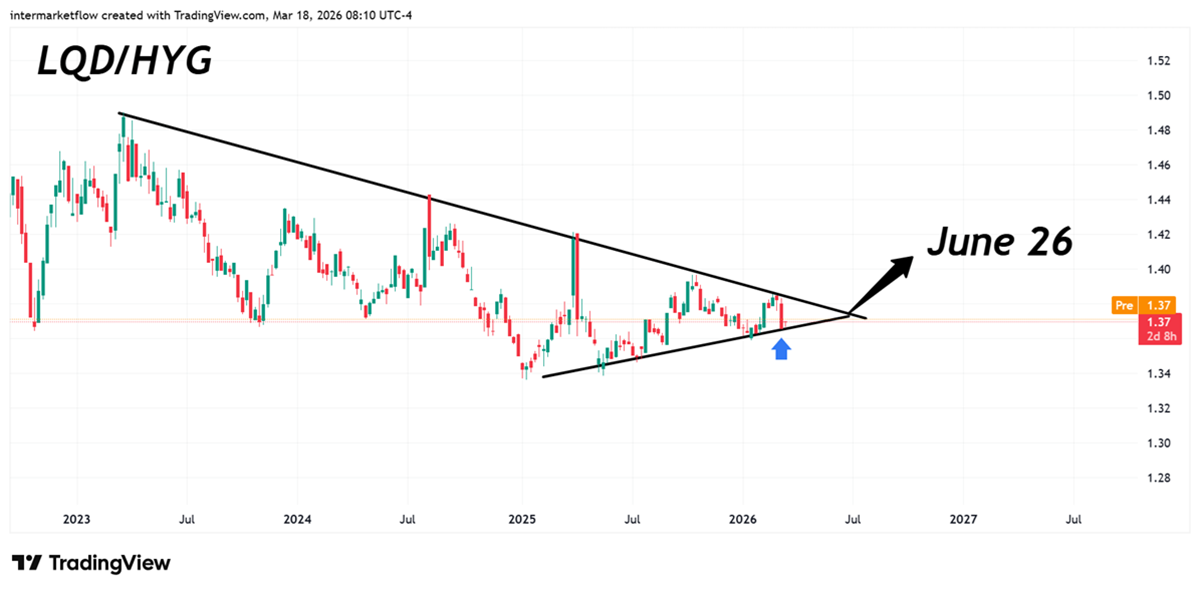
An upside breakout in spreads—where capital rotates out of junk bonds into higher-quality credit—becomes a self-reinforcing signal of a hard landing. Rising funding costs for lower-quality issuers accelerate stress and tighten financial conditions further.
A downside move—spread compression—points to an inflationary environment without recession. A growth scenario is not currently in play. Given current inflation and macro data, it would require growth north of 4–5%, which is inconsistent with prevailing conditions.
Even though an inflation environment does not necessarily mean lower valuations. This is another source of risk that could push markets even higher, though we don’t see it as the most probable outcome.
Conclusion
- We have a clear catalyst today, with all the ingredients in place for a “sell the news” reaction and a subsequent bull trap.
- Beneath stable prices, the VIX is signaling stress—volatility is building below the surface.
- As discussed previously, flows are shifting toward the front end of the curve, largely indifferent to credit quality.
- Once credit differentiation re-enters the pricing mechanism, the signal for a hard landing will be confirmed.
Trading Framework
Same playbook as last week:
- Zero equity exposure.
- The market is liquid—in dollars. Any directional move will be amplified.
- To interpret the Fed’s message, focus on the futures market tomorrow. Ignore analyst narratives. The futures curve will determine how the message is processed and priced—its verdict materializes with a lag of hours to days. Until then, patience is a position.
- For risk takers: each equity rally improves P/L asymmetry, making short exposure increasingly attractive within this developing bull trap.
Risk Sources
- The market can remain irrational for longer than anticipated. However, signals from the VIX suggest that a return to rational pricing is not far.
- A short squeeze. This scenario carries real potential, given the elevated short positioning—hedge funds are near extremes.
Course of Action
Wait for confirmation. Beneath the surface, positioning decisions have already been made.
If you believe this is an error, please contact the administrator.