
This Is Not a Defensive Rotation. It Is a Market in Retreat
- We have been describing a thin market with a defensive bias. Our view is that its underlying dynamics are primarily driven by a risk-out process, not a risk-off rotation.
- We also developed the hypothesis that a credit crisis was unfolding beneath the surface of the bond market, with several intermarket channels through which these pressures were being transmitted.
The latest price action makes one thing increasingly difficult to ignore: this is not simply a matter of capital rotating toward defensives. The broader market is moving toward the exit.
A Market Moving in One Direction
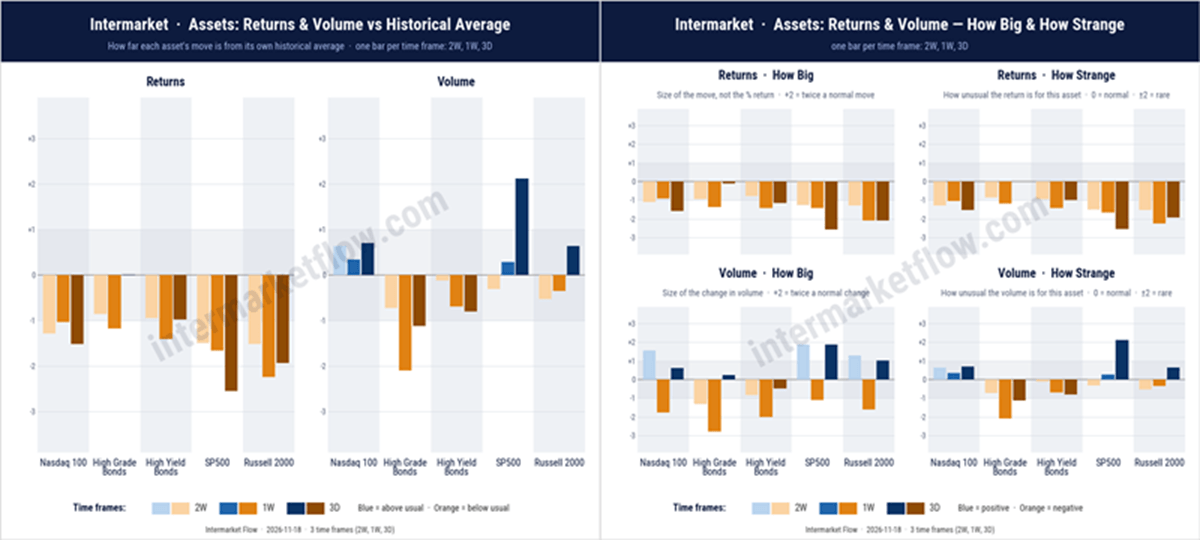
- Over the last three days, major equity indices have registered statistically extreme negative returns.
- Within bonds, High Yield remains under significantly greater pressure than High Grade.
- But the key signal is volume in the S&P 500. Trading activity has reached statistically extreme levels alongside extreme negative returns.
- Capital is moving toward the exit without meaningful opposition.
- The buy-the-dip strategy has not emerged, and executing it amid this degree of bearish convergence is not advisable.
- At a minimum, we need selling volume to subside or buying pressure to emerge to defend prices.
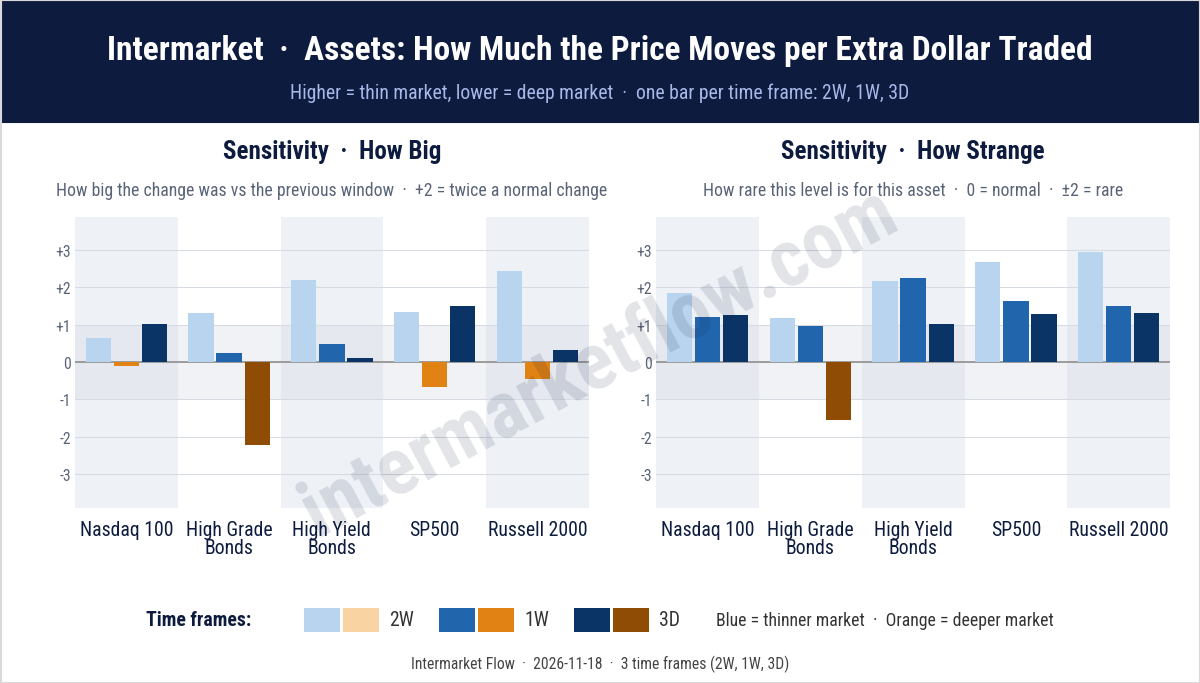
- Looking beyond returns themselves, the magnitude of the S&P 500 move, (size not return) stands more than two standard deviations above its historical average.
- Its statistical rarity is equally extreme.
- We are not seeing a typical correction, where you have buyers and sellers at regular volume levels. Here, the move is large, one-directional, and accompanied by volume.
- Volume displays the opposite pattern, with the same degree of statistical extremity.
- Both signals point to an unusually strong and convergent bearish move.
- The Nasdaq and Russell 2000 show similar patterns, although they are less anomalous.
This is not business as usual.
Volatility Confirms the Pressure
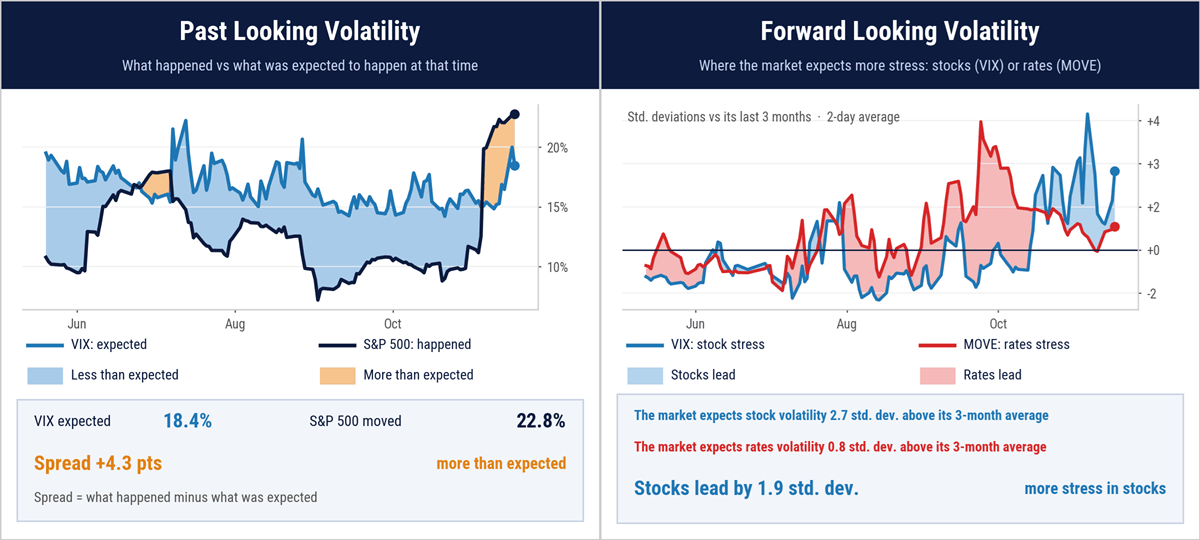
- Realized volatility once again exceeded expectations, catching the market off guard.
- For the next 30 days, the market expects volatility to increase, particularly across equities.
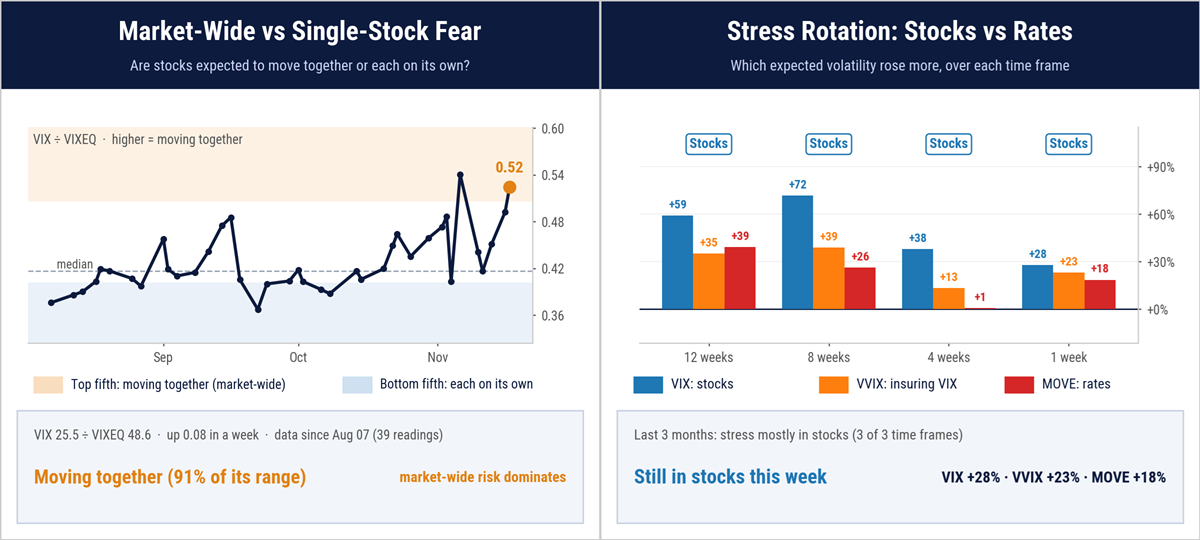
- Equities remain the main source of instability, although expectations for further increases are gradually easing.
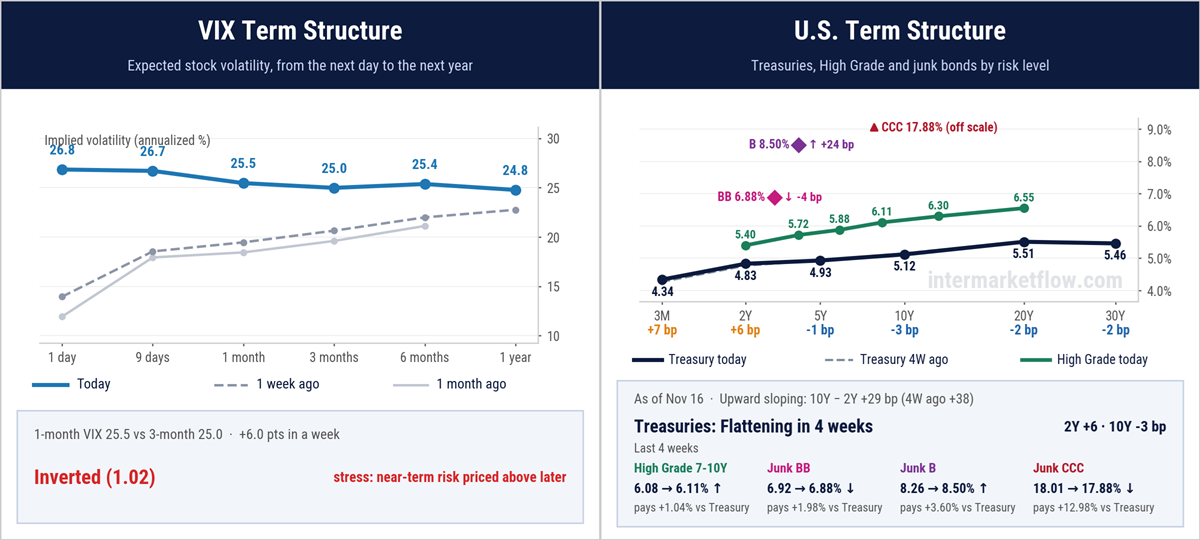
- A quiet market typically trades with a VIX around 15 or lower.
- Despite expectations for a decline over the next nine days, implied volatility remains elevated.
- The credit yield curves deserve particular attention.
- If a credit crisis is unfolding, as our hypothesis suggests, this is where the first signs should emerge.
We will use, in coming reports, these relationships to monitor BB, BBB and CCC spreads relative to High Grade and High Yield.
Is This Really a Defensive Rotation?
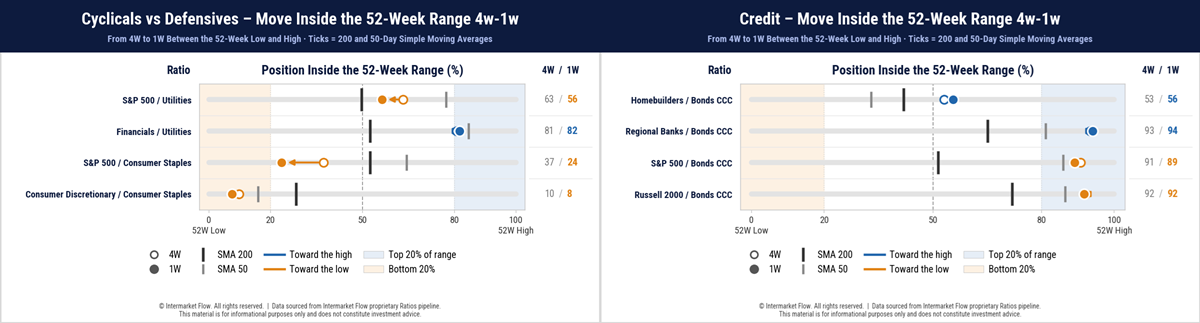
- From a one-year perspective, defensives, particularly Consumer Staples, clearly appear to be the preferred refuge.
- Looking only at relative prices, this could easily be mistaken for a healthy capital rotation.
- The major indices are falling, yet they continue to maintain relative strength against lower-quality debt.
- Today, it is the relative magnitude of the declines that is keeping these ratios near their highs.
Cyclicals on the left, Defensives on the right
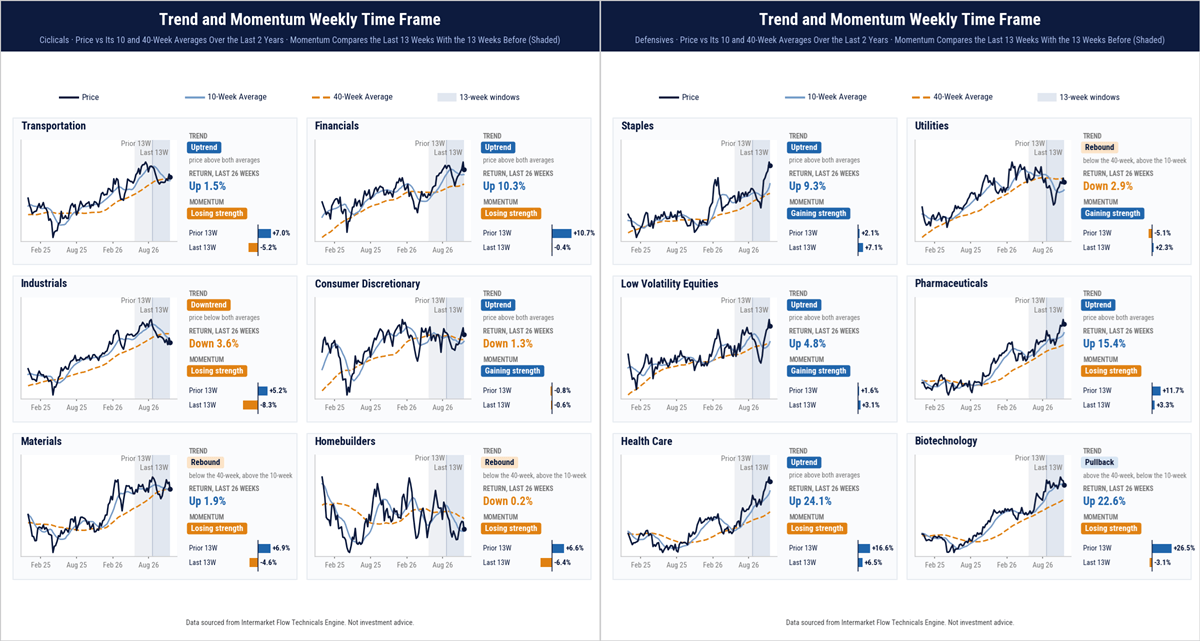
- The dotted line represents the 200-day moving average, which we use to put current valuations into a broader perspective.
- The market’s profile is clearly defensive. But if this were a healthy rotation, how do we explain the abnormal, convergent bearish move across major indices, with statistically extreme negative returns and volume?
Does it make sense to rotate into defensive assets when virtually everything is falling?
Main Conclusions & Course of Action
- We are in a market where hedges, other than short positions, are not working.
- The defensive profile is primarily driven by a steeper decline in cyclicals than in defensives.
- A healthy rotation does not occur alongside the kind of broad index decline we are currently witnessing.
- Even the S&P 500, the strongest of the major indices, is falling sharply in a bearish extreme convergence.
This is a market in retreat, not one undergoing rotation. Consequently, this is once again a Cash Is King environment, and that should be our stance.
The importance of this positioning goes beyond what is happening now. It is also about preserving the capital and flexibility needed to capitalize once the inevitable unfolds.
This is not a minor correction. This is not a buy-the-dip environment.
This is Cash Is King.
Intermarket Flow
If you believe this is an error, please contact the administrator.