
The market is beginning to rotate
The important development is not simply that equities weakened or that bonds improved. It is that capital is starting to move between categories with measurable participation.
The weekly data confirm a defensive Risk-Off rotation. They do not yet confirm a fully established multi-horizon Risk-Off regime. That distinction matters because the current signal is strong enough to affect positioning, but still too recent to justify treating the transition as complete.
Capital Allocation by Category
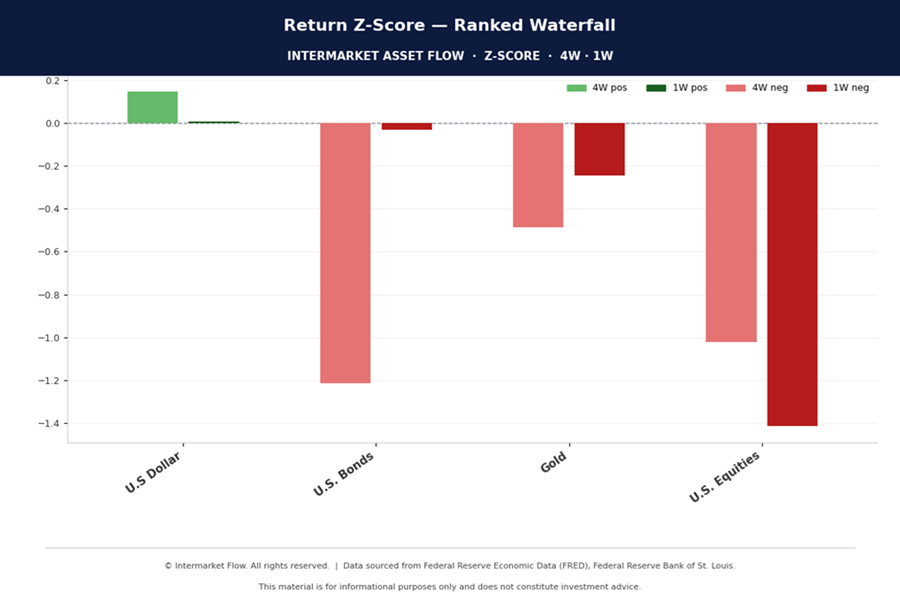
- Flows into the U.S. dollar remained mildly positive over the past week.
- The more relevant development is that capital outflows from bonds have stopped.
- Fixed income had been consistently expelling capital for at least three months, making this stabilization a meaningful change in behavior.
- At the same time, the source of the reallocation is becoming clearer.
- Capital is leaving equities and moving toward bonds and defensive exposures. We have not seen this combination with meaningful participation for some time.
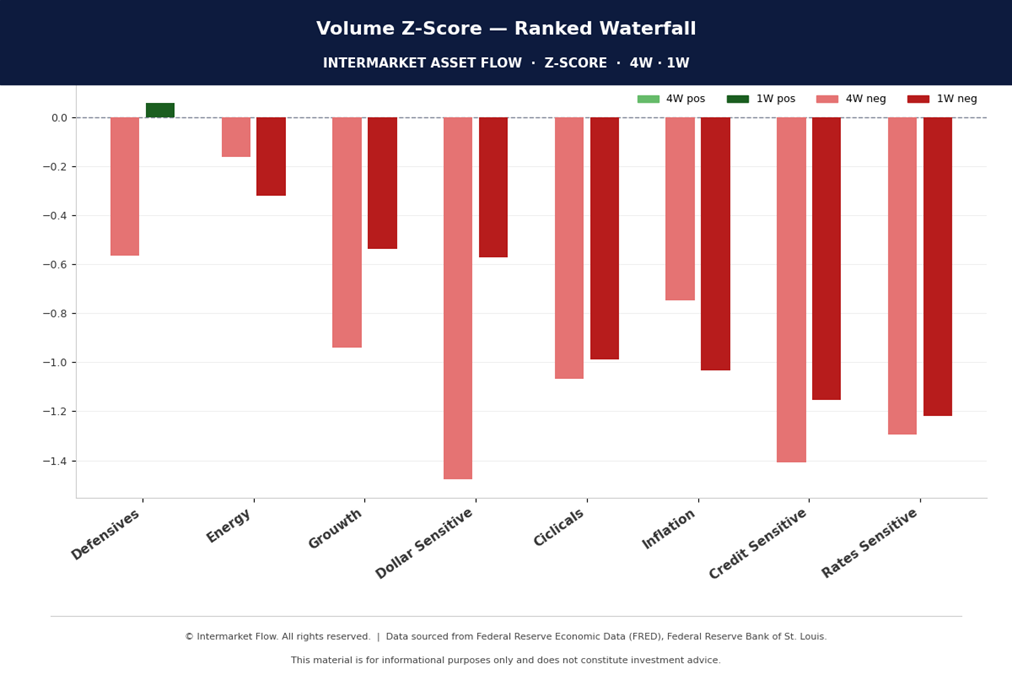
The observation window remains short. However, the rotation occurred, and volume confirms that it was not driven by price alone.
Where the Capital Is Moving
Breaking the broad categories down into subcategories reveals a more precise hierarchy.
- Duration: Capital flowed primarily toward the long end of the Treasury curve. The magnitude of the improvement increases progressively with maturity.
- The longer the duration, the stronger the convergence between return and volume.
- Credit: High-grade bonds recorded the strongest positive change across the entire bond complex. Capital is favoring quality rather than spread risk.
- Equities: Outflows were strongest in the Nasdaq, followed by the Russell 2000 and the S&P 500. In all three cases, weekly deterioration exceeded the monthly move, confirming that the exit accelerated during the past week.
- Gold: Outflows slowed and are now marginal relative to their historical mean. The liquidation phase appears close to stabilizing, but stabilization is not yet accumulation.
- High Yield: Junk-bond outflows also decelerated. The difference is that withdrawals remain statistically significant.
- High yield has stopped deteriorating as quickly, but it has not become a destination for capital.
Two conclusions emerge without internal contradiction:
- Volume and return converged toward long-duration.
- Capital is moving away from equities and lower-quality risk toward defense and quality.
Rotation Within Equities
The internal equity signal is more mixed, but the direction remains clear.
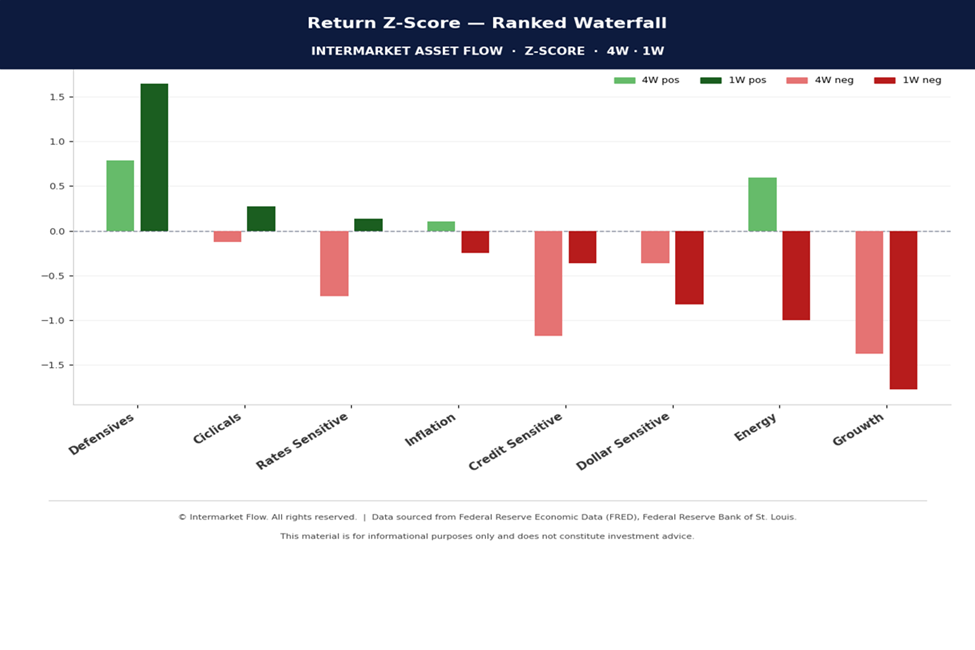
- Capital inflows into defensive sectors turned positive and accelerated during the past week. Weekly participation moved above its historical average.
- Growth-related assets showed the opposite behavior. Monthly outflows were already substantial and accelerated from elevated levels.
- Between those extremes, rate-sensitive defensive sectors benefited. This does not mean that all rate-sensitive assets are strong. Rate sensitivity is only constructive when combined with defensive characteristics or high balance-sheet quality.
- Most sectors experienced smaller weekly outflows than those observed over the monthly horizon. However, except for defensives, the withdrawals remain statistically relevant.
The distinction is critical. Slower outflows are not inflows. Stabilization is not accumulation. A rebound without participation is not a regime change.
That clear, Capital has a clear destination inside equities: defensives.
Macro Regimes: The Broader Picture
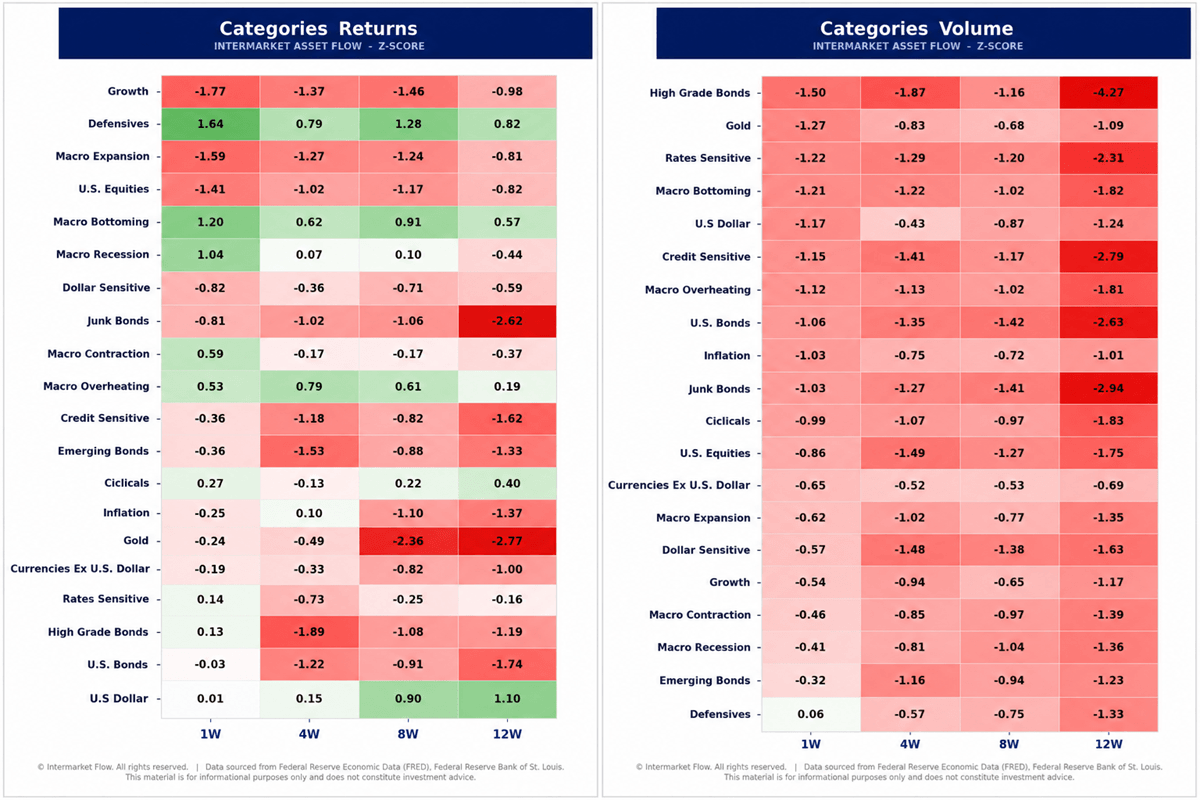
Tracking the progression from 12W through 8W, 4W, and 1W—across both return and volume—produces the same general message.
Returns
- Contractionary, recessionary, and cycle-bottoming regimes show improving convergence between returns and participation.
- The expansion regime continues to experience convergent capital outflows.The overheating category is also receiving relative support, although this signal requires caution. It may reflect persistent inflation exposure rather than a broad improvement in economic risk appetite.
Volume
- The volume heatmap shows an important normalization.
- The red gradient fades toward the 1W window, indicating that capital outflows are moving closer to historical norms.
- That is constructive at the margin, but it should not be confused with broad-based accumulation.
Current Strengths and Weaknesses
Strengths
- Defensive assets
- Long-duration, high quality bonds
- Defensive sectors benefiting from lower rates
Weaknesses
- Broad Risk-On exposure in all its forms
- Nasdaq and high-beta equities
- Small caps and cyclical companies
- High yield and lower-quality credit
- Short-duration bonds on a relative basis
Course of Action: Risk Positioning
- Risk exposure should remain selective and conservative.
- Although the observed shift cannot yet be classified as a trend, its simultaneous appearance across multiple categories adds credibility.
- The weekly data justify a defensive bias, but not an aggressive assumption that a complete Risk-Off regime is already established.
- Broad Risk-On positioning remains unsupported while equities continue to lose participation and capital rotates toward duration, quality, and defense.
- Capital preservation should take priority over expanding directional risk.
Portfolio Management
- Within fixed income, maintain a preference for long duration and high-grade credit over short duration and high yield.
- Within equities, favor defensive sectors over growth, high beta, small caps, and cyclical exposure.
- Gold should remain on the watchlist. Outflows are close to stabilizing, but the asset still lacks confirmed accumulation.
- This is a quality-over-beta environment.
Trading
- Do not confuse slower outflows with renewed strength.
- Weak rebounds in equities or high yield should be treated as tactical moves unless volume confirms a genuine return of participation.
- The cleanest relative-strength areas remain long-duration bonds, high-quality credit, and defensive sectors.
Invalidation
- The thesis cannot be invalidated by the behavior of a single asset or by price recovery alone.
- A valid invalidation would require simultaneous improvement in:
- QQQ
- Small caps
- High-beta equities
- Cyclical sectors
- High yield
Returns must improve together with above-average volume(+1.5𝝈). The greater the rate sensitivity of the assets participating in the reversal, the stronger the invalidation signal.
Until that happens, price recovery without participation remains noise.
Bottom Line
- The market has not completed a regime transition, but the weekly rotation is no longer ambiguous.
- Capital is leaving equities, favoring long duration, high-quality credit, and defensive sectors. The message is not panic. It is repricing.
The edge is not in reacting once the regime is obvious. It is in identifying the direction of capital before price fully confirms it.
Intermarket Flow
If you believe this is an error, please contact the administrator.