A Bipolar Market
On Monday morning, the market had to digest everything that happened over the weekend. What began on Friday as a potential crisis in the private credit sector quickly escalated into a full-scale war in Iran.
In the Asian open market entered a regime we describe as Cash is King — a scramble for liquidity, overwhelmingly denominated in dollars.
The Intermarket Dollar Squeeze
The moment of panic triggered a run into the dollar and into dollar-denominated assets perceived as safe.
The S&P 500 was not one of those destinations. In fact, it sold off in the same way an emerging market would, and that dynamic was the basis for the positioning we outlined in the Mid-Week report.
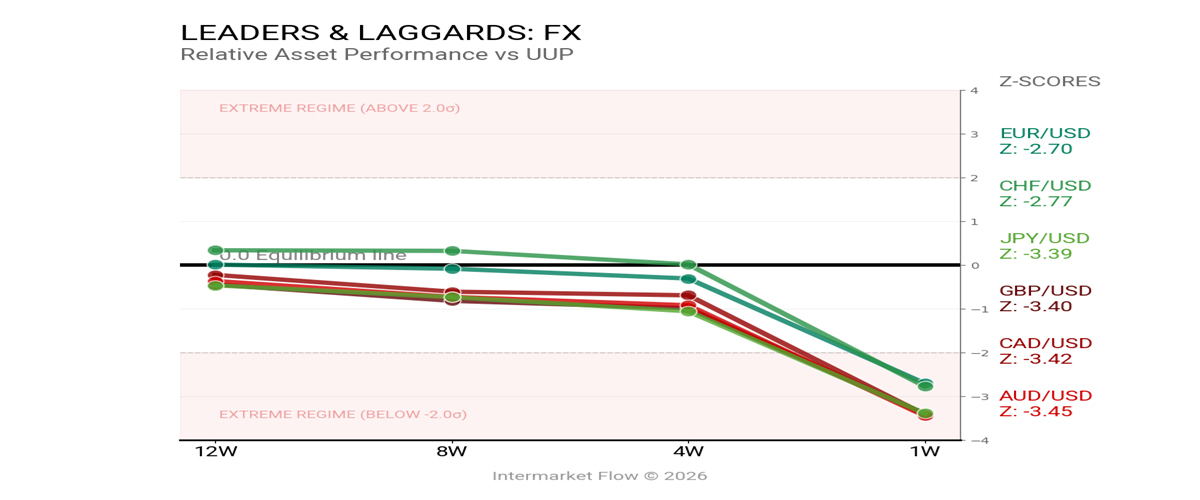
Fiat currencies leaders for the week, against the dollar.
To understand the magnitude of this move, we need to look at the Z-scores across currencies.
Even the euro, which held up the best, registered a -2.7 standard deviation move — statistically a black swan event. Cash is King — crystal clear on Monday.
Intermarket Flow Analysis
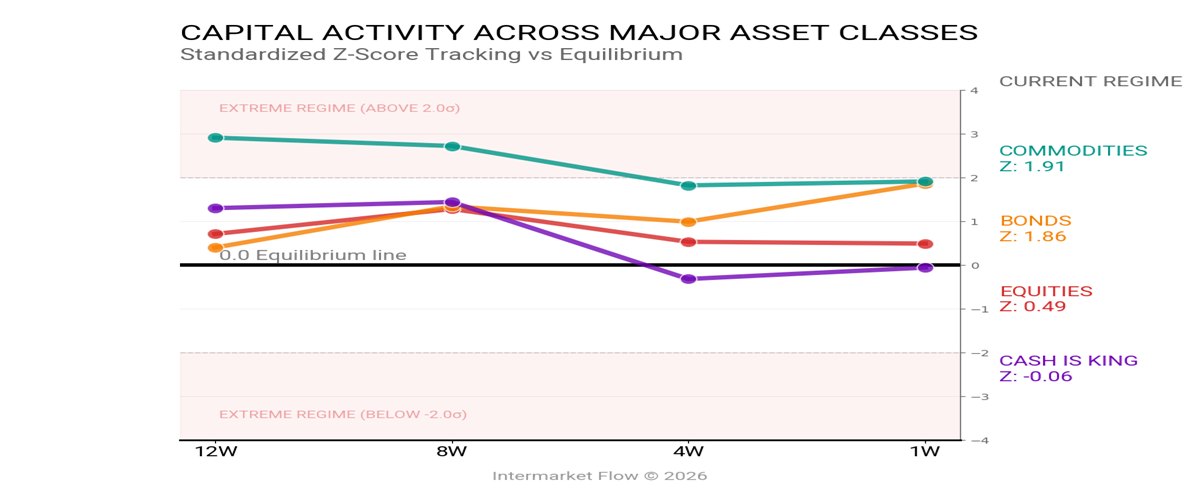
Duration Bid: The Bond Market Warning
Look at the activity in bonds over the past week. It is not only that activity increased, which used to be a near dead category, it is the speed at which it increased, something we can clearly observe in the slope of the curve.
Intermarket Regime Shift
Once again, generalization dilutes information.We want to identify which bonds were the actual destination of this flight.
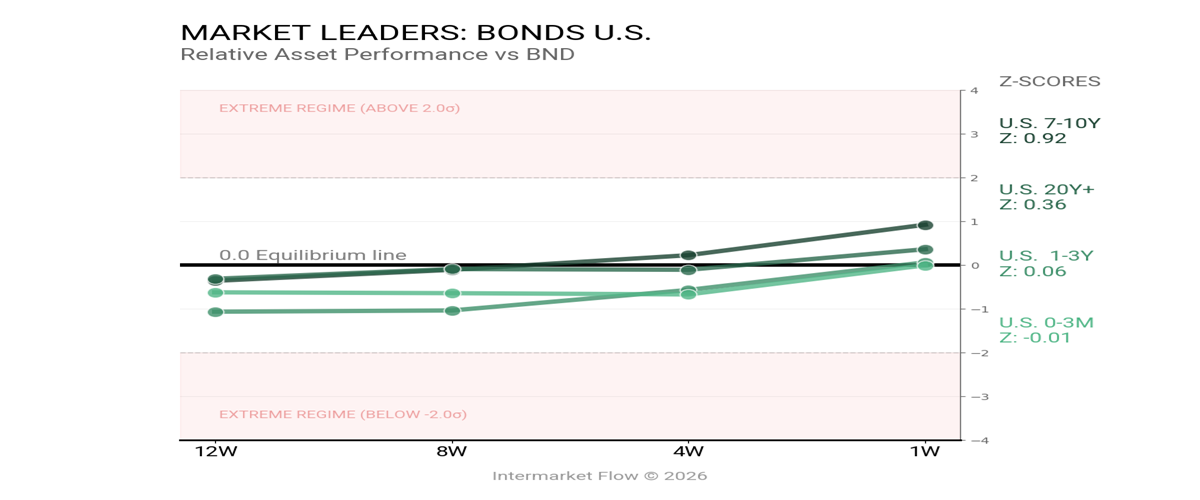
The long end of the curve is where most of the activity took place.The bond market is positioning for lower long-term rates, and investors are adding duration. This behavior is consistent with expectations of an economic hard landing.
Cyclical Capitulation in Equities
Building on the message coming from the bond market, we turned to the equity market and analyzed which economic sectors have seen the least activity over the past three months.
We categorized them into leaders and laggards, and this is what we found.
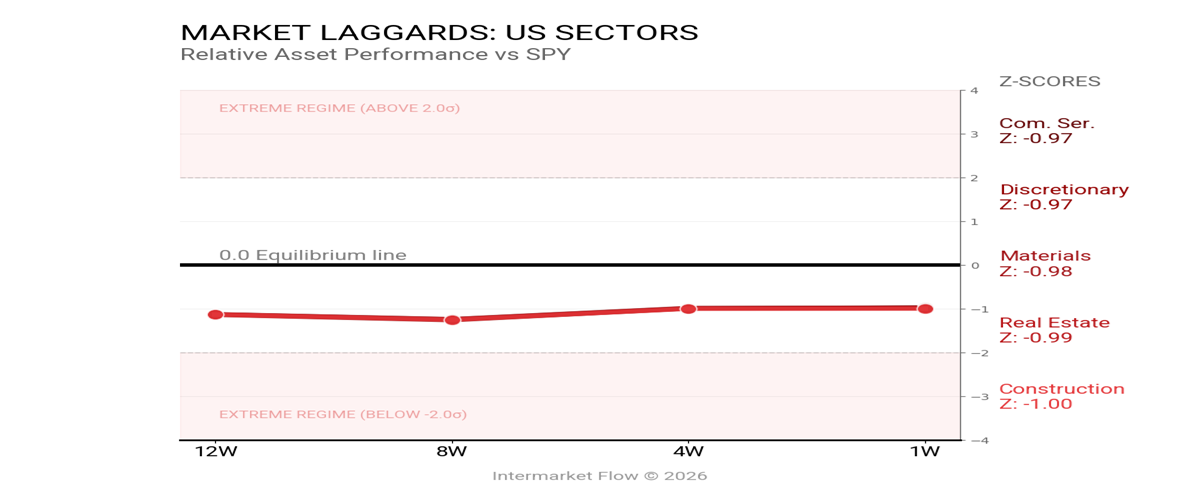
All sectors show Z-scores so similar that the charts overlap. What is most striking is that, as the rolling window incorporates new weeks, it becomes increasingly clear that this process began at least three months ago.
These are, of course, leading sectors of the macro cycle. Yet another message from the market — in this case, from the equity market.
Conclusions
We experienced a bipolar market this week.
- What had been pricing in an economic hard landing briefly turned into panic, at least for a few hours, as markets began to price the possibility of a full “Cash is King” liquidity crisis.
- Throughout the week, bonds — especially long-duration bonds — were the center of attention. Markets are clearly adding duration, which implies expectations of lower long-term rates in the future.
- The moves into the dollar during the panic phase reached black-swan magnitude. It wasn’t gold. It wasn’t crypto. It was the dollar.
- The S&P 500 traded the same way the Ibovespa and the Kospi traded — essentially like an emerging market. This dynamic directly shaped our trade positioning.
- From the equity markets we got another confirmation message. Cyclical sectors of the economy are presenting no signs of action.
- Financials would complete the picture, but we already know their condition — and how we are trading them.
Trading a hard landing scenario
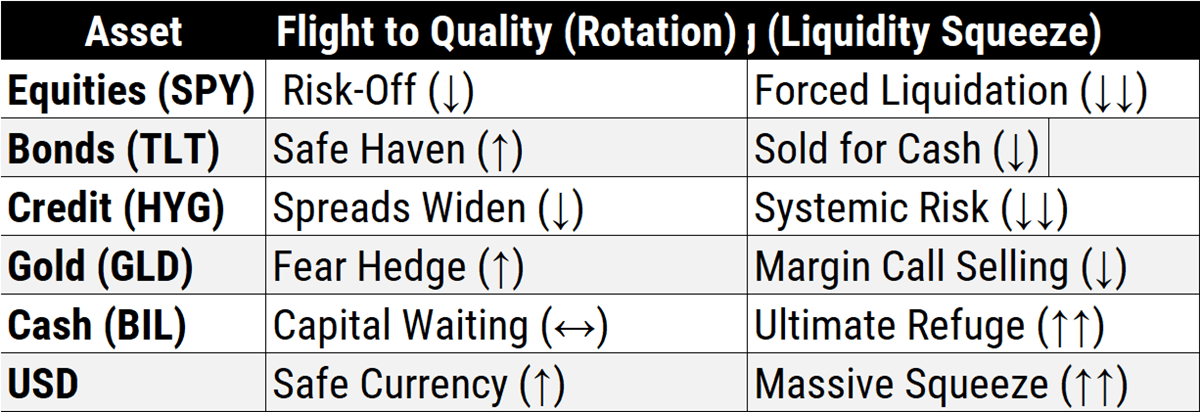
The market is pricing a hard landing, with an orderly transition toward higher-quality assets. That is the current situation, and it already carries many implications for positioning. At the same time, it is clear that there is a thin line between the scenario the market is currently pricing and the full-blown crisis environment we briefly saw on Monday.
Some effects are already unfolding.
- The dollar has exploded, a characteristic common to both regimes.
- TLT has begun to show signs of strength, although there are still no indications of a Fed rate cut. This creates a major crossroads given the current inflation environment and the inflation expected ahead.
- LQD/HYG spreads are at the limit.
- Further equity corrections are still needed in both scenarios, which is precisely the framework we laid out in the Mid-Week report.
The key question is when those flows shift — from an orderly rotation into quality to a full-blown crisis environment.
Intermarket Credit Spreads
The intermarket landscape will signal it in many ways. One of them is the following.
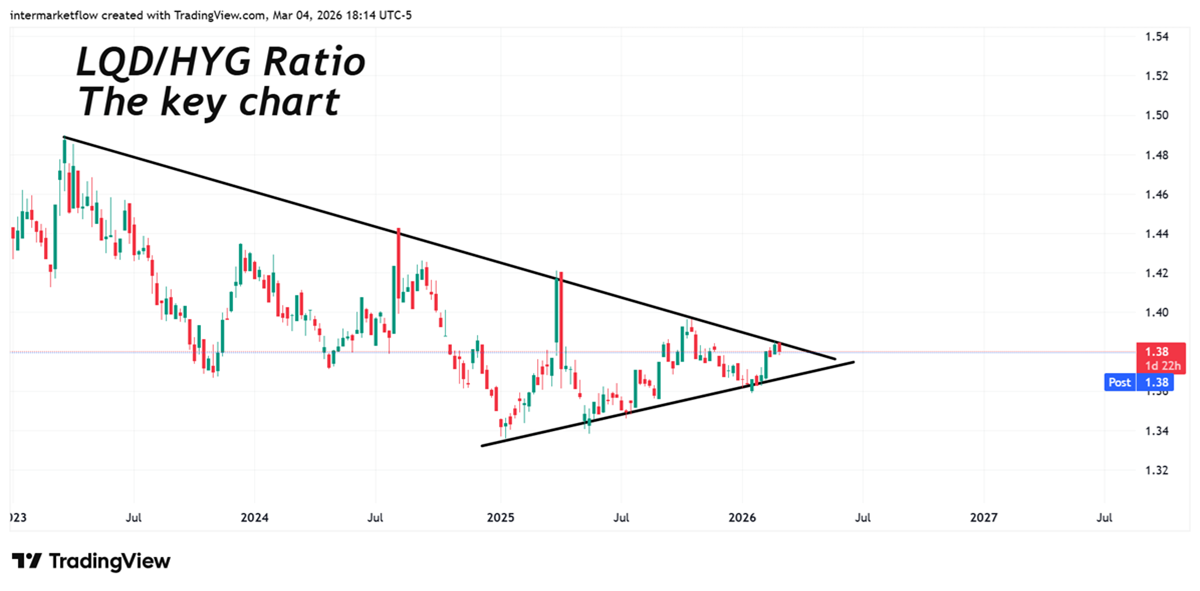
The ratio between investment-grade corporate debt (LQD) and what we call junk bonds (HYG) expresses what the market thinks about the risk differential between top-tier companies and lower-quality issuers.
For now, spreads remain very compressed. However, the moment this chart breaks to the upside, the situation will have begun to unfold. This break will occur. What will be decisive is the violence with which it unfolds.
Concepts
- Equity correction is coming. Some will choose to step aside, while others will attack it — it depends on time horizon and risk tolerance.
- Duration is the asset to consider in an orderly transition toward a hard landing.
- Expect an increase in volatility.
If you believe this is an error, please contact the administrator.