From Repo stress to institutional relocation: Tactical positioning for the impending liquidity drought
Capital activity is dying
Continuing what we saw last week, activity (price × volume) continues to fall across all categories. The Intermarket Tracker, a proprietary Intermarket Flow tool, shows where the action is. It is not return, it is not volume, it is both combined. There can be very high activity and it can be bearish, or vice versa.
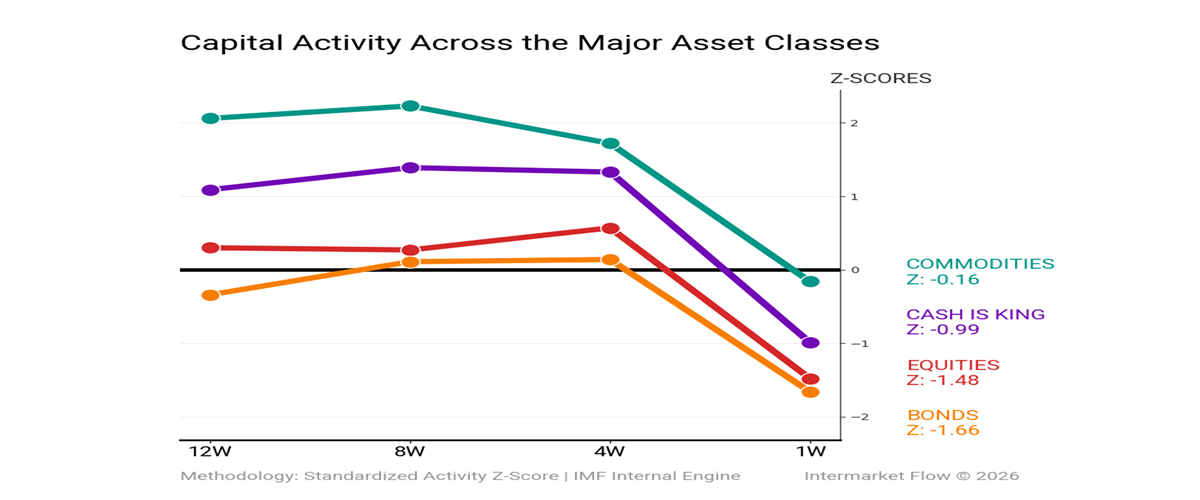
This is a repeat of last week’s report (here), when we concluded that liquidity had withdrawn. With this week’s events, we can conclude that this withdrawal was, in practice, a relocation.
Funding Squeeze: Reverse Repo, Repo market and the SOFR rate.
The Reverse Repo (RRP) facility is the system’s liquidity cushion. When banks hold excess reserves, they park them there in exchange for T-bills. This is QE, a core reserve-management tool. (If you are not fully familiar with QE, I strongly recommend this piece, it explains the mechanics clearly and simply). Unlike previous episodes, QE is now being applied to the short end of the curve. That cushion is being absorbed by Treasury issuance required to finance the fiscal deficit. Ergo, Liquidity has relocated, generating stress in the system.
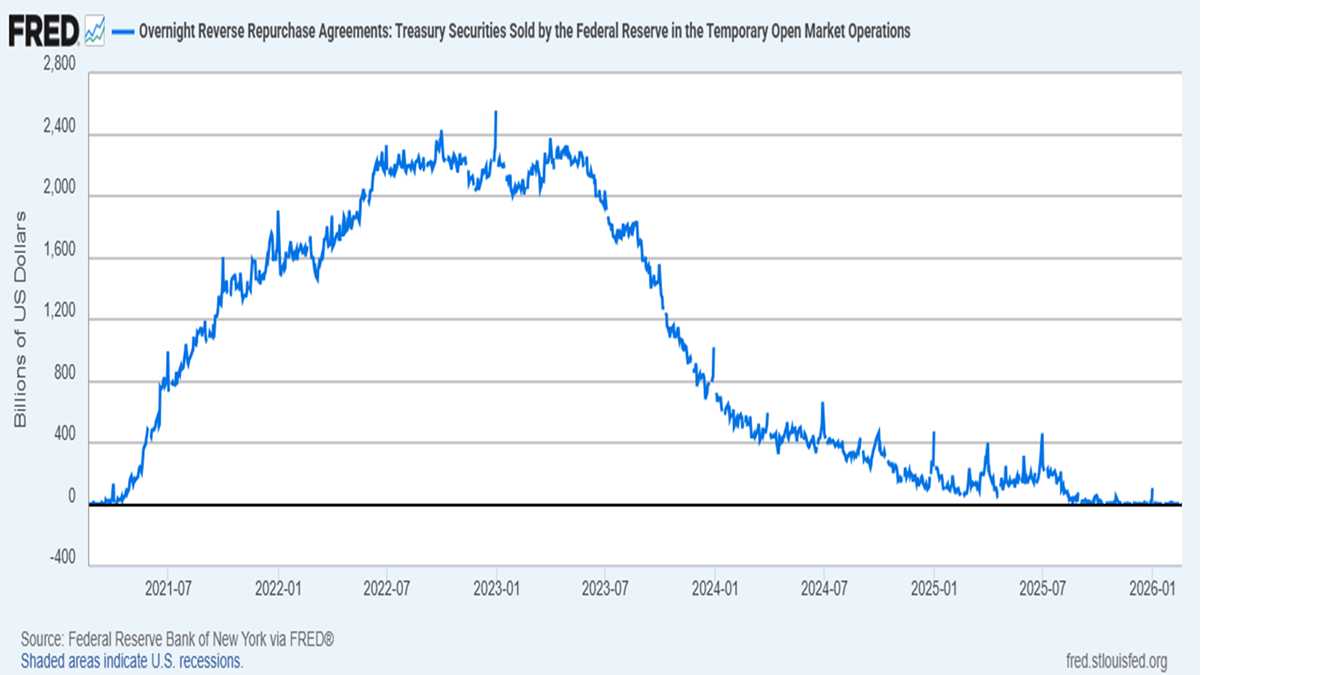
When excess reserves fade, banks pull back from the natural repo market, logical and legal move, they need to have certain amounts of cash. That is where the stress cycle starts.
SOFR rate and Fed funding the repo market
The repo market is a “natural” funding market where bank reserves are bought and sold at a price — a rate — known as SOFR.
When scarcity appears in any market, price adjusts higher. The issue here is that SOFR is the systemic floor; every credit instrument is priced as a spread over this rate.
It is a systemic variable. Allowing it to adjust freely in today’s context would transmit stress directly into the real economy.
So the FED did this last Tuesday
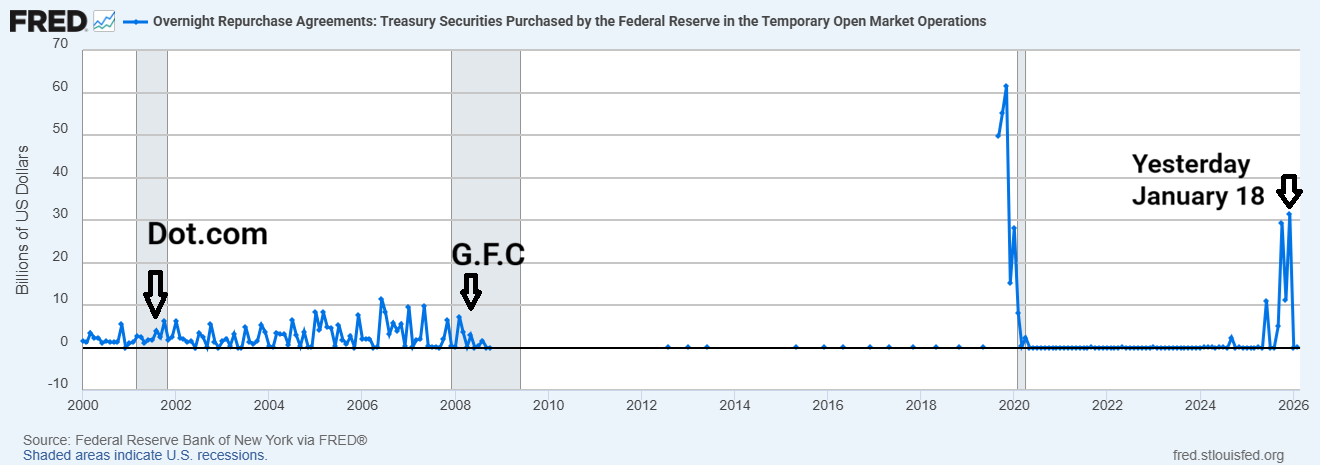
The Fed injects reserves into the system. Someone sits at a computer and credits “reserves” into large bank accounts, which then flow into the repo market.
The supply shortage is resolved. Bank reserves are created by pressing Enter. New money in the system.
Has liquidity disappeared?
No.The composition changed.
Before, it was T-bills parked in the Reverse Repo.
Now, it is bank reserves sitting on the balance sheets of large banks, under the radar of several accounting rules.
The system tightens. Stress builds.
SOFR spike — as we have already seen in the recent past — becomes a real risk. What risks does this situation create?
It places pressure on multiple variables — the most direct one being the dollar.
Dollar Index
Portfolios of all sizes — particularly across the Western financial system — are predominantly dollar-denominated.
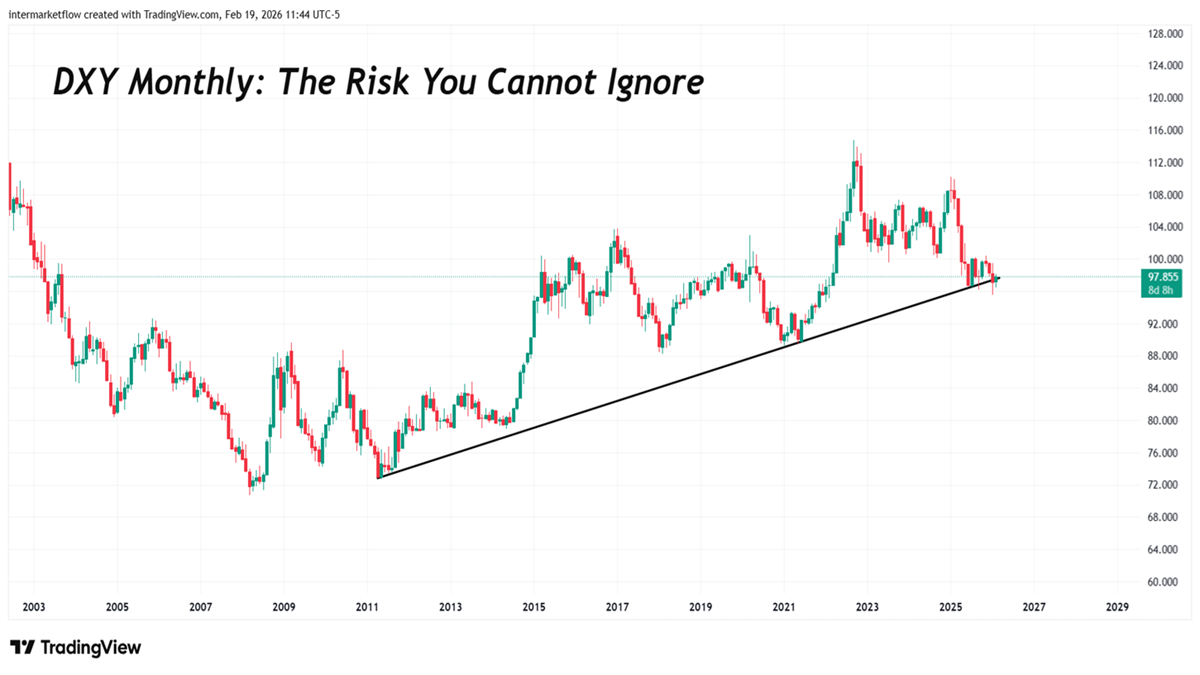
To this situation, we must add this chart — one we have already reviewed two or three times. We have two clear drivers pressing the dollar, and both can intensify further.
What if this opens the door to a dollar-funded carry regime?
If real rates are forced lower (we think they will) to sustain this debt machine, the Dollar could transform into the world’s primary funding currency—much like the Japanese Yen of the past two decades.
When the Fed prioritizes system solvency over currency value, the dollar-funded carry trade becomes the path of least resistance. Big Banks won’t just watch it happen; they will architect it.
Are we there yet?
The regime shift is conditional on real rates crossing into negative territory. We are monitoring the spread, not guessing the date.
Midweek Report
Tactical Execution & Update: Wells Fargo (WFC)
Our tactical short thesis remains fully intact. WFC remains a primary vehicle to play the disconnect between bank valuations and credit losses that already exist but are not yet reflected on balance sheets.
Possible LH forming
It can evolve into a break trade. Upon confirmation, the setup shifts into a breakout structure. P/L compresses — but so does the stop.We will review it in detail in the mid-week report.
Dollar hedge-Spy Hedge. Both?
On Wednesday, we deliver the exact tools to navigate this regime change—because in this environment, you are either the architect of the hedge trade, or the liquidity for those who are.
If you believe this is an error, please contact the administrator.