
Date: 26-JUN-2026
1. Regime Evolution
Risk On-Risk- Off- Credit crisis Zs, Dollar value, Return Volume and Volatility for timeframes 12w, 8w, 4w and last week.
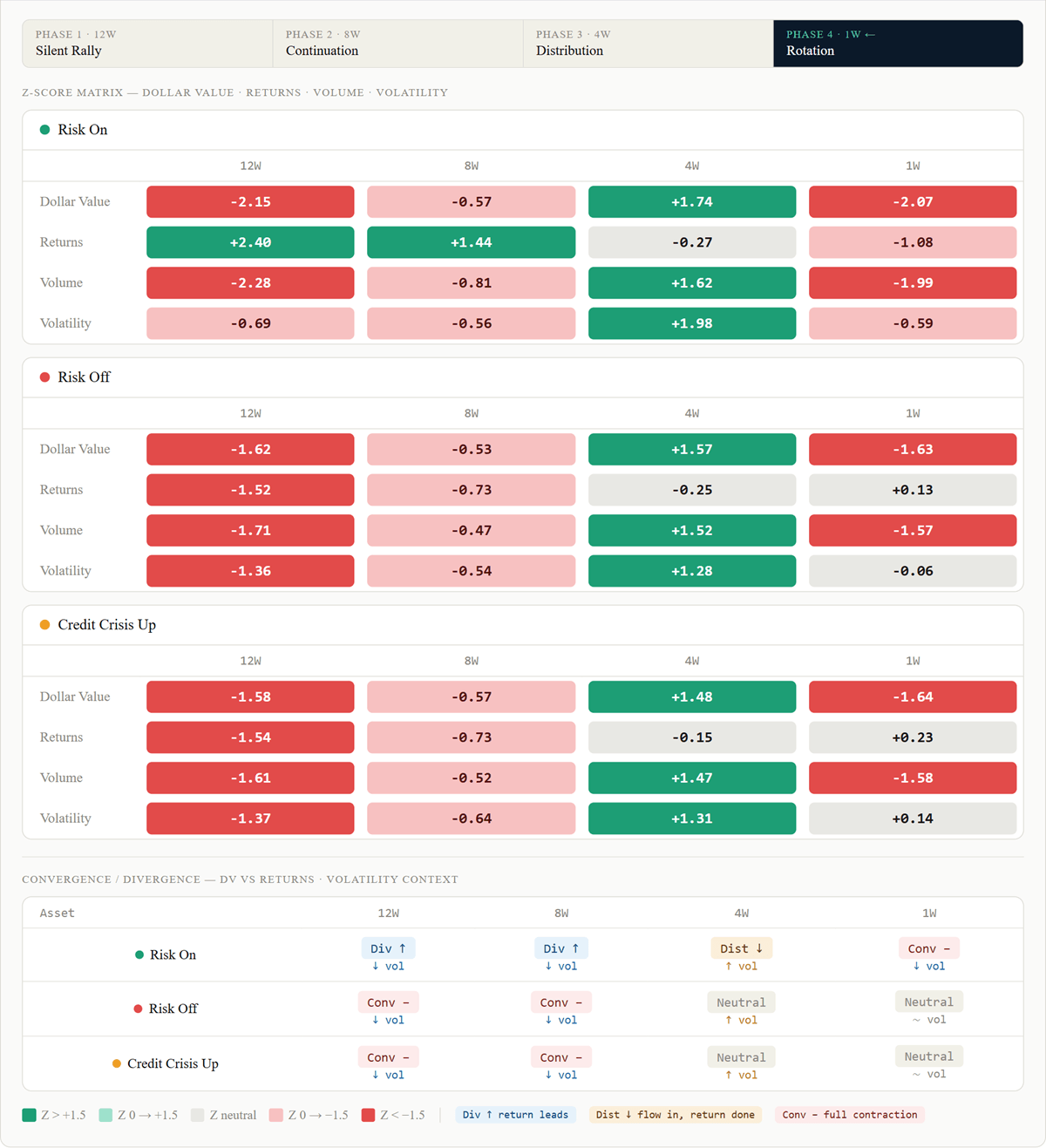
12W / 8W — Inertia
- Risk On kept positive returns, but without confirmation from Z_Dollar Value, Z_Volume or Z_Volatility. Prices moved higher because there was no supply, not because there was real accumulation.
4W — Break Point
- Notice that all three regimes — Risk On, Risk Off and Credit Crisis — showed positive Z_Dolar Value and Z_Volume, between +1.28 and +1.98.
- Capital entered massively, but returns were negative: -0.27, -0.25, -0.15.
- The interpretation is clear: flow — Dollar Value — increased, but price did not respond.
- This is not accumulation. It is supply absorption at high levels.
- The market “ate” the liquidity without any intention of moving higher, with one key difference: restrictive assets handled the capital inflow / liquidation much better.
That is the signal.The Risk On regime is exhausted. Convergence between price and volume changes sides.
1W — Tension
Last week, the volume disappeared again.
Defensive returns held better than offensive returns, but without volume we still do not have a confirmed trend change.
Conclusion
- Risk On lost validation.
- Risk Off has not fully absorbed the flow.
- The Credit Crisis is becoming more relevant, but it is not dominant yet.
- The message is clear: when volume finally appeared, it exposed the weakness of the previous rally instead of validating it.
- Last week extended that trajectory in returns, but not yet in participation.This is not confirmation. It is a warning.
2. Trading: Distribution Beneath Russell
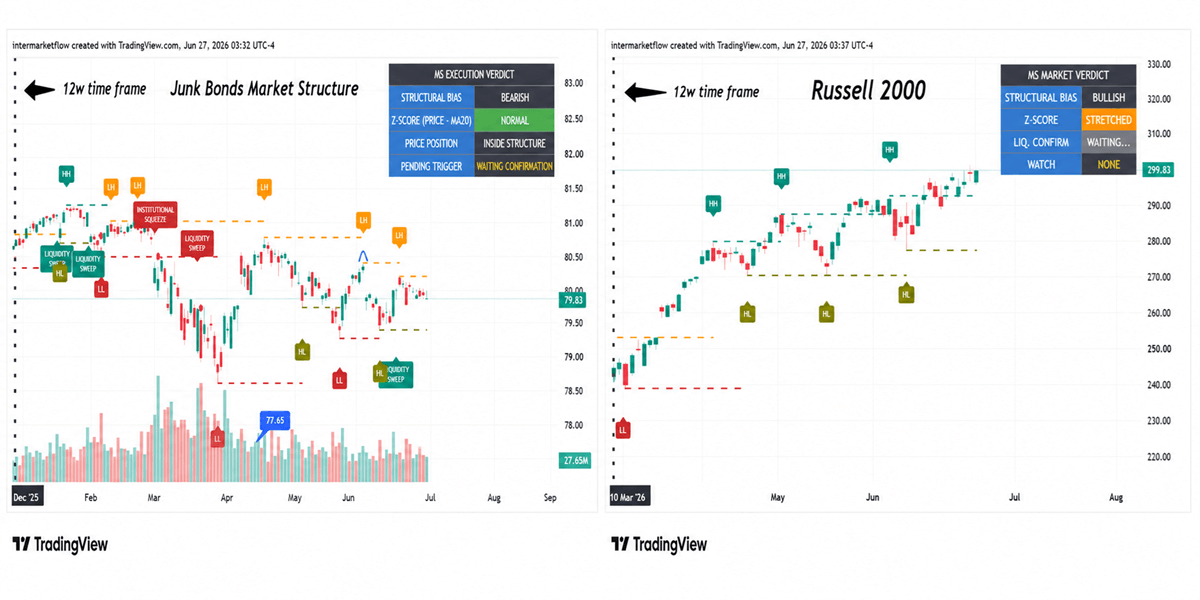
- The Russell 2000 breakout lacks credit confirmation.
- Equity beta is pressing higher, but Junk Bonds remains trapped inside its range. That disconnect matters.
- A healthy Risk On breakout should be confirmed by credit. It is not.
- This is the technical divergence: Russell is acting like a bull trap sustained by lack of supply, not by real conviction.
- If Junk breaks support, the divergence will not resolve sideways. It will likely close to the downside, and beta will be forced to reprice fast.
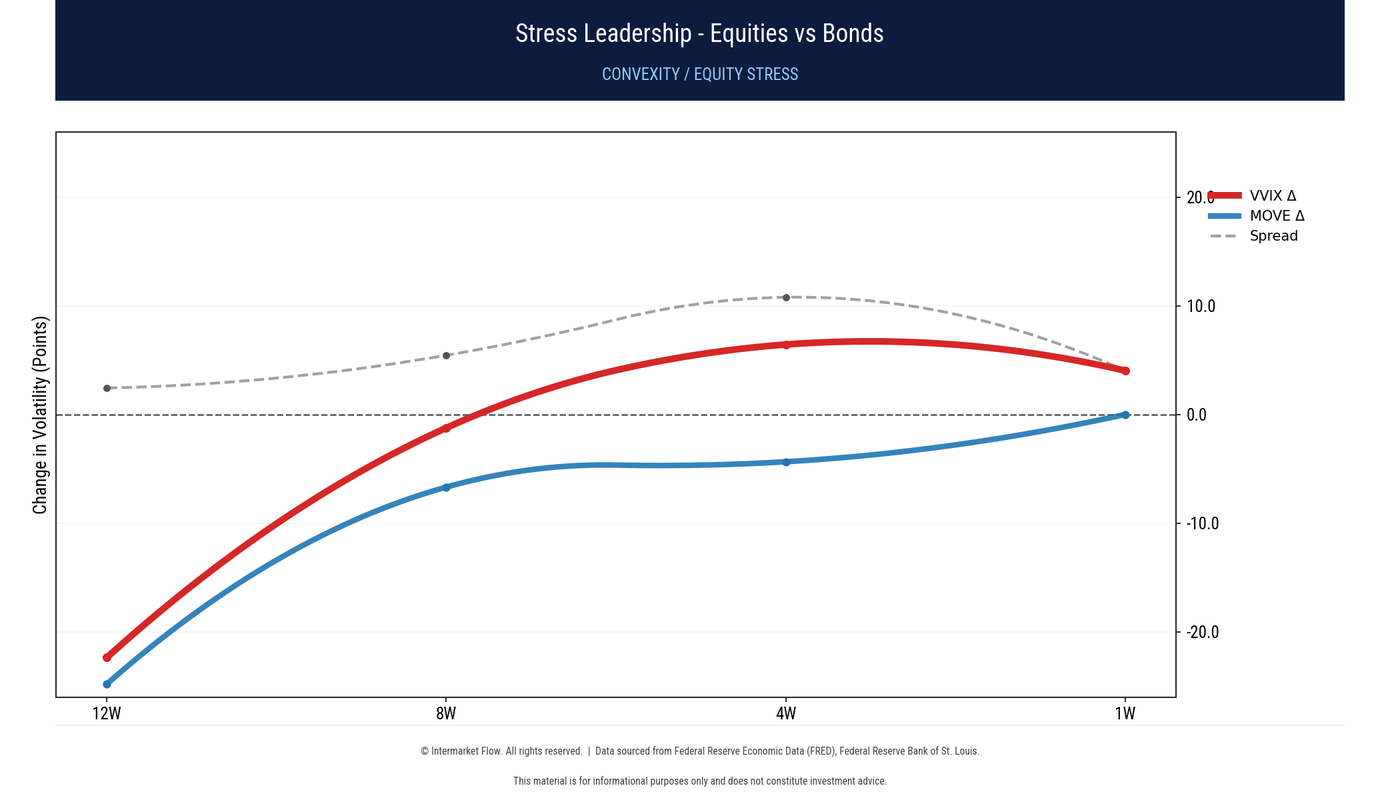
Protection is cheap.
With VVIX/VIX at -1.75σ, the market is not paying for convexity. This underpricing increases operational risk: if flows adjust, implied volatility can rebound fast and without warning.
Executive Verdict
- The Risk On structure is insolvent.
Action
- Reduce beta exposure tactically.
- Buy convexity — protection — while the current cost remains low.
Trigger
- If HYG breaks below range support, the “Sustainable Rally” thesis is invalidated. Full hedge execution/ Short Trades in credit dependance small caps.
Signal
- Persistent divergence between Z_Dolar Value/ Z_Volume and Z_Return / price in Risk On.
Validation
- HYG does not validate the Russell breakout.
Interpretation
- We are in a technical distribution phase. Russell is acting as a proxy for artificial sentiment, while credit — the real judge of risk — remains latent and structurally weak.
Scenario A — Weakness Confirmation
Junk breaks support. The Russell/Junk divergence resolves through a beta collapse. That invalidates any sustainable rally thesis.
Scenario B — Warning Invalidation
Junk follows the move and breaks previous resistance. In that case, flow validates price. Only then is Risk On positioning sustainable.
Final Verdict
- We are not in panic, but the Risk On structure is technically insolvent. The absence of price response when volume appeared in 4W is the evidence that the accumulation cycle ended.
- Protection is not a cost. It is a necessary hedge. The current asymmetry favors buying convexity before the market reprices fear.
Russell is the illusion. Credit is the reality.
Operating Levels — HYG / 12W
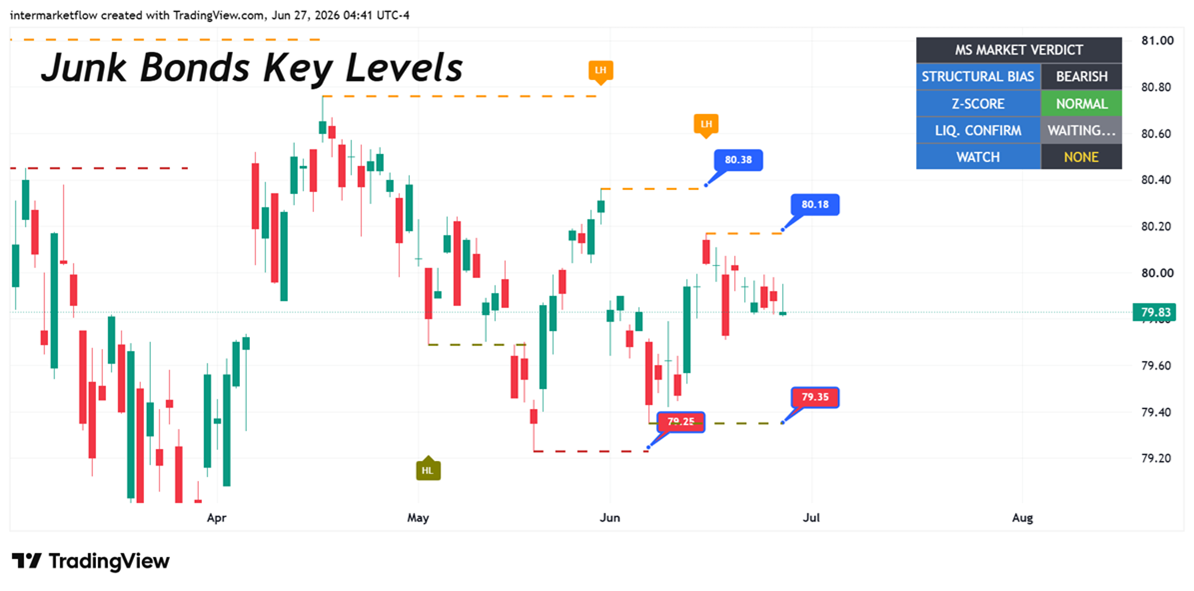
- Stop Loss Zone: 80.38. Mandatory exit. Total invalidation of the bearish thesis.
- First Resistance: 80.18. First barrier to upside continuation.
- Equilibrium Price: 79.88
- P/L management starts 79.35. Timeframes and risk tolerance defines entry and vehicle to express thesis.
Intermarket Flow
P.S. Your free trial expires in 48 hours. Time to decide.
To keep receiving the reports, consider upgrading your access. One correctly identified trade, regime shift, or risk signal can more than pay for the cost of the subscription.
If you believe this is an error, please contact the administrator.