
We continue to operate under our hypothesis that we are entering a credit crisis. Low volume is masking a dangerous liquidity drought. We are analyzing the cracks beneath the surface.
VIX Term Structure: Maximum Alert State
As a term structure, this chart is read from left to right, but it’s critical to understand that it is built on current market expectations. The same applies to the adjacent chart.
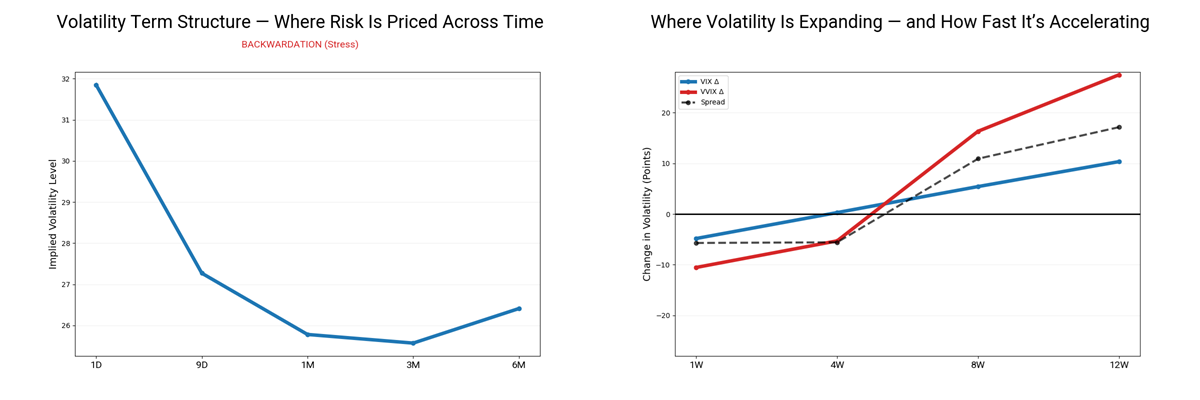
The first chart shows aggressive backwardation. This is the definition of a market in “fire mode.”
Spot panic (1D at ~31.8)
The fact that 1-day volatility is nearly 6 points above 1-month volatility (1M at ~25.8) indicates the market is willing to pay any price for immediate protection.
This is not a healthy correction; it is a liquidation event.
Full inversion
The market perceives current risk as significantly higher than future risk. Historically, going long under this structure is suicidal until the 1D–9D segment begins to collapse.
No floor
The slight rebound in the 6M versus 3M suggests the market does not expect a quick resolution, but rather a prolonged period of instability with a temporary pause in between.
VIX vs. VVIX Δ: Convexity Shock Pricing
This is the most dangerous chart. It shows that while spot volatility appears to “stabilize” in the very short term (1W), the volatility of volatility (VVIX) is exploding over the 2–3 month horizon. Again, this is a term structure, meaning these values are market expectations today about the future.
Convexity explosion (8W–12W)
The red line (VVIX Δ) spikes vertically toward 28 points at the 12-week horizon. This means the market is aggressively buying second-order hedges (options on the VIX).
The spread is the key
The gap between VVIX Δ and VIX Δ is widening violently. A translation for this: fear is accelerating faster than price. This typically precedes crash-type moves where the VIX doesn’t just rise — it gaps higher. The market is paying extreme prices geting bigger from 4 weeks on wards.
Weekly divergence
The negative Δ in 1W is a bull trap. It’s the eye of the storm. As long as the 12-week VVIX maintains that slope, any rebound in equities should be treated as an exit opportunity, not an entry point.
The evolution of credit and the Z-score of its returns
This chart is not a term structure. It illustrates the evolution of prices over time. To facilitate interpretation, we inverted the time axis to align it with the first chart.
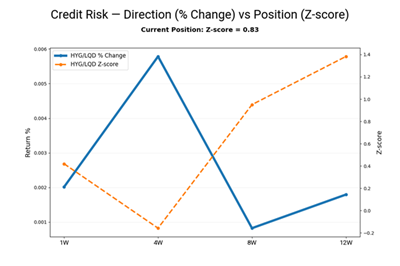
- The HYG/LQD ratio (blue line) had been rising between 8 and 4 weeks ago, reflecting a risk-on phase where lower-quality credit outperformed higher-quality credit. That process has reversed over the past month.
- The key signal is the dotted line: the Z-score of the return spread between them. At 1.4, twelve weeks ago, it indicated a statistically stretched condition.
- While the ratio continued to rise, the Z-score declined, signaling a loss of momentum—technically resembling a still uptrend rounded top.
- More recently, the Z-score has risen again while the ratio falls, implying the return spread is widening during a decline. A falling ratio with a high and uptrend Z-score is, by definition, a correction in progress.
- Currently, the HYG/LQD ratio is falling while the Z-score is rising. This is a rare and lethal divergence: it confirms that the underperformance of credit is accelerating relative to its own volatility. It’s not just a drop; it’s a ‘statistical breakout’ to the downside.
The Gravity of the Correction
Most traders look for a “bottom” when prices fall. We look at the speed of the panic.
Right now, credit prices are dropping, but our risk measure (the Z-score) is rising. In plain English: The correction is accelerating, not slowing down. This isn’t a normal dip where things “return to average.”
This is a breakdown where risk is spiraling out of control. When credit panics this hard, big funds are forced to sell their stocks just to stay alive. The market has stopped looking for “deals”—it is now looking for the exit.
The floor becomes an illusion because the engine of the correction is just now hitting top speed.
Executive Summary: This divergence should reverse if we are to avoid a credit crisis
The market is in a liquidity mismatch. Options are pricing stress, while credit has yet to capitulate.
- Immediate Panic (VIX): Aggressive backwardation. VIX 1D at 31.8 vs 1M at 25.8 signals extreme demand for immediate protection.
- Tail Acceleration (VVIX): Explosion at the 12-week horizon (Δ +28). Fear is not linear—it is accelerating.
- Credit Exhaustion (HYG/LQD): A 0.83 Z-score shows positioning remains extended, but momentum has already broken. Smart money stopped buying risk weeks ago.
Strategic Verdict
The gap between a VIX at 32 and credit that has not yet capitulated is unsustainable.
- Sell Rallies: Any bounce in QQQ, SPY is technical and unsupported by credit flows.
- Gap Risk: VVIX expansion suggests the next move is likely a downside gap, not a gradual decline.
- Imminent Capitulation: A true bottom will only form once credit Z-scores turn negative and the VIX term structure returns to contango.
Trading logic
With a correction in HYG increasingly likely, we ran relative performance regressions across a group of credit-sensitive equities—names dependent on credit for capital structure, demand or sales. Or a mix of them.
Weakness is not random. By aligning 1-week and 4-week data, we identify a cluster of systemic weakness led by COF, SF, LPLA, and GM.
The fact that 80% of the weakest names overlap across both timeframes confirms this is not a technical pullback, but a flow-driven imbalance.
Trading and positioning
As you already know, we have been positioning according to our hypothesis for the past couple of weeks.
Moreover, portfolio-level decisions—across different timeframes, objectives, and vehicles—are also taking place.
Weekly Time frame base trade
From a technical standpoint, and focusing on weekly timeframe trades, this is the setup we favor the most.


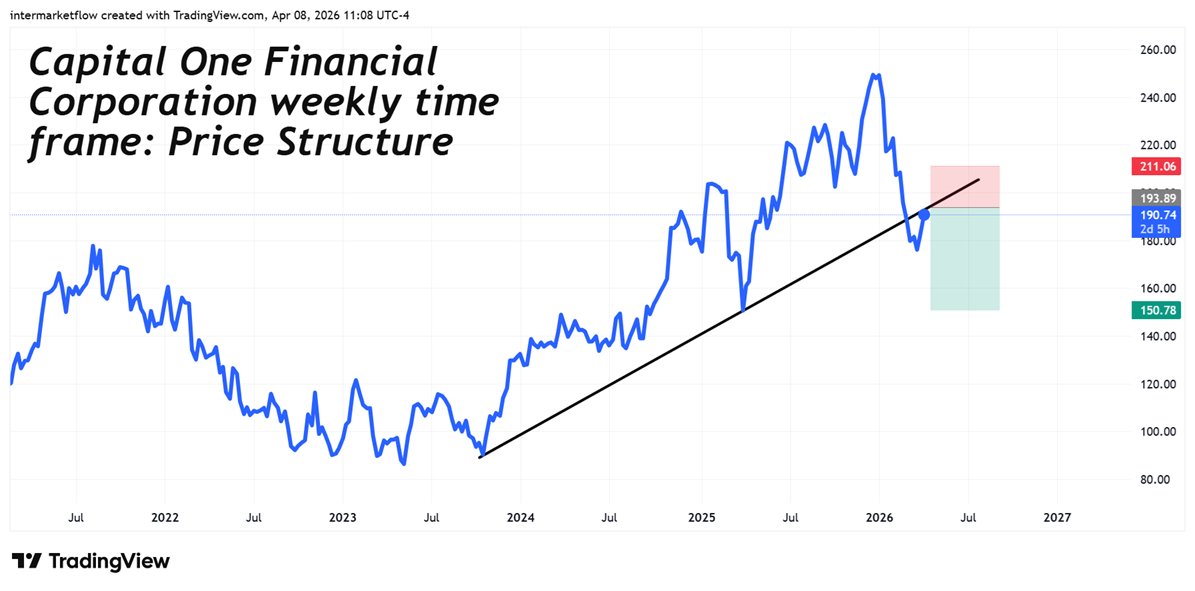
Of course, we still need to reassess the invalidation of our hypothesis—whether in terms of timing, structure, or both.
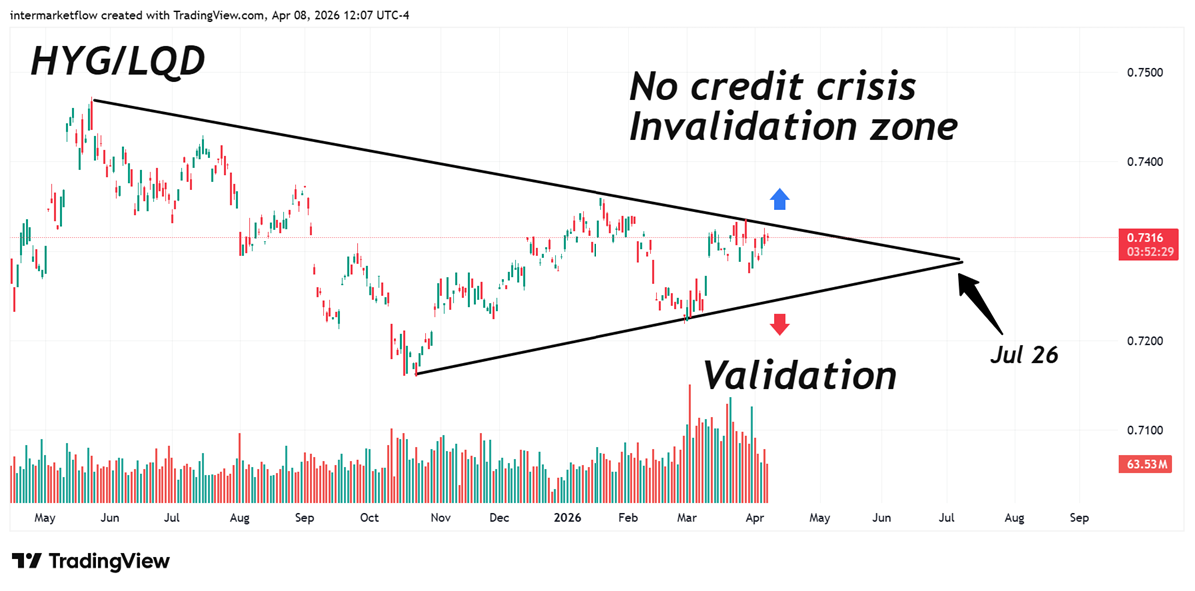
Markets demand humility, as strong as life does. Keeping focus on invalidation zones is not weakness or distrust in our analysis. It is humility and nearly 3 decades of trading.
Martin
P.D. “The setup for our Weekly Base Trade is now live for Premium members. We are not waiting for the gap; we are waiting IN the gap.”
If you believe this is an error, please contact the administrator.