
PCE at 3.5% – FED Funds Rate at 3.5% / 3.75%.
The market is trapped between inflation and growth.
If the FED raises rates:
- equities likely reprice lower,
- credit stress accelerates,
- refinancing conditions tighten further.
If the FED cuts rates:
- real rates likely turn negative,
- inflation expectations drift even higher,
- FED credibility deteriorates.
Bonds are already reflecting it:
- widening stress,
- weaker credit,
- and growing sensitivity to rates.
Initial Monthly positioning and last week flows
Bonds
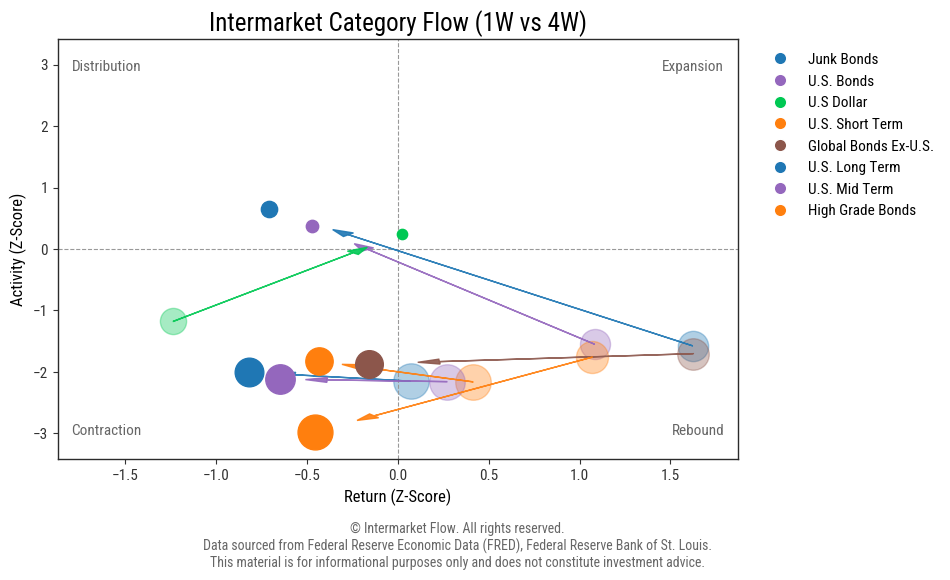
Inflation is burning fixed income holders from the inside out, forcing capital toward liquidity.
That escape is already visible in Bills, where activity (price × volume) and returns surged aggressively. This remains one of the clearest proofs of the ongoing flight to liquidity.
Initial Monthly positioning and last week flows
Equities
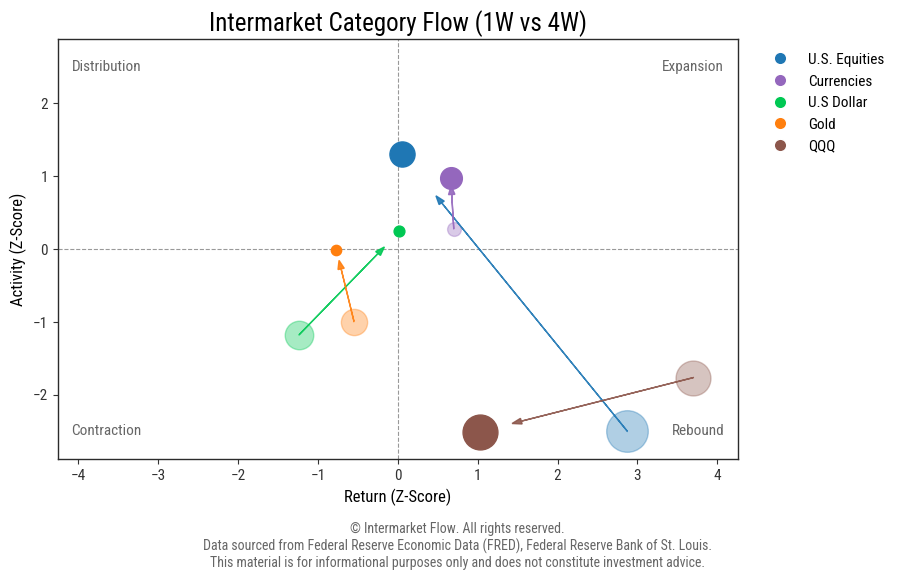
The situation is becoming increasingly selective.
Global equities remain deep inside the distribution quadrant, while QQQ continues losing both activity and returns, entering the contraction zone, although returns still remain positive on a 4-week basis.
Meanwhile, U.S equities finally experienced an increase in activity, pushing the category toward the boundary between distribution and expansion.
Flow characterization through volume and volatility
Price alone is no longer enough to identify capital flows. Volume and volatility become critical to determine whether these movements reflect real accumulation or ongoing distribution beneath the surface.
Recent short term returns are explained by:
- the squeeze in equities,
- and the internal mechanics of the options market, where market makers artificially suppress or amplify volatility through positioning and hedging activity.
However:
- DV,
- Volume,
- and Volatility
fail to confirm the move consistently across longer timeframes.
That is critical. The price is rising. Structural flows are not.
This type of divergence usually appears during:
- bear market rallies,
- tactical rebounds,
- or distribution phases.
Activity, or Dollar Value, becomes critical in this environment because it reveals whether capital is truly accumulating positions or simply using price strength to distribute risk.
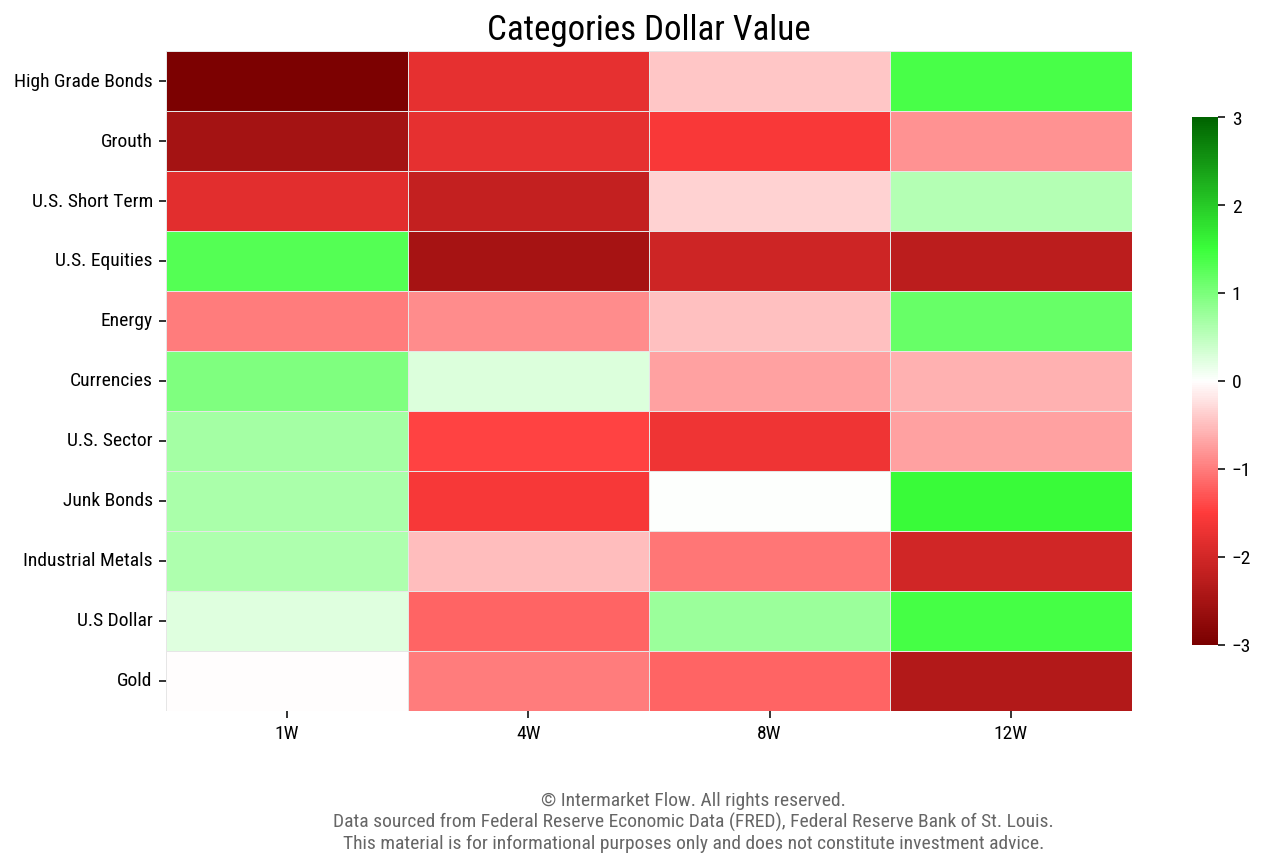
DV and Volume continue deteriorating beneath the surface, as exposed in the first column through Weekly Stock, Size and Positioning relative to the initial positioning at the beginning of the month.
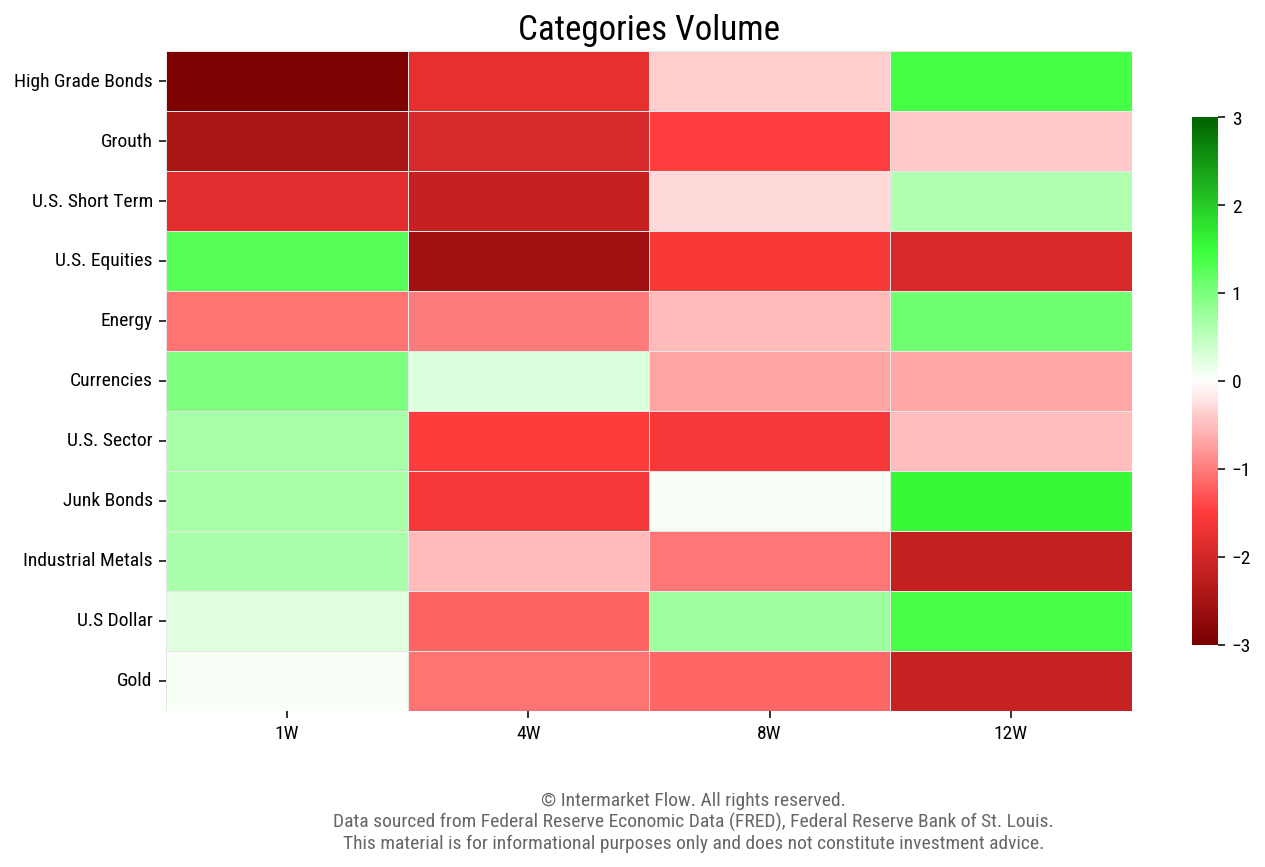
Cyclical categories:
- equities,
- growth,
- industrial metals,
keep losing:
- real flows,
- participation,
- and market depth
as the timeframe expands from:
1W → 4W → 8W → 12W.
That implies:
- capital is not building structural positions,
- it is rotating tactically.
Very different from:
- structural accumulation,
- cycle expansion,
- or a healthy bull market.
Volatility Confirms Progressive Stress
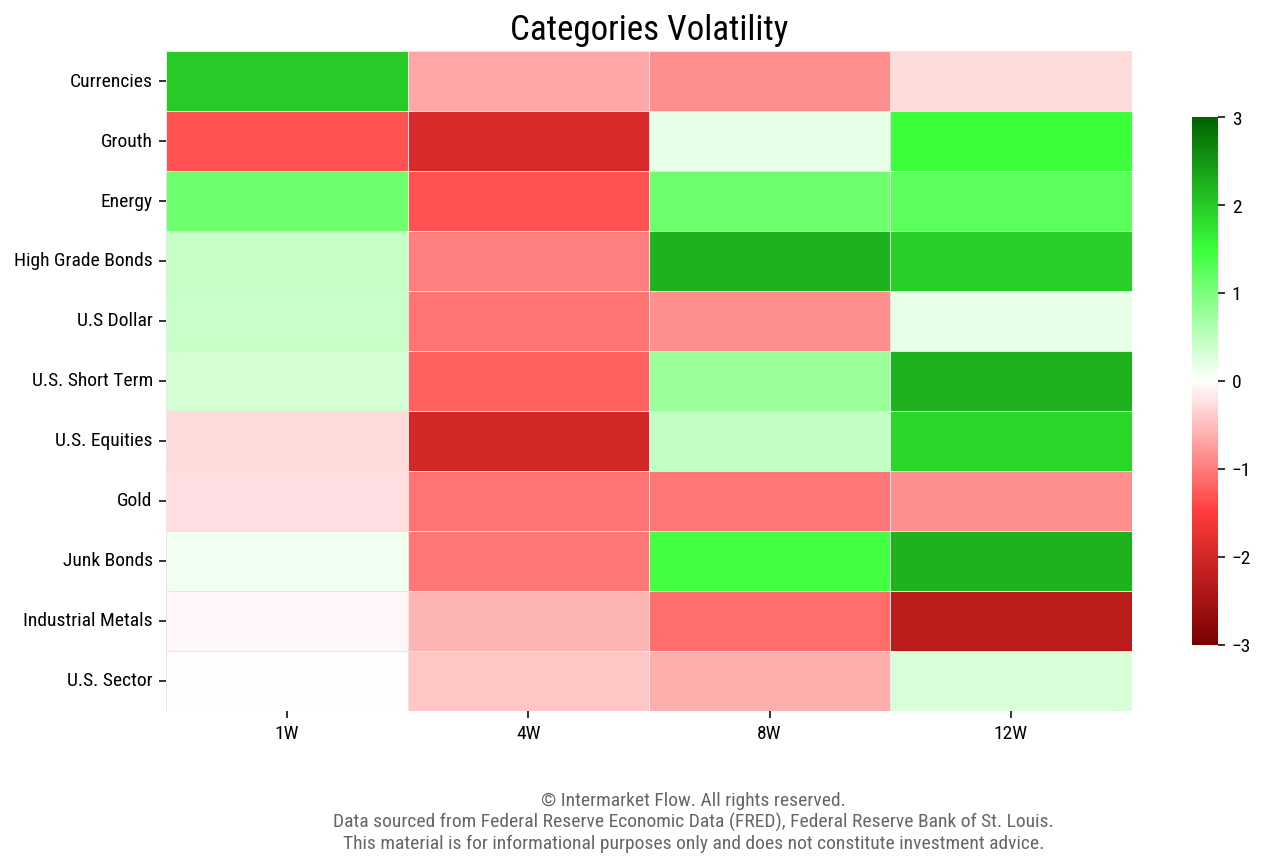
- High Grade Bonds,
- Junk Bonds,
- U.S Short Term,
- and Growth.
That matters because volatility is rising precisely in the assets most sensitive to rates and credit conditions.
The market is beginning to:
- reprice risk,
- reprice duration,
- and reprice credit.
The U.S Dollar remains Dominating the System
- strong in returns,
- strong in DV,
- strong in volume,
- while volatility stays relatively controlled.
Industrial Metals Remain the Cleanest Macro Warning
- weak returns,
- weak flows,
- weak volume,
- and negative volatility.
That is almost textbook global slowdown behavior.
Gold Warning Sign
Volume continues climbing a staircase that began 12 weeks ago. Week after week, small inflows keep generating progressively higher returns. (Slow accumulation).
Gold remains in an early stage. If real rates turn negative, its opportunity cost would shift from negative to positive.
However, Gold still fails to confirm a structural breakout, suggesting the market continues prioritizing immediate liquidity (USD) over inflation hedging.
However, if:
- PCE remains elevated,
- the FED stays trapped,
- and real rates turn negative,
Gold could quickly transition from a secondary defensive asset to a systemic leader. Good time for stocking some of it.
The nail in the coffin: Categories correlation with the 2 year Yield
The defensive reading becomes significantly stronger once we add structural sensitivity to the 2Y into the framework.
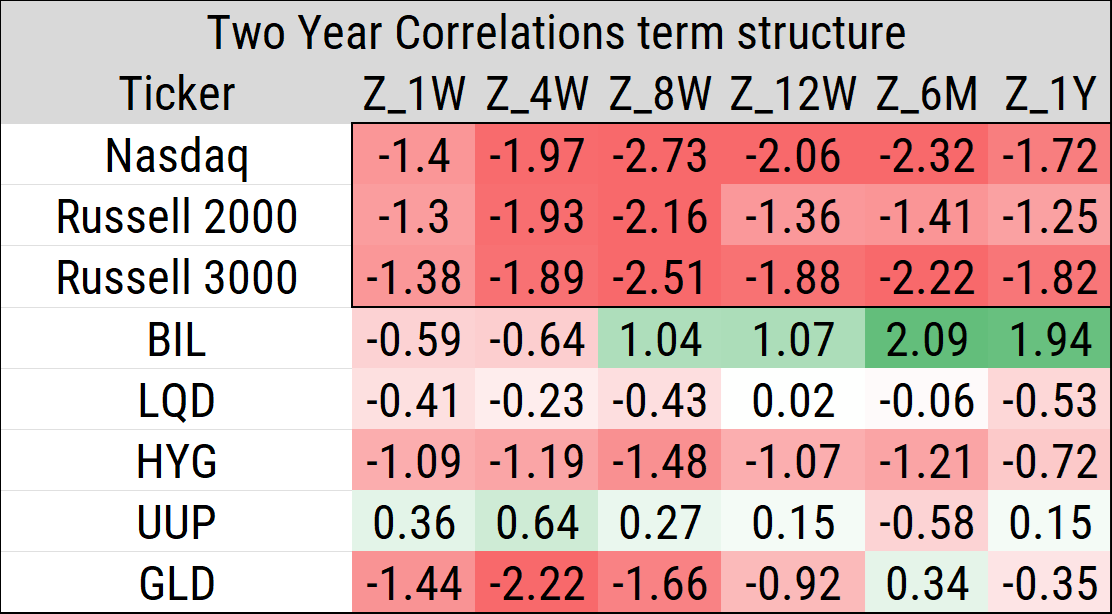
Markets are no longer trading growth. They are trading monetary policy and the cost of money.
Nasdaq and Russell remain deeply negative against the 2Y across multiple windows, confirming extreme sensitivity to front-end rates.
That is typical of fragile markets dominated by duration risk and financial conditions rather than internal strength and growth expectations, including A.I trades.
Could it be that the actual A.I trade upside is already discounted in price?
At the same time:
- BIL continues outperforming across longer windows.
- HYG remains weak across all windows.
That is critical.
In healthy bull markets, capital leaves cash. Here, cash-like instruments are outperforming risk assets, reflecting liquidity preference and defensive positioning.
Final Conclusions
All four metrics together describe a market where:
- returns still maintain the appearance of stability,
- but DV and Volume show progressive capital withdrawal,
- volatility is expanding across credit and duration,
- the USD is absorbing global liquidity,
- and cyclical assets continue deteriorating beneath the surface.
That does not describe:
- healthy economic expansion,
- or a structural bull market.
It describes:
- fragility,
- liquidity compression,
- progressive macro deterioration,
- and a potential transition toward credit stress, which remains our final-stage macro hypothesis.
Intermarket-wise, bonds and front-end rates are leading the macro narrative while equities still attempt to sustain a bullish one.
Historically, when that divergence appears, bonds tend to be right first.
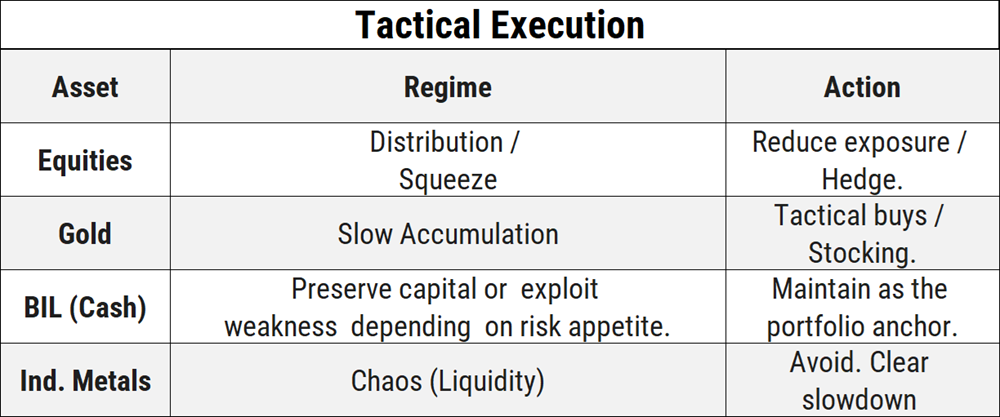
Portfolio Stance and trading bias
If you believe this is an error, please contact the administrator.