
Intermarket Capital Flows — Equities and Bonds
Monthly to Weekly Transition in Volume and Volatility
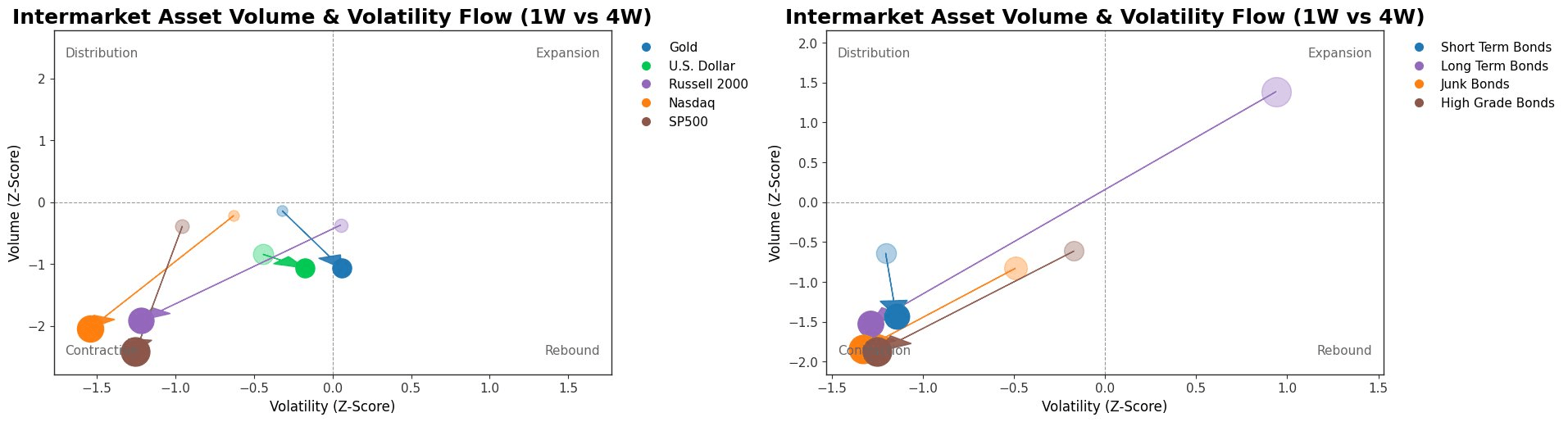
How to Read This Chart
Each asset appears twice: a 4W state and a 1W state. Bubble size measures the magnitude of flows relative to that asset’s own historical average for each timeframe. The arrow connects both states, capturing the direction and magnitude of the change in volume and volatility from 4W to 1W. Bubble size and arrow direction together reveal participation, momentum, and conviction.
Conclusions
The message is uniform — and that uniformity is the signal.
- Across equities, Treasuries, High Yield, and Investment Grade credit, volume and volatility contract simultaneously. No rotation. No differentiation by credit quality.
- That last point matters: when High Yield and Investment Grade behave identically, the contraction is not being driven by credit risk. Something broader is behind this move.
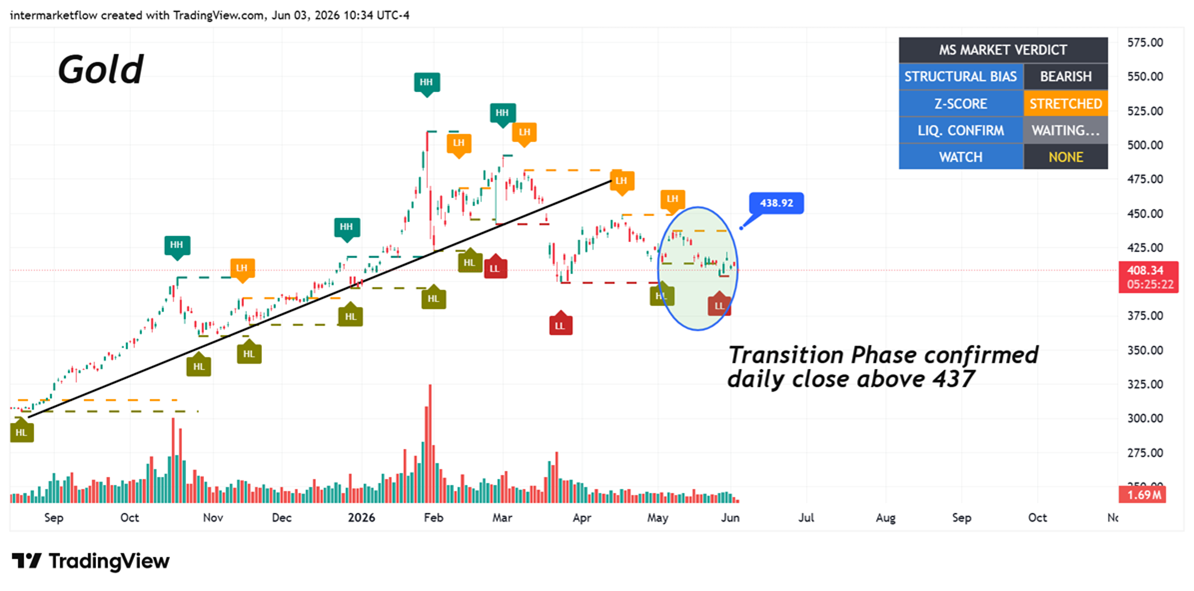
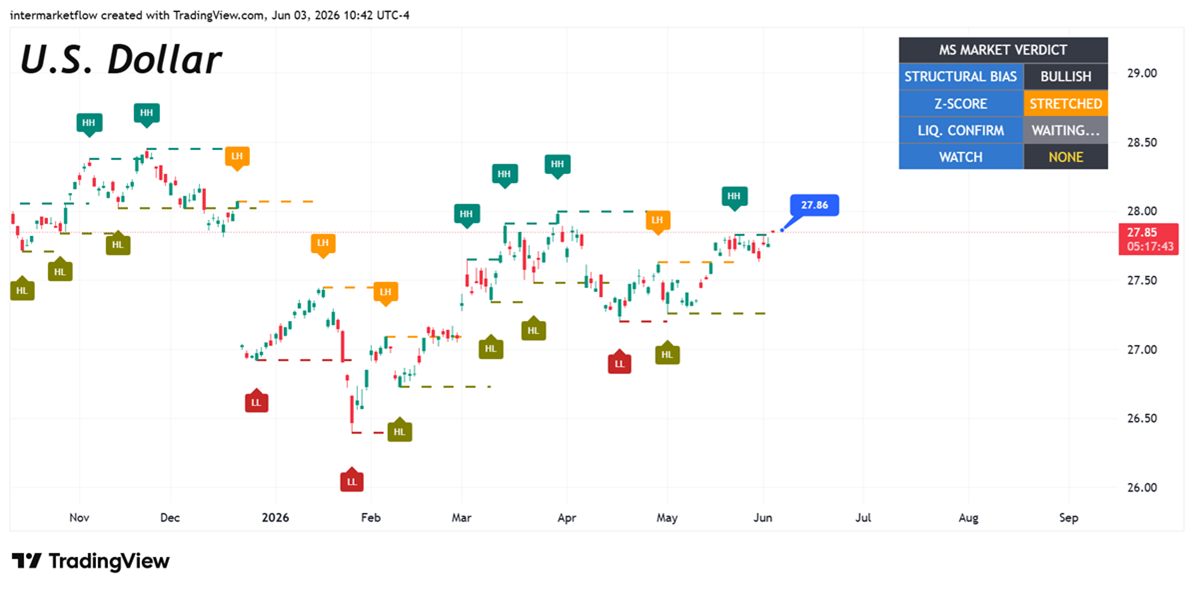
- Gold and the U.S. Dollar are the only exceptions. Participation remains relatively stable while volatility expands — indicating two-way flow activity rather than unidirectional movement. These are the only assets in this snapshot continuing to attract active capital.
- The acceleration of equity outflows in the 4W→1W transition confirms bearish momentum with strong directional conviction. The divergence in Gold and USD confirms that capital is not rotating within the risk spectrum. It is leaving it.
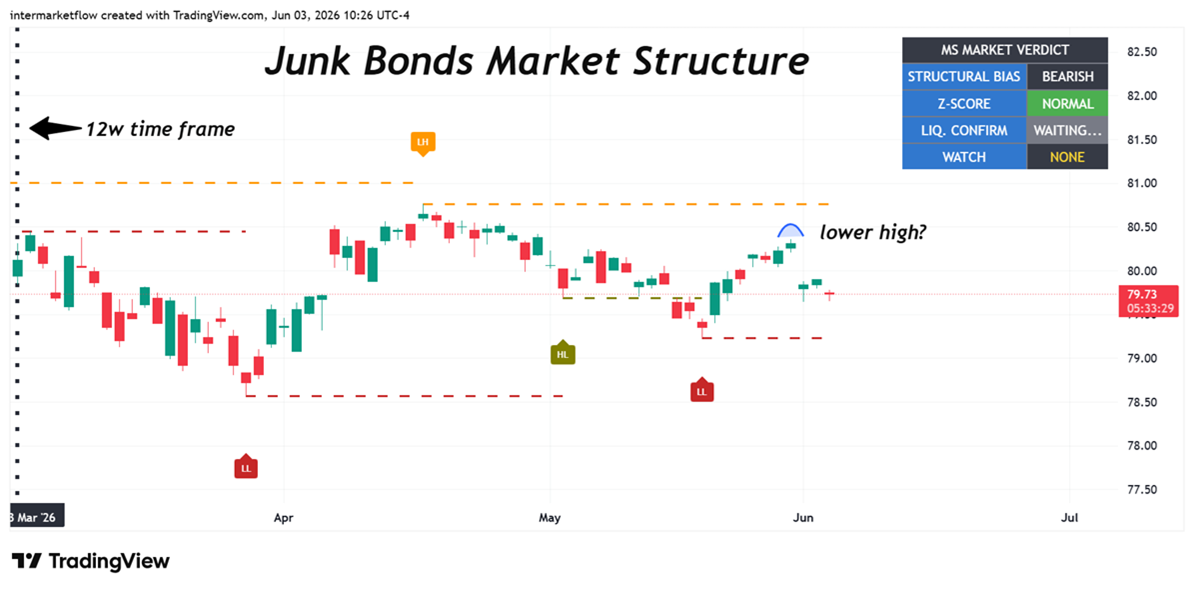
Key levels in Gold and the U.S. Dollar carry particular weight in this environment. Both assets join Junk Bonds — our primary credit risk proxy — as the critical levels to monitor in the sessions ahead.
The market is not searching for opportunities. It is choosing shelter.
Returns — Equities and Bonds
Weekly return data must be read through the lens of the current market context.
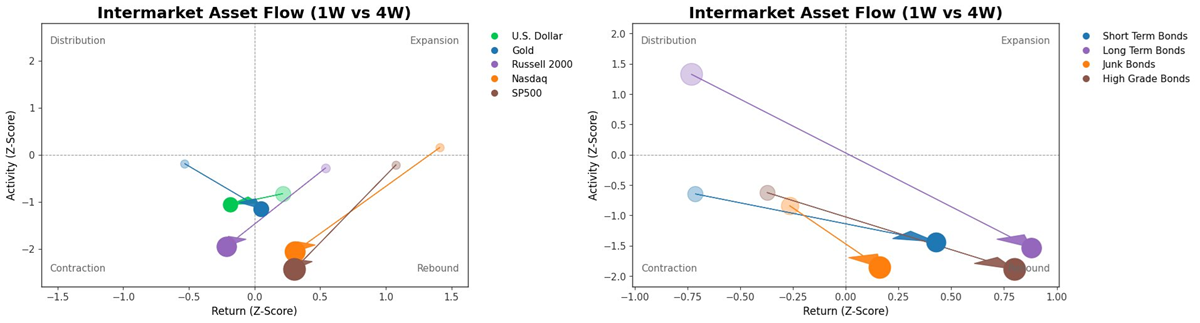
- Equity returns declined across the board, with Russell 2000 showing the sharpest weakness — consistent with the participation contraction and volatility compression observed in the flow data.
- Fixed income posted modest gains. Given that bonds have been expelling capital for months, this should not be read as a regime change. It is a technical rebound inside a broader distribution process — nothing more.
Operational Translation — I.F Block
Signal
Negative returns across equities, led by Russell 2000 weakness, alongside continued capital expulsion from fixed income.
Validation
Z_RET data fully aligned with the liquidity contraction and volatility compression observed throughout the 4W→1W transition. Price action confirms the flow data — it does not contradict it.
Reading
Equity weakness reinforces an already deteriorating participation backdrop. Bond gains are a technical bounce, not evidence of renewed accumulation. The flow data has been signaling this for weeks.
Two-Year Weekly Correlations
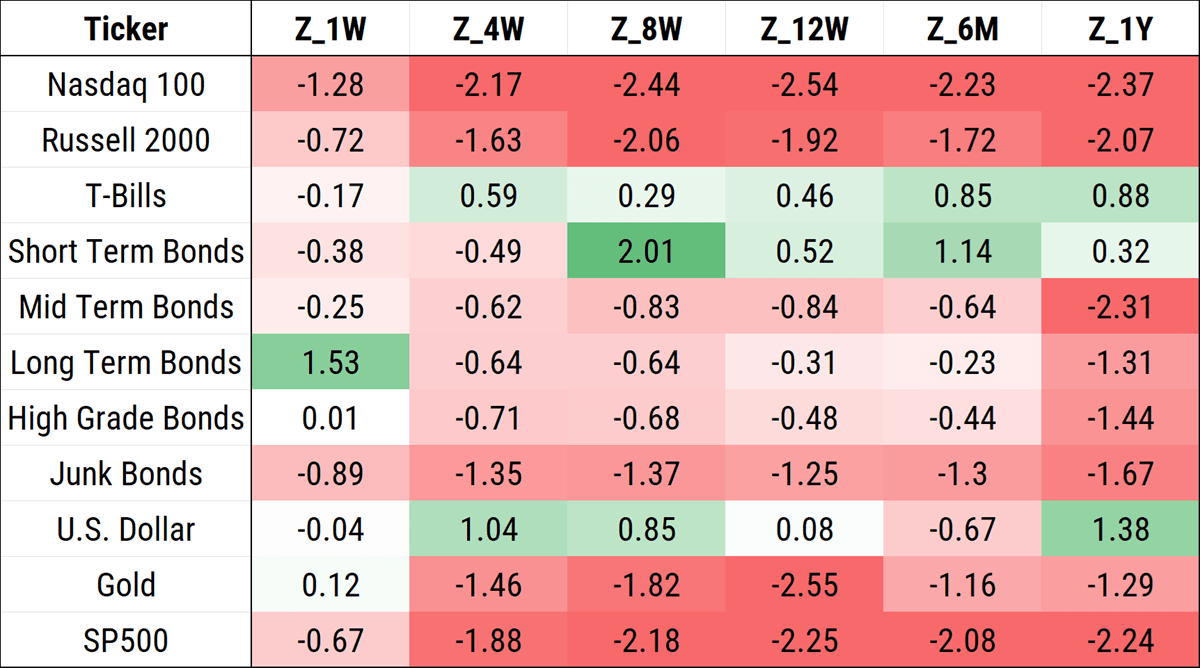
Stepping back to the annual timeframe and working down to the weekly, the relationship between rates and equities is gradually losing coherence. In isolation, one could argue equities are beginning to define their own direction. The data does not support that reading. Capital is prioritizing exit regardless of what rates are doing.
Key observations
- Both short- and long-term rates showed positive correlation during the week (z-score 1.53 ∂)— a pattern that diverges from most other assets. Whether higher rates today imply lower inflation and therefore lower long-term rates tomorrow is a question the current sample cannot answer. It is too early.
- Gold and the U.S. Dollar have decoupled from rates. Other variables are driving those flows.
Duration
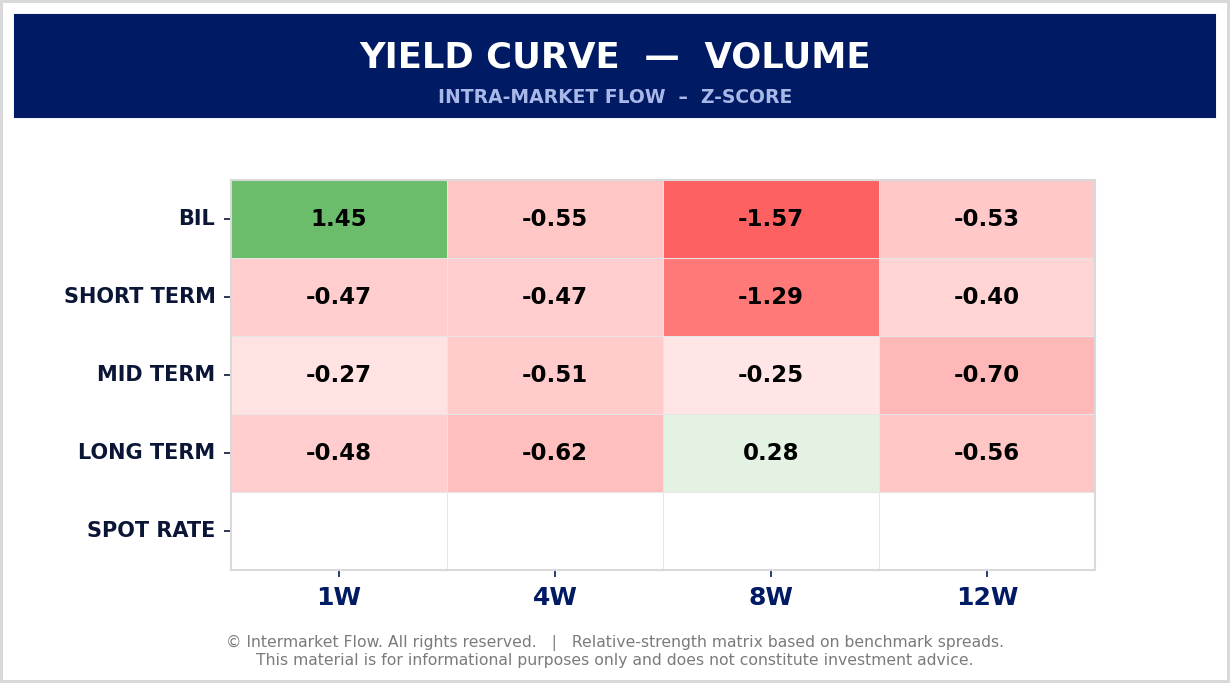
The weekly rate-of-change in short-term flows sits at a Z-score of +1.45∂ above its historical weekly average — a meaningful increase in demand for the front end of the curve, fully consistent with the broader evidence presented in this report.
Action
- Pivot to Safe HavenExecute tactical reduction of exposure in equities and bonds across the full credit quality spectrum — High Yield and Investment Grade alike. Flow is not discriminating by quality. It is abandoning the system. Maintaining exposure means accepting liquidity risk with no directional benefit.
- Divergence Arbitrage — Gold / USD: Prioritize long positions in Gold and USD. Volume holding, volatility expanding, two-way participation sustained — these are the only assets with real demand in the current regime. Trade them accordingly.
- Front End — Z_FLOW +1.45 – Capitalize on short-end curve demand as a volatility hedge. This is a defensive trade — not a signal of long-duration regime shift.
That is not a market on pause. That is a market continues choosing shelter in spite of mass media and consensus sugest.
Market Structures Key Assets
If you believe this is an error, please contact the administrator.