
Looking for trades in a context of volatility compression: momentum across the 4W→1W timeframe.
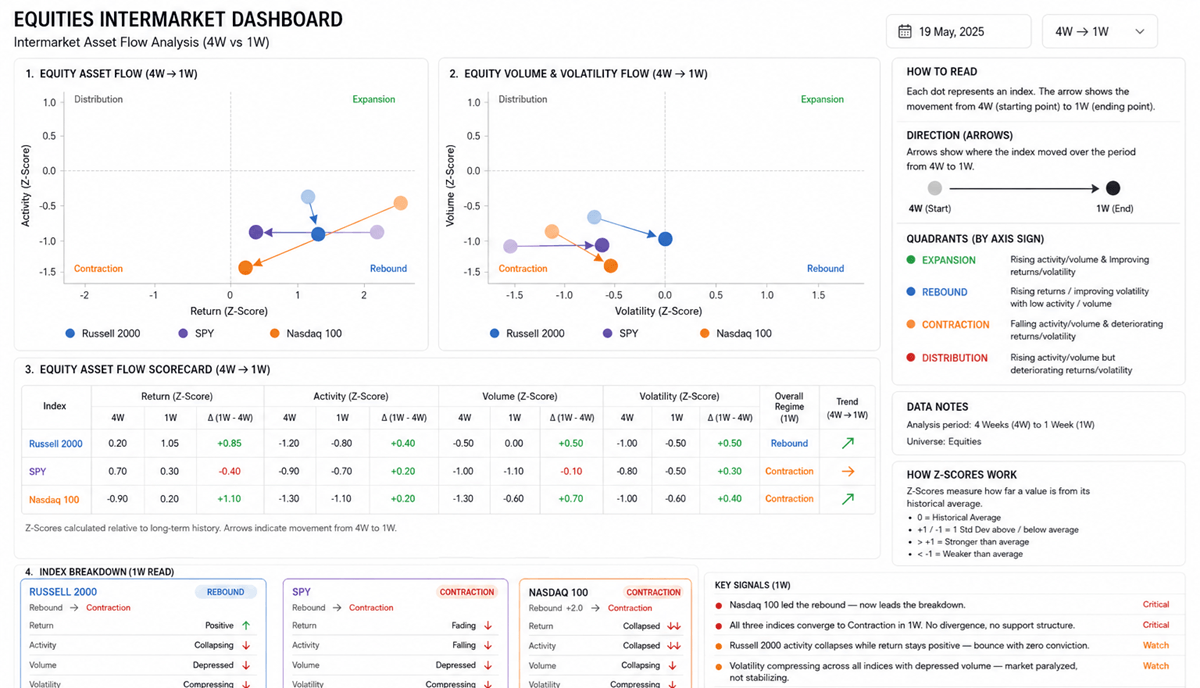
Equities: a quick snapshot of the current flow
Key points
- The market is violently quiet (Don’t fall for the trap).
- The mainstream narrative claims the Russell 2000 bounce ($+1.05$ Z-Score) is a healthy rotation into small caps. The data says otherwise.
- Reality: It is high-stress paralysis. The Nasdaq 100, SPY, and Russell 2000 have collapsed together into the Contraction quadrant.
- Danger: Volatility is compressing while volume has completely evaporated. The market isn’t stabilizing—it’s locked up.
The structure is highly vulnerable to a sudden, violent break. Any strategy involving equity setups should strictly refuse to short volatility. We are holding our tail-risk hedges and protecting our capital.
Bonds-Credit
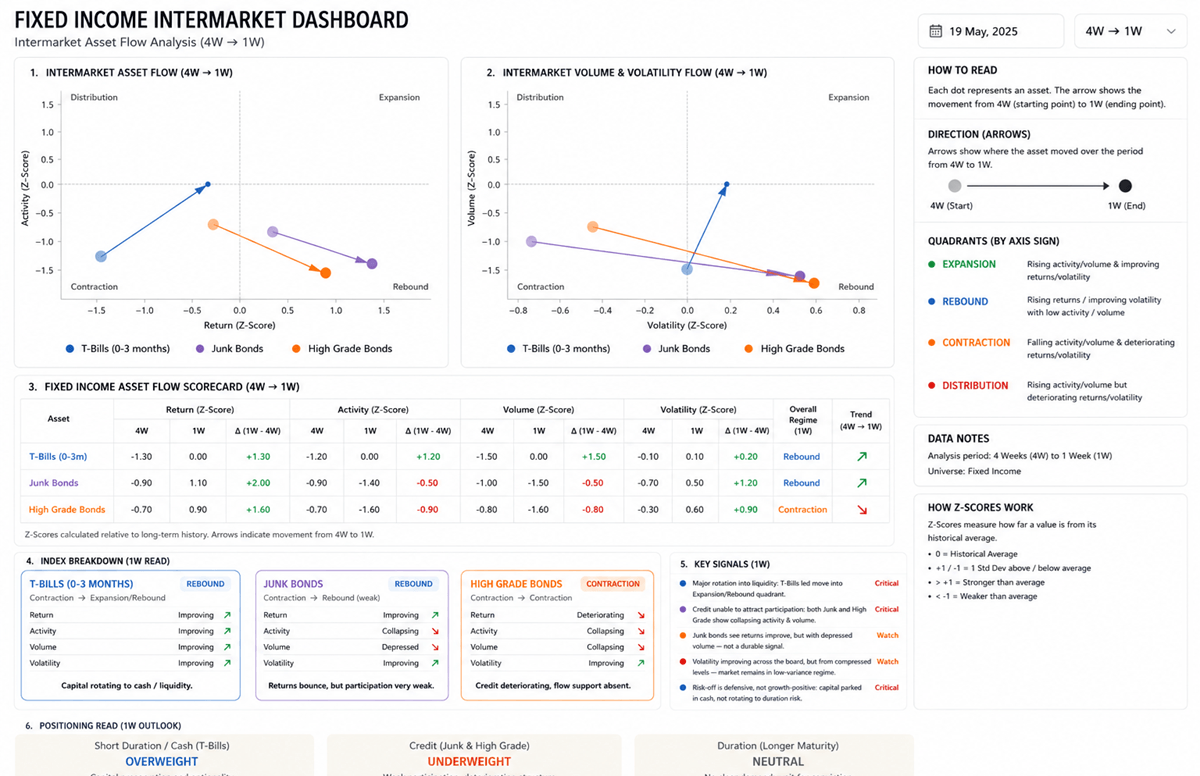
Where the smart money is hiding right now.
Key points
- The capital isn’t panicking, but it is hiding. Institutional cash is rotating heavily into T-Bills, which currently show the strongest internal metrics across returns, activity, and volume.
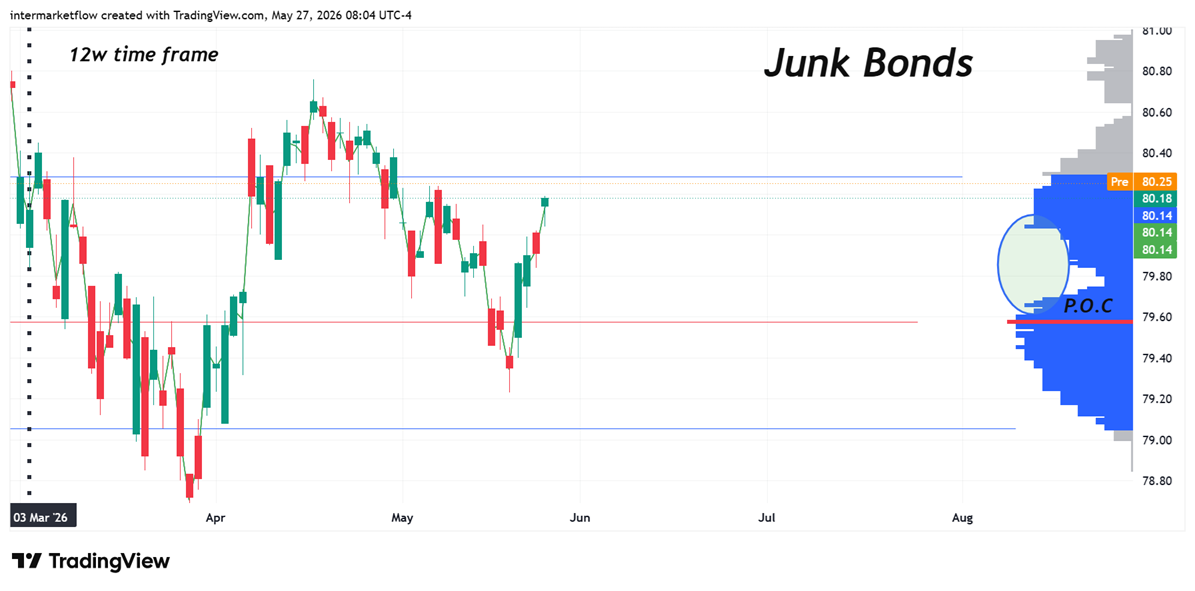
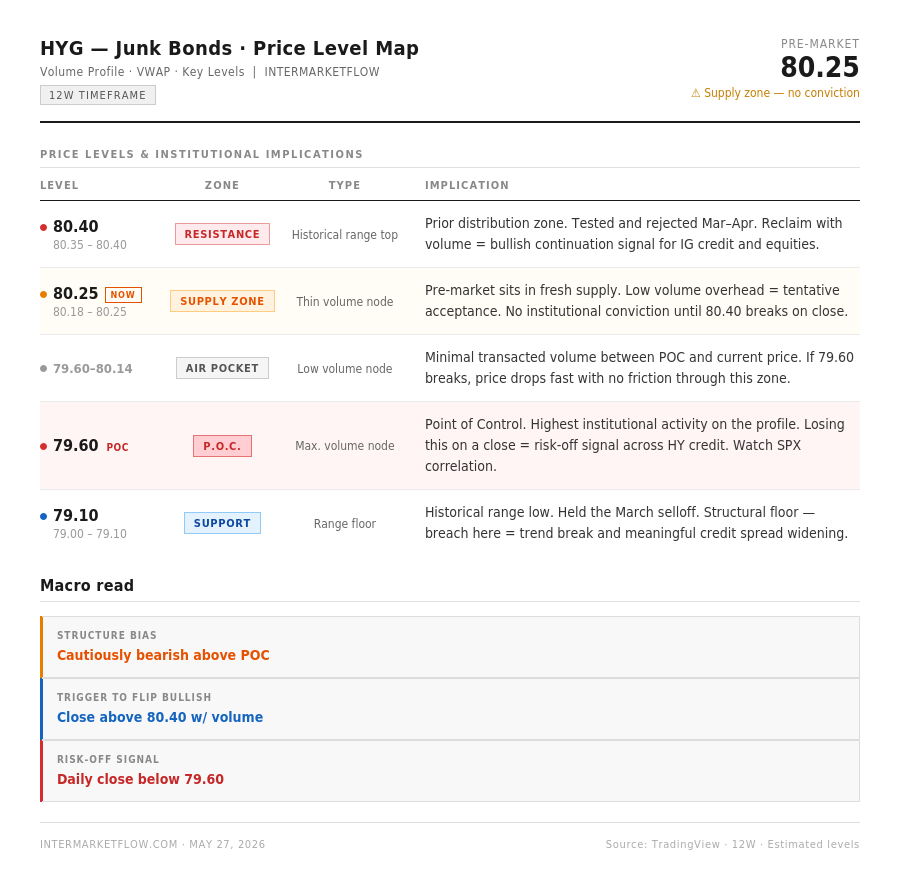
- The Corporate Illusion: Junk and High-Grade bonds saw a slight price bounce, but don’t buy it. Participation has completely collapsed. These moves lack real backing; demand for credit risk and duration exposure is dead.
- The 12-Week Reality: For three months, the market has ignored corporate earnings, economic data, and valuations. This is a pure Inflation and Interest Rate regime. Both stocks and bonds are locked in the exact same paralysis for one reason: rate uncertainty.
We are aligning with the data. We remain heavily parked in short-duration liquidity (T-Bills) while completely avoiding long duration and corporate credit. Cash is a tactical position.
Volatility: The key intermarket message
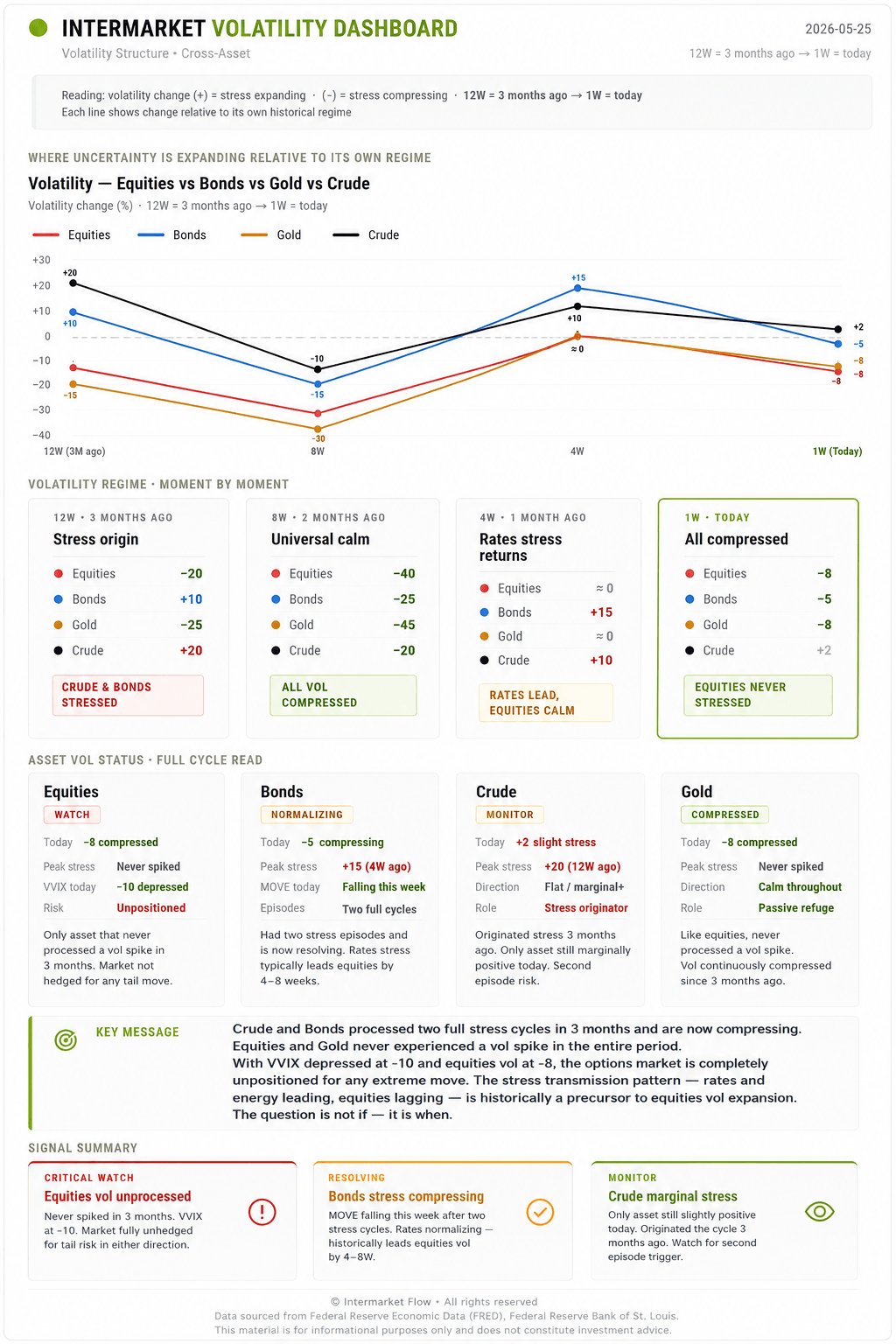
The calm before the expansion (Why we are buying protection today)
The Illusion
- Cross-asset stress has completely collapsed. Volatility metrics for Equities ($-8$), Gold ($-8$), and Bonds ($-5$) are signaling absolute, transitional calm. The mainstream is complacent.
- Vulnerability: Equities are completely unprotected. The equity options market has failed to process any real volatility over the last 3 months, pushing the VVIX down to a critical $-10$. No one is buying insurance.
- The 4-8 Week Lag: History shows that macro stress (rates and energy) hits the stock market with a 4-to-8 week structural delay.
- Bond volatility peaked at $+15$ a month ago, and Crude Oil remains sticky at $+2$. The current calm in stocks is a lag, not safety.
We are capitalizing on dirt-cheap insurance. We are aggressively holding tail-risk hedges and long-volatility exposure before this structural lag closes.The options market is pricing in zero risk just as the macro fuse is lit.
Trading strategy-Entry and Invalidation zones
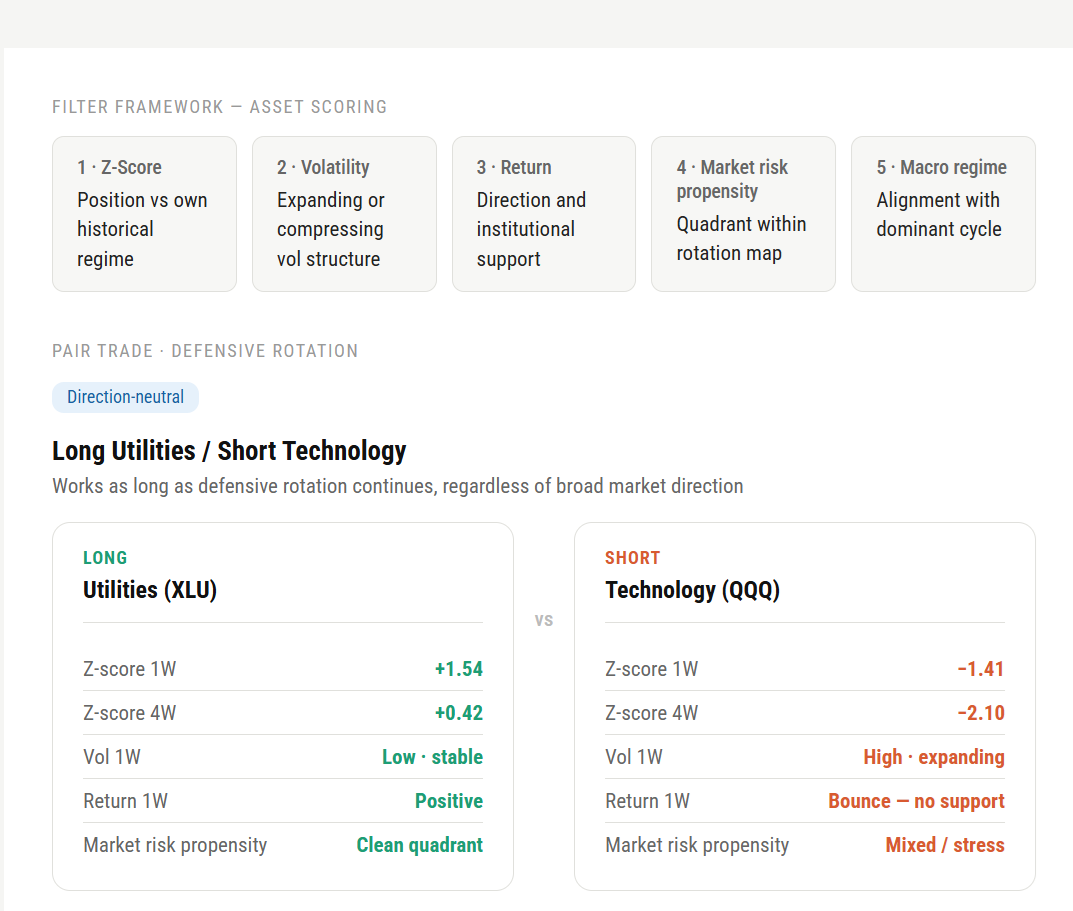
- Long XLU / Short QQQ remains fully aligned with the current intermarket framework.
- XLU continues showing clean defensive leadership
- Positive momentum,
- Compressed volatility,
- Stable participation,
- Consistent defensive flows.
- QQQ continues displaying:
- Structural fragility,
- Volatility expansion,
- Rebounds lacking support.
Strengths
- The trade does not require a market crash to work. It only requires
- Utilities to keep outperforming,
- While Tech continues losing relative leadership.
- A direction-neutral hedge designed to capture the continuation of defensive rotation and a potential increase in equity volatility.
Main risk
- If correlations spike toward 1 during a systemic liquidity event, QQQ volatility could temporarily pressure the position before convergence occurs.
- Risk-off rotations simply stop.
Invalidations
- Strong volume rotating back into Technology.
- Stabilization in credit-sensitive assets signaling the end of the defensive regime.
Explicit invalidation levels
We have been tracking this chart for months now. It remains one of the clearest proxies for the market’s prevailing risk appetite — a key variable behind our current setup.
Numbers and key points
- The market is no longer trading on optimism. It is trading on liquidity, inflation and volatility transmission.
- That is why we focus on intermarket flows instead of isolated price action.
The goal is simple: identify where capital is rotating before the broader market fully reacts.
Stay ahead of the rotation.
Subscribe and continue tracking where capital is moving before the broader market fully reacts.
Intermarket Flow
If you believe this is an error, please contact the administrator.