
Executive Summary: The Credit Fracture and 2 year yields
- Intermarket flow shows liquidity Exhaustion, Not Rotation: Capital is not moving between sectors; it is withdrawing from the system.
- The fading momentum in Cash and Bonds confirms we are approaching a state of liquidity exhaustion, where the “safety” trade is becoming a crowded bottleneck.
- The Correlation Death-Cross: The 2-Year Yield correlation has fundamentally flipped from positive (growth-driven) to negative (recession-driven).
- Higher rates now imply default risk. This is the “message in the bottle” signaling that the market is no longer fighting inflation, but pricing a hard landing.
- JP Morgan as the Systemic Canary: JPM’s -2.59σ collapse represents the banking system state.
- The HYG Short-End Breach: Junk credit (HYG) is already broken at the short end of the curve, meaning pure insolvency risk is now visible, with no duration effect to mask it.
- The transition to a systemic crisis will be complete when LQD (quality credit) also breaks at the short end.
Operational Mandate:
- Short XLF remains the core active trade; any rally should be treated as liquidity to sell into.
- The secondary focus is lower-quality equity credit—a structural six-month trade triggered on the weekly timeframe. We are already positioned here. Update in the mid-week report.
- The Cash Regime: Being positioned in T-bills is the only rational stance, but it should be understood as an exit-door trade. Cash is being held not for yield, but for the optionality to deploy capital once the credit repricing is complete.
Capital is not rotating — it is withdrawing. We are no longer in a market of ‘hesitation,’ but one of liquidity exhaustion.
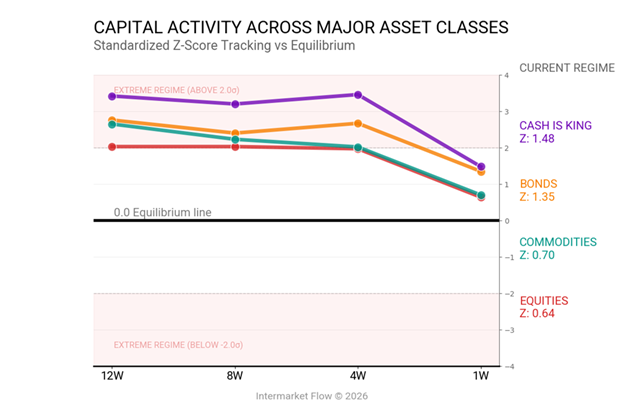
- The system is not reallocating risk, it is compressing it.
- Cash and bonds still dominate, but with fading momentum — not as conviction, its liquidity exhaustion.
- The slopes of the flows reflect momentum.
- This is not a dip-buying environment.
It is a market waiting for resolution — most likely through a repricing of credit.
Intermarket Flow: The End of the “Safety” Trade
Prof #1: JPM and the Canary in the Consumption Mine
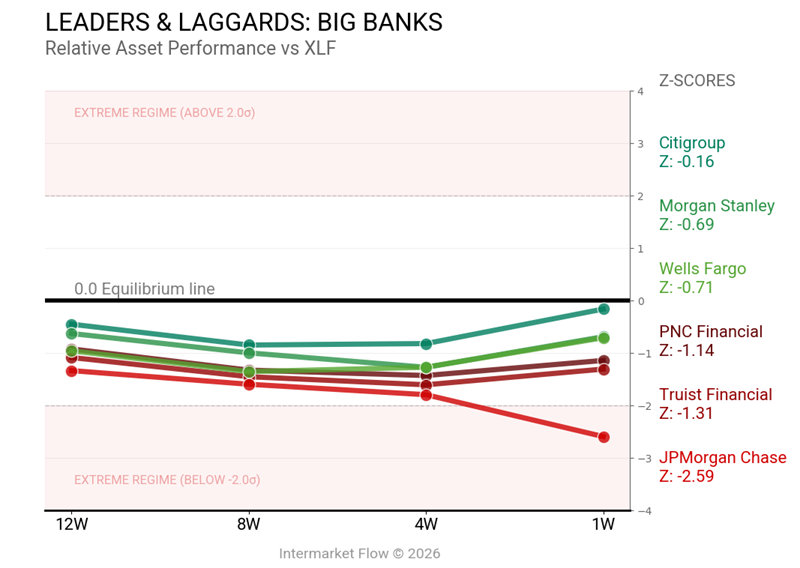
- Extreme Regime: JPM is at -2.59σ. This is not a “decline” — it is a relative capitulation versus its peers and the XLF.
- The Message: When the “gold standard” of banking collapses like this while Citi (-0.16σ) remains “stable,” there is either a massive positioning problem or a quality rotation that is cannibalizing what was once untouchable.
- Remember, City ‘s main business model is not consumption credit, where charge offs are growing.
- Keep in mind that 90% of Credit consumption business sits in four of the big banks. JMP, WFC, BAC and MS. We saw and publish this September 25 (here the details)
- If the leader of the financial sector bleeds like this, the heart of the system (banking) has a severe arrhythmia.
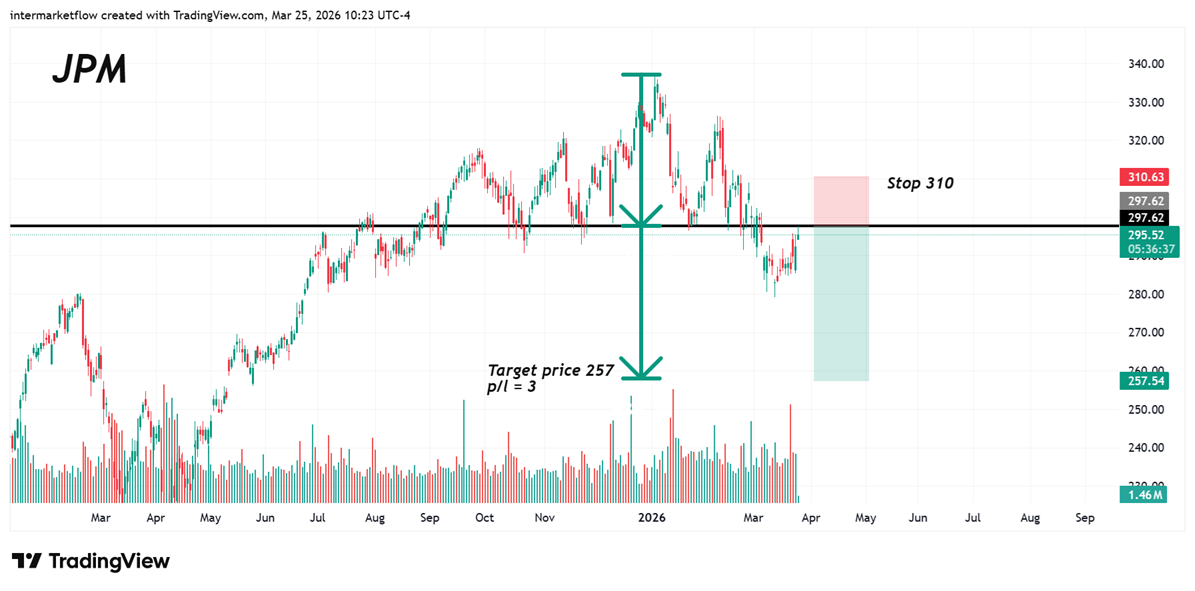
In the last mid-week report, we sent this trade, shorting JPM. (here). The reality is that we had been watching this chart, but it did not yet have weekly confirmation, which is why we decided to wait. This is the chart, 3 days old now.
Prof #2: The 2-Year Yield, HYG and JPM: A Compass Pointing Toward Recession
If you believe this is an error, please contact the administrator.
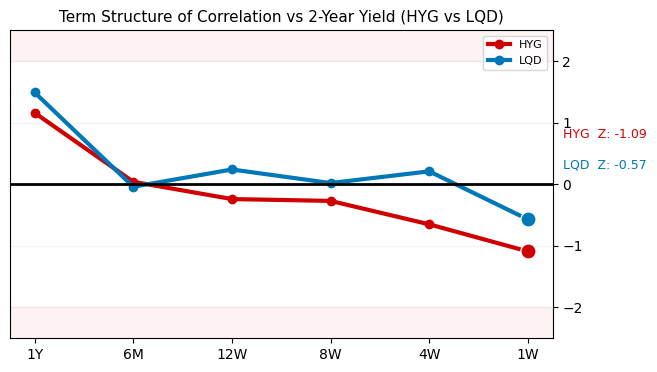
- Exactly one year ago, a rise in rates was perceived as a growing economy (strong, near extreme, positive correlation between 2 year yields and quality and junk credit) that increased the value of corporate debt, within a strong macro backdrop.
- Today, a rise in rates generates recessionary expectations. Negative, not yet extreme, correlation with two year yields.
- At first, mildly, affecting lower-quality debt. Eight months ago, the negative outlook accelerated and lower-quality debt began to fall while higher-quality debt remained stable.
- One month ago, the duration trade affected both types of credit, especially higher-quality credit, which tends to be longer in duration.
- This masked information in the LQD/HYG ratio, which only becomes evident when you look at the full movie rather than a single snapshot.
Prof #3: HYG
This is low-quality credit being slaughtered
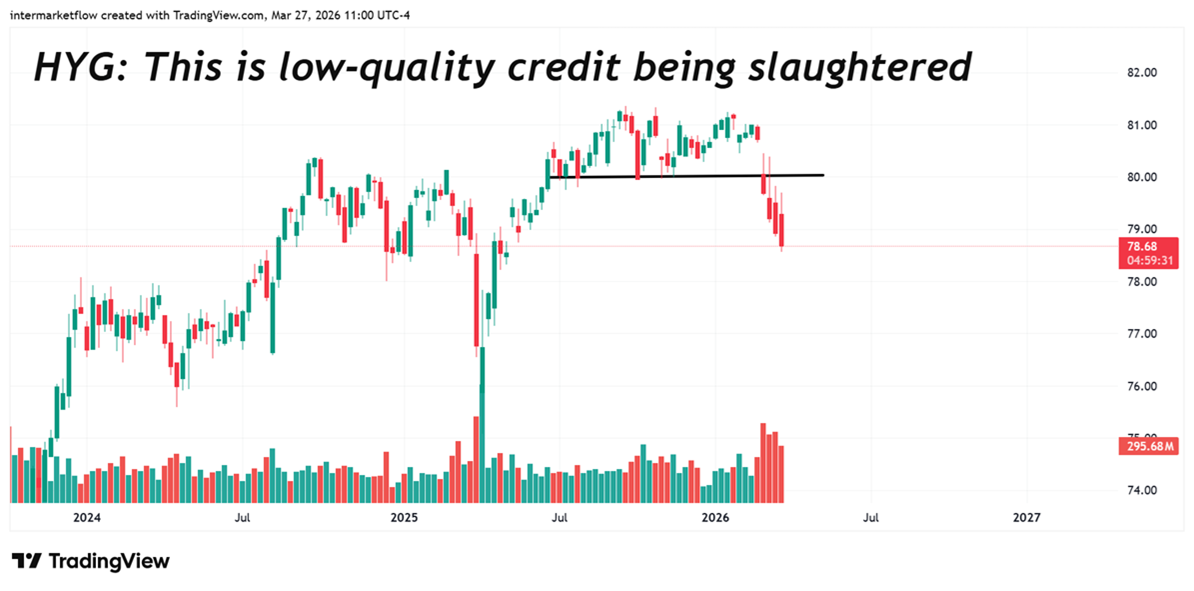
There is no widening spread differential because LQD is also falling. The capital is waiting. Cash is King is the prevailing regime. Keep this in mind to contextualize the scenario and understand why LQD is not getting bid.
Prof #2: The Term Structure — Pure Stress vs. Duration
If you believe this is an error, please contact the administrator.
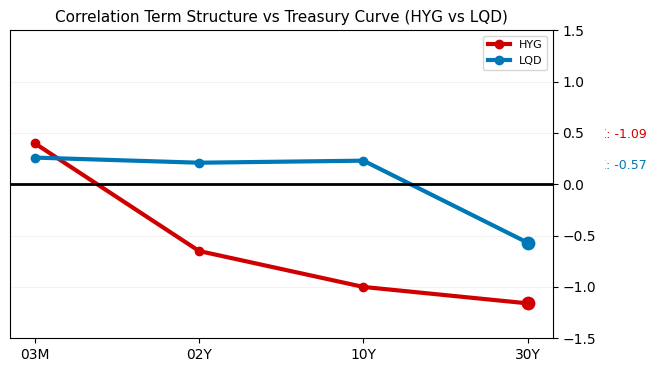
- HYG is already breaking on the short end of the curve, which is pure credit stress—there is no duration there to hide behind.
- LQD, on the other hand, is still holding in the front end but getting hit in the long end, where duration dominates.
- This tells us the system is being pressured from two fronts: credit deterioration in lower quality first, and duration stress in higher quality through the long end.
- The key is that this has not been unified yet.
- When LQD starts to break in the short end as well, the transition from isolated credit stress to systemic credit risk will be complete and a full credit crisis will be priced.
In short, the market sees a credit problem in the short term (HYG is suffering), but it is not a full-blown crisis, yet. If it were, LQD would also be falling in the short end.
In other words, the market sees the situation, but perceives it as contained and still distant.
Conclusions and course of action
- The sector the market is already punishing—and will continue to punish— XLF. This is where the trade is today. It has not yet fully priced in all the losses from delinquencies in loan portfolios. This trade remains open. Quantify pullbacks and operate in follow-the-trend mode or sell the rally.
- The trade the market has not yet punished is lower-quality credit equities. This will be our focus on Wednesday.
- We remain in a “Cash is King” regime, which is why these trades are not yet being fully priced. Capital is concentrated in dollars, parked in T-bills or money market funds.
- Correlation levels with the 2-year rate have shifted from positive a year ago to negative today. Higher rates now create a recessionary environment, with the added nuance that lower rates would likely lead to the same outcome. A decline in rates in this context would be a repricing of a slowdown in economic activity, not a bullish event for the market.
- When looking at the term structure of both, quality and junk credit, it becomes clear that in HYG, credit risk has already entered, putting pressure on the short end of the curve, while in LQD the correction, for now, is driven by duration and concentrated in the long end of the curve.
Martin
If you believe this is an error, please contact the administrator.