
Rate Repricing
How to Read Implied Rate Probabilities:
- These probabilities are derived from the pricing of short-term interest-rate futures, which trade continuously in the market and reflect investors’ expectations for the future path of Federal Reserve policy rates.
- Changes in these probabilities therefore capture shifts in expected short-term rates and, by extension, changes in the expected cost of capital.
Source: FRED.

Interpretation
- Sharp Monetary Repricing: In a single day following Kevin Warsh’s speech, the implied probability of a September 16, rate hike rose from 35.4% to 59.5%.
- Equities Have Not Adjusted: Equity markets remain largely range-bound, creating a clear divergence between rapidly shifting monetary expectations and relatively static asset prices.
Risk Propensity Regime
How to Read
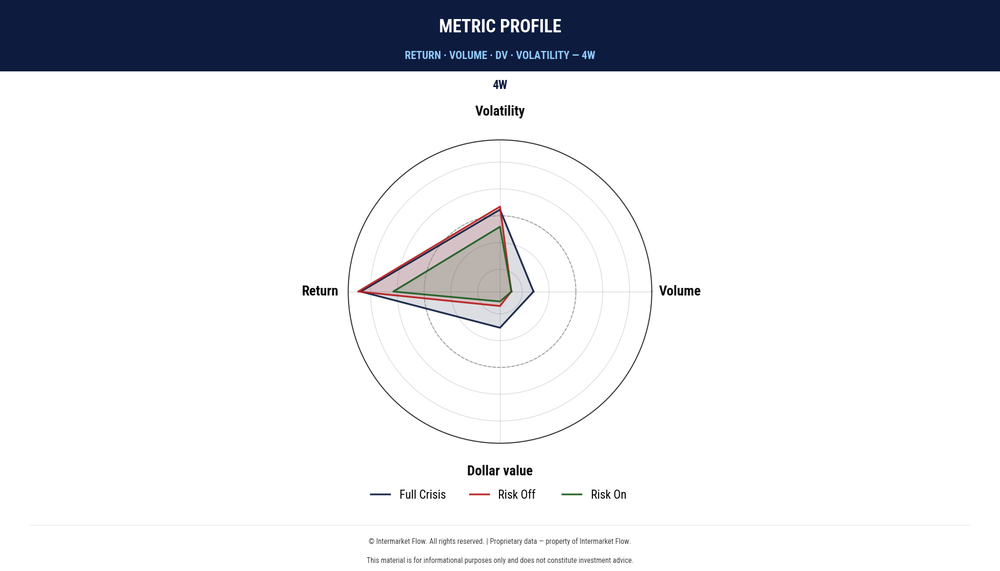
- Radar 4w Flows: Each axis measures a core market variable. A balanced shape suggests broader confirmation across returns, volatility, volume, and Dollar Value; a pointed or distorted shape signals fragility and lack of confirmation.
Interpretation
- Returns and Volatility Lack Confirmation: Across the last 4W window, returns and volatility are moving without equivalent support from Volume or Dollar Value.
- Hands-Out Regime Persists: Participation continues to deteriorate across the board, keeping the market within a clear Hands-Out regime.
- Without a healthy risk propensity regime, the market remains structurally Hands-Out. The immediate consequence is fragility.
Macro prices Regime
How to Read
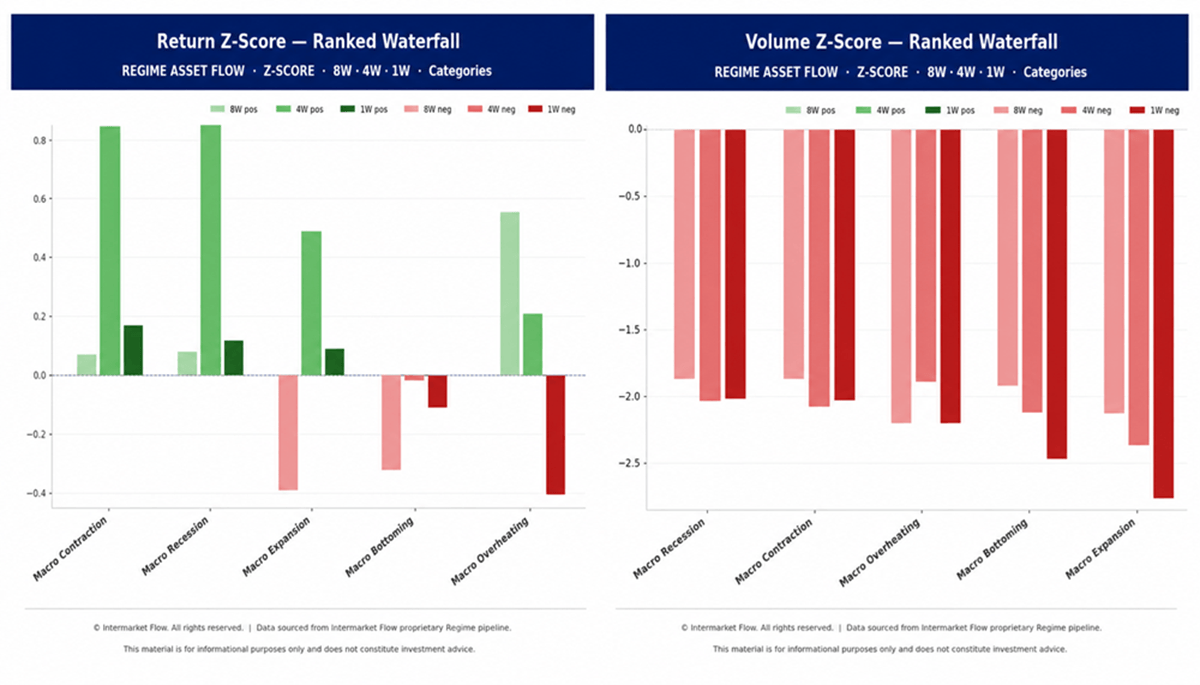
- Macro Regime Matrix (8W → 4W → 1W): Tracks how market-implied macro conditions evolve across different time windows, identifying whether the underlying structure is shifting toward expansion, slowdown, contraction, or recovery.
Interpretation
- Contractionary Bias Persists: The macro structure reflected in asset prices continues to show a clear contractionary bias.
- Defensive Rotation Dominates: Capital participation is weakening across traditional risk assets while defensive exposures increasingly lead the underlying trend.
All interpretations throughout this report should be understood within a persistent Hands-Out market context. This condition is not arbitrary: it reflects a weak Risk Propensity Regime, where capital remains sidelined because the underlying risk-reward structure is not sufficiently attractive under any of the prevailing scenarios. The immediate consequence is greater market fragility.
Volatility Divergence
How to Read
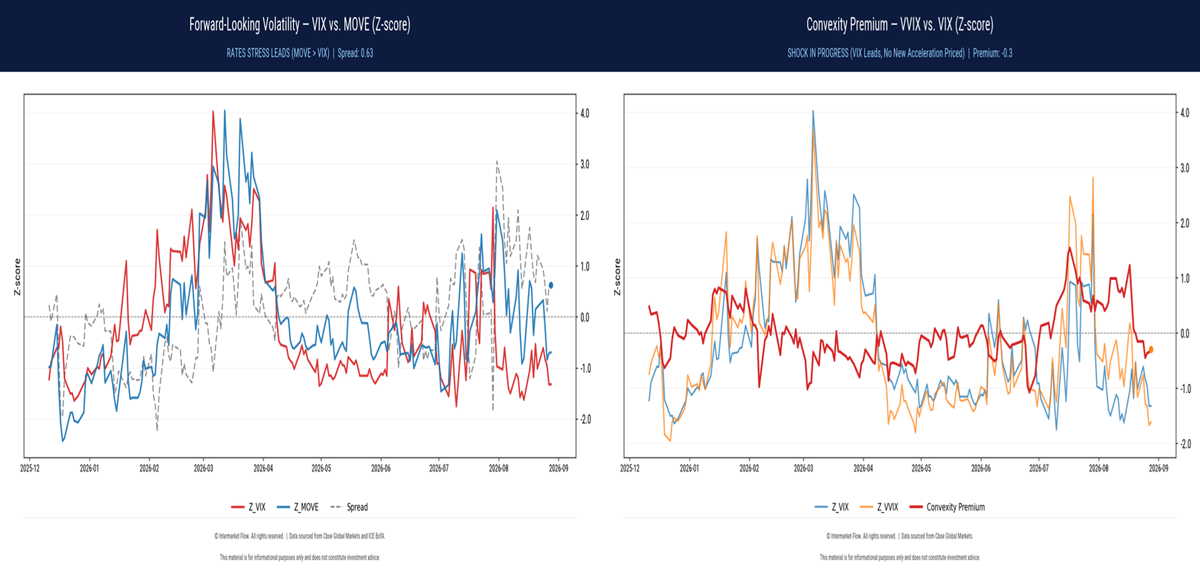
- Left — VIX vs. MOVE: Positive spread = rates volatility leads equity volatility.
- Right — VVIX vs. VIX: Positive premium = volatility acceleration; negative premium = VIX lacks VVIX confirmation.
Interpretation
- The headline VIX moved higher, but VVIX failed to confirm the move.
- VVIX remained largely flat, indicating that the rise in VIX was not accompanied by a comparable increase in demand for volatility-of-volatility protection.
- This lack of confirmation suggests that the move in VIX reflects short-term friction and positioning adjustments rather than genuine systemic stress or strong institutional hedging conviction.
The divergence points to “defensive complacency” not yet to a confirmed deterioration in broader risk sentiment.
Course of Action
Thesis: Valuations may struggle to withstand a higher cost of capital and tighter financing conditions under a dry, Hands-Out liquidity regime. The repricing in rates acts as a direct margin squeeze and funding shock for rate-sensitive structures.
- An equity repricing is still ahead.
- Macro Context: Prices across contraction-sensitive assets indicate that the market is increasingly pricing a contractionary scenario.
- Volatility Has Not Fully Adjusted: The speed of the volatility response remains insufficient relative to the repricing already taking place in rates.
- Rate-Sensitive Sectors Are Exposed: These sectors now have to adjust to a new interest-rate reality and tighter financing conditions.
- Vehicles Expressing the Thesis: Small Caps, Nasdaq, Financials, and especially Small Financials or Regional Banks.
The Short Scenario — Subjective Desk Views
The short basket — IWM, QQQ, XLF and KRE — is based on a combination of deteriorating participation, weak capital intensity, rate sensitivity from different angles and incomplete volatility repricing.
- Entry Bias: The setup remains valid while 4W and 1W measures continue to show deteriorating Dollar Value, weak relative volume, and negative or flattening returns across the basket.
- Cross-Asset Confirmation: Rates volatility remains elevated relative to equity volatility, while the equity volatility complex has not yet transitioned into a full convexity event. This supports a fragile, but not yet disorderly, risk environment.
- Invalidation: The bearish thesis weakens materially if participation recovers, Dollar Value normalizes sharply, and the basket breaks above recent resistance with expanding volume.
- Profit-Taking: Exposure should be reduced as realized volatility reaches statistically extreme levels and selling pressure begins to stabilize, particularly if Dollar Value and participation stop deteriorating.
Current Status: The framework is being monitored dynamically. Some positions are already open and were reported when they were initiated.
A technical perspective: Some Weekly Time-Frame Charts
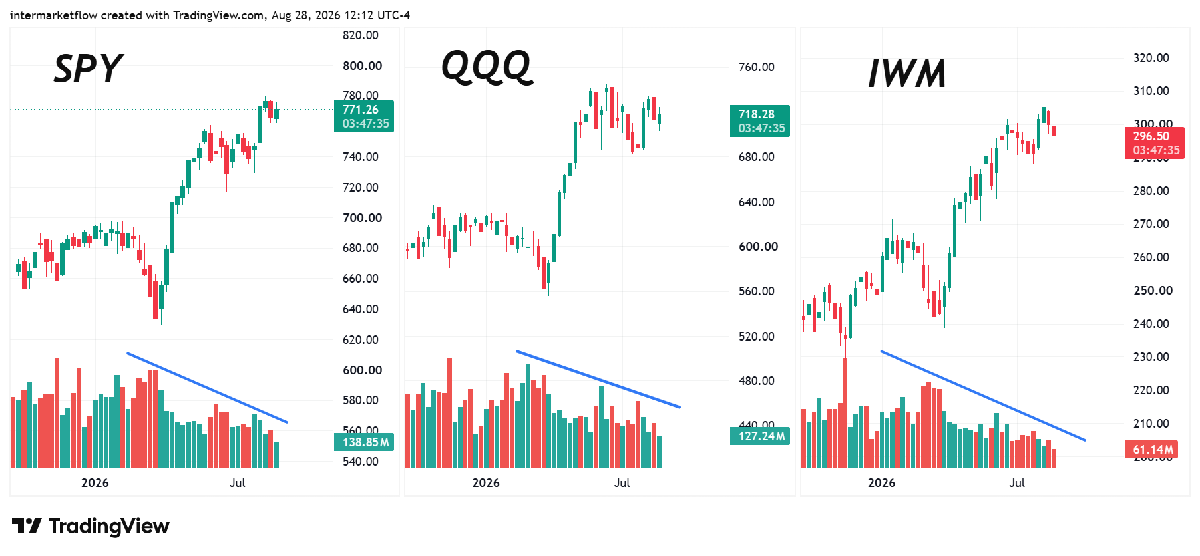
A weekly chart
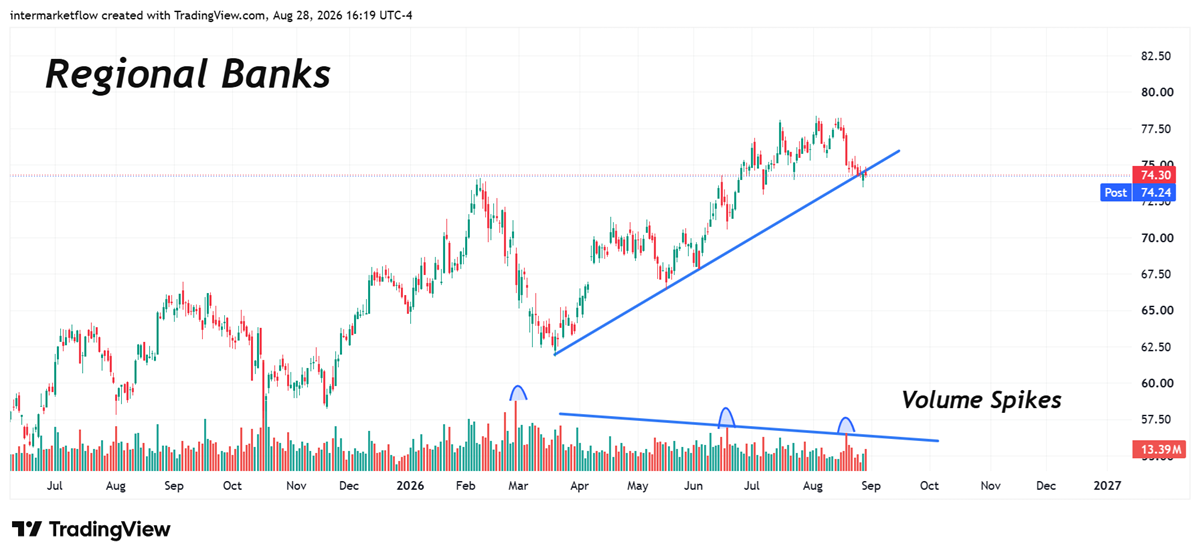
- Price has yet to fully price in the latest rate shock, while capital participation has been deteriorating for weeks. The Hands-Out regime is the market expression of that withdrawal.
- We do not trade opinions about what the economy “should” do. We trade measurable dislocations and wait for the market to close them.
- Turn market context into an edge. Subscribe to Intermarket Flow for two weekly reports tracking risk regimes, capital flows, volatility, and cross-asset confirmation.
Intermarket Flow
If you believe this is an error, please contact the administrator.