
Intermarket Regime Diagnosis: Exhaustion Rally & Liquidity Drought
- The structural evolution exposes an exhausted rally where returns rise broadly across all categories, driven by a severe contraction in supply rather than genuine demand.
- The Return versus Volume plane shows that this transversal upward advance lacks participation, operating within an environment of profound liquidity drought across the entire intermarket spectrum.
Exhaustion Rally: Regime Diagnosis (4W → 1W)
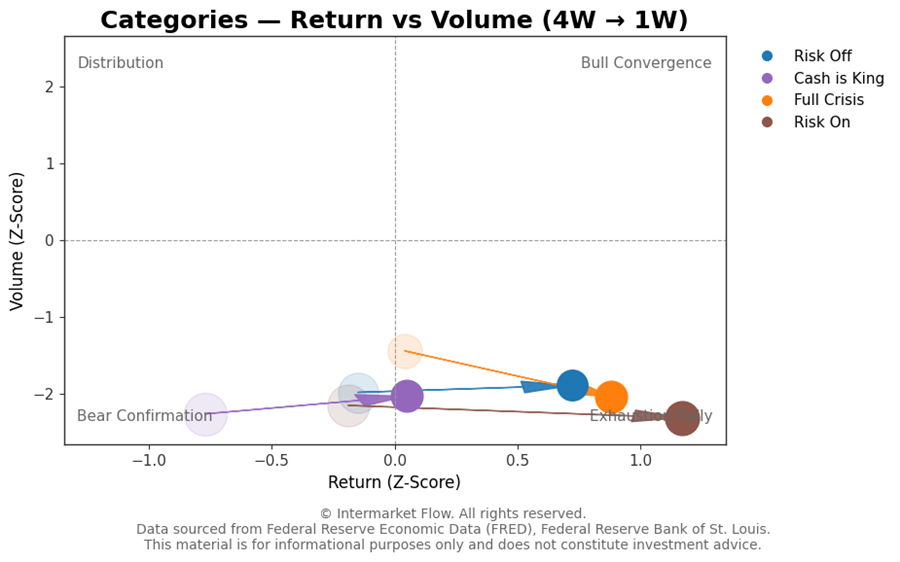
- Interpreting this generalized price rebound as a healthy expansion is a diagnostic error, as the total absence of volume strips the movement of operational backing.
- The structure reflects a market where prices rise via passive inertia in minimal trading conditions, maintaining extreme systemic fragility.
Intermarket: Absence of clean asset rotation.
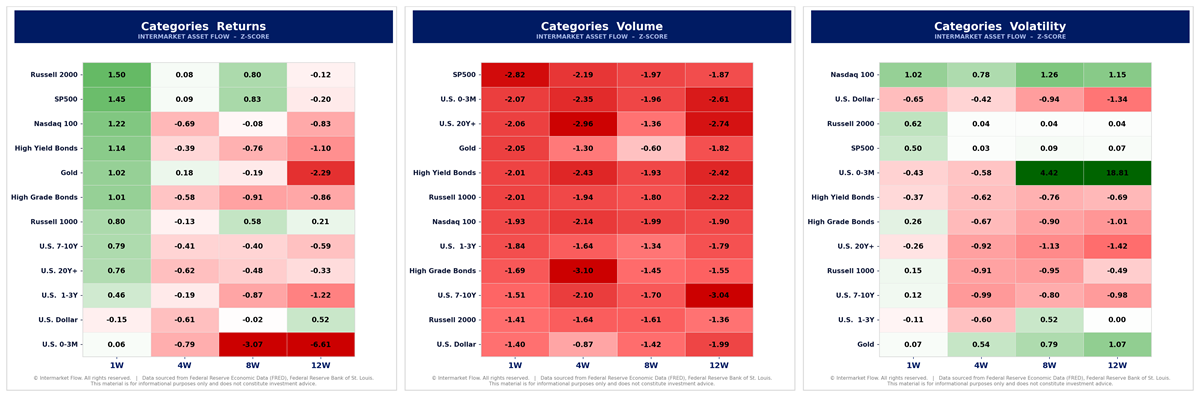
- Broad rally: almost every asset class shows positive 1W returns.
- No clean rotation: equities, credit, Treasuries, and Gold are rising simultaneously.
- Depressed volume across the system: no category shows normal participation; volume Z-Scores remain deeply negative.
- Higher returns, weaker confirmation: several of the strongest-performing assets also show some of the weakest volume readings.
- High price sensitivity: prices are covering significant distance on limited flow, signaling reduced market depth.
- Equities concentrate the fragility: S&P, Nasdaq, and Russell combine strong returns, weak volume, and expanding volatility.
- Credit participates but does not validate: HYG and IG rise without an equivalent recovery in participation.
- Gold and Treasuries also advance: this contradicts a clean Risk-On interpretation and reinforces the idea of generalized repricing.
The dominant signal is structural, not directional: the problem is not that the market is rising, but how it is rising. Broad-based liquidity-vacuum rally; strength in price, weakness in depth, participation, and movement quality.
Volatility Decoupling and Defensive Apathy
- Risk-On is becoming more unstable, not more normalized. From 4W to 1W, its volatility expands while volume deteriorates to the weakest level in the regime panel.
- Defensive stress is fading, but the transition into Risk-On is occurring without participation — leaving the rally increasingly sensitive to marginal flows.
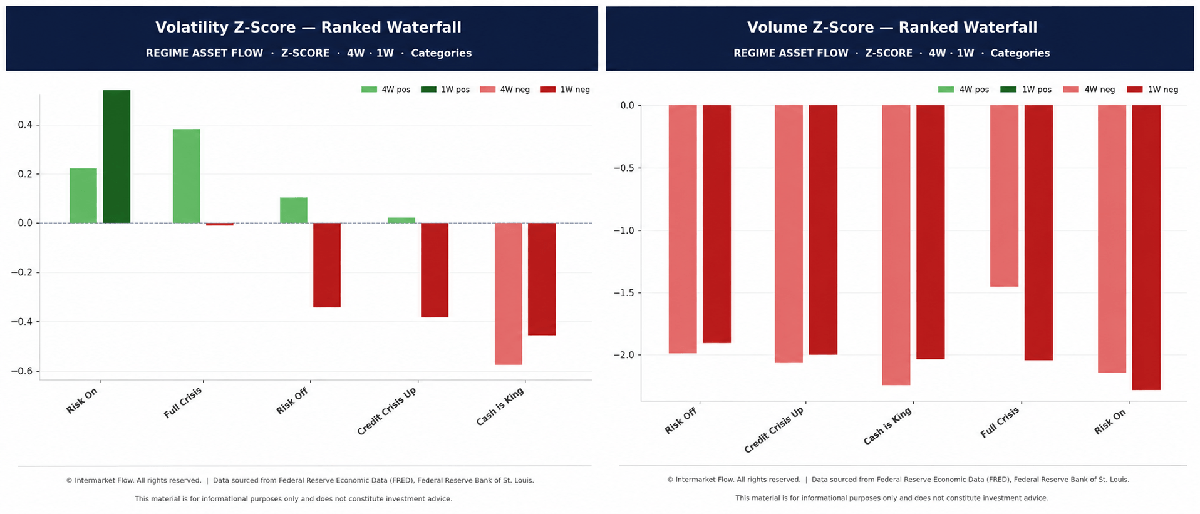
- Defensive safe havens such as Cash is King compress their volatility while registering the same volume drought.
- This configuration confirms a scenario of defensive apathy: a movement devoid of dynamism where the lack of selling pressure sustains prices
Volatility
- In the recent past, the market systematically priced more volatility than ultimately materialized (Right hand chart). The market was more concerned about what could happen than about what ultimately did happen.
- Today, that gap has narrowed sharply: realized volatility is rising while expected volatility is falling.
- If these trends continue, the two will converge, leaving the market increasingly under-hedged in a context that has the potential to become explosive.
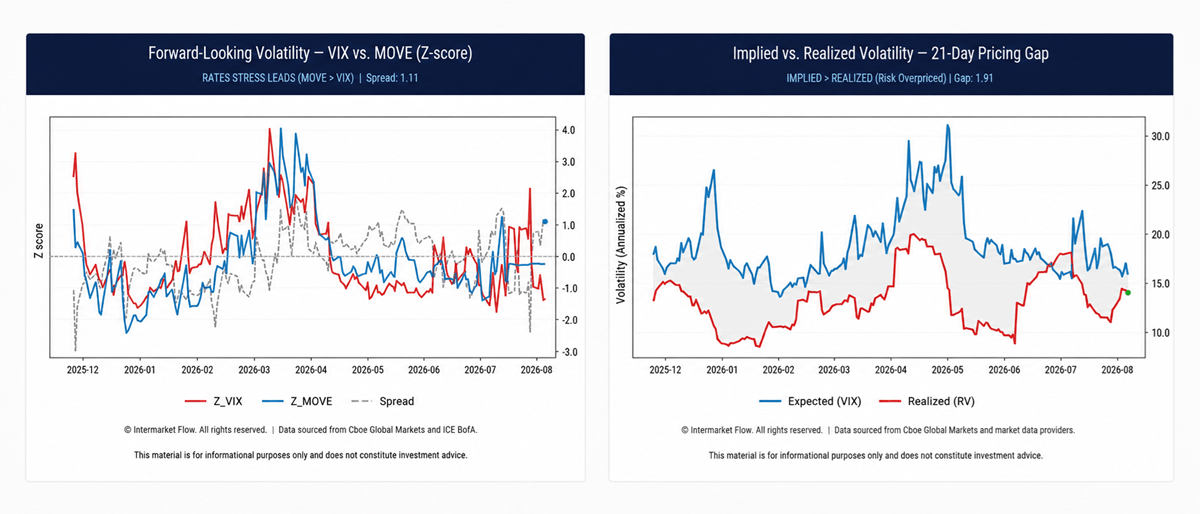
- Normalizing (z-scores) MOVE and VIX shows that current market expectations are tilted toward greater volatility in rates.
- The forward-looking signal is therefore not one of broad systemic stress, but of relative pressure concentrated more heavily in the rates complex than in equities.
What to Watch: Early-Warning Triggers
- Volume on down-moves: The definitive breakdown signal occurs if volume normalizes during a negative return day/week, converting structural fragility into an actual liquidation trigger.
- Volatility and Rates Stress: Risk-On volatility continuing to expand while volume stays below -1.5/-2 sigma, alongside a widening MOVE/VIX spread.
- Leadership Failure: Simultaneous deterioration in Russell and Nasdaq, or credit stopping its participation (HYG underperforming IG).
- Defensive assets, regardless of the category they belong to.
- Note: Over the past two to three days, gold has been receiving flows in convergence with returns, a clear intermarket signal against against a hypothetical Risk-On regime.
Final Conclusions & Course of Action
- Confirmed Exhaustion Rally: Returns rise broadly across the intermarket complex amid an extreme volume drought, driven by supply contraction rather than genuine demand.
- Defensive Apathy & Instability: Risk-On volatility expands while defensive regimes compress, pointing to an inactive, hollow market structure.
- Structural Fragility: Prices are sustained by passive inertia. The system is extremely fragile, with high price sensitivity capable of generating massive overshooting in either direction.
Course of Action
- Zero long exposure.
- In this context, the applicable strategy is strictly tactical hedging.
- Directional exposure remains dangerous because thin liquidity guarantees overshooting regardless of the eventual trigger.
Intermarket Flow
OR
UPGRADE
Free trial has expired.
If you believe this is an error, please contact the administrator.
If you believe this is an error, please contact the administrator.
OR
UPGRADE