
This was the central conclusion of Sunday’s report:
“The market is defensive, fragmented, and vulnerable. With limited depth and compressed volatility, even a modest macro shock could trigger a disproportionate repricing.”
- The price action of the last few days is consistent with that framework. Low volume, limited market depth, and elevated price sensitivity are producing moves that are disproportionate to the level of participation.
- This is not an unexpected regime change. It is the type of behavior the existing structure was already warning about: when liquidity is thin, relatively small shocks can generate outsized price moves.
Market Structure Overview
Returns and Volume
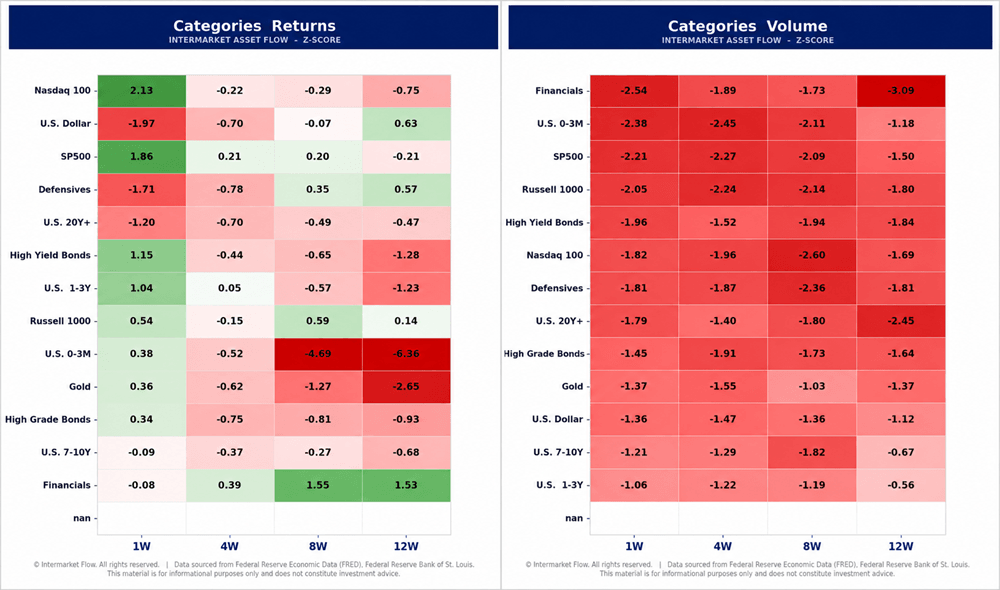
- Nasdaq and the S&P 500 post the strongest weekly returns, but also some of the weakest volume readings. Price is rising without broad participation, so the move is not structurally confirmed.
- Russell 1000 is the key confirmation failure. Its +0.54σ weekly return and −2.05σ volume show that the broader equity market is not validating Risk-On.
- Equities therefore remain the most fragile structure in the group: strong headline returns, collapsing participation, and weak breadth.
Market Fragility and Volatility
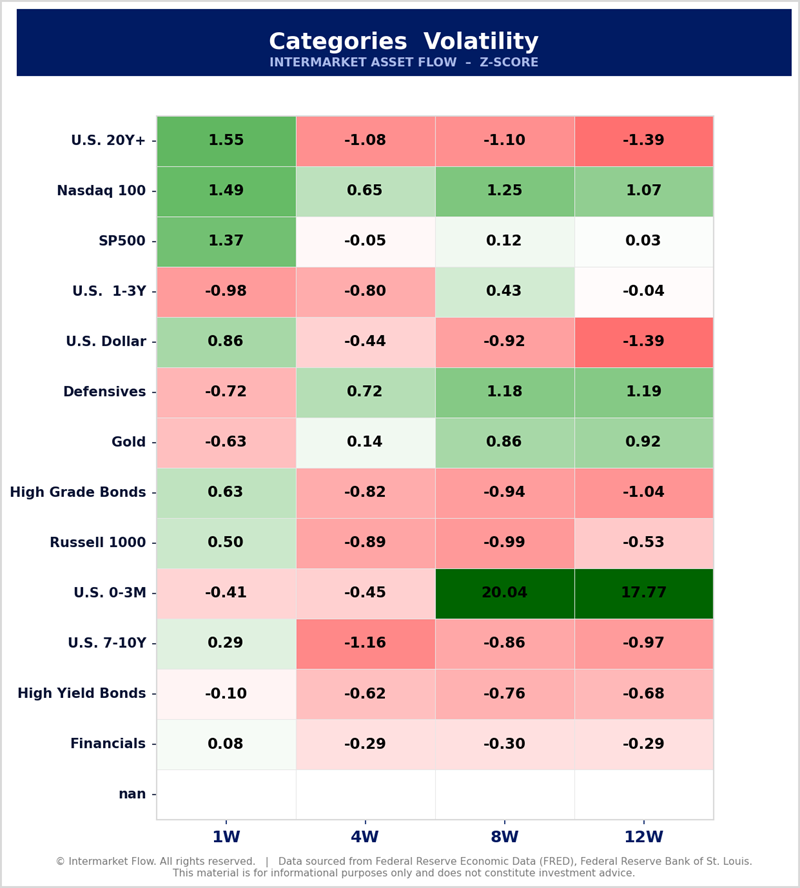
- The volatility panel confirms the same fragility. Nasdaq and the S&P 500 combine the strongest weekly returns with volatility of +1.49σ and +1.37σ, while Russell also turns positive at +0.50σ.
- This is not a deep or healthy Risk-On structure. It is a thin, highly sensitive equity market in which lower participation is producing larger price responses.
- U.S. 20Y+ shows the same fragility on the downside, with volatility at +1.55σ, the highest reading in the panel. Long duration is falling in an increasingly unstable and illiquid environment.
Convergence and Divergence
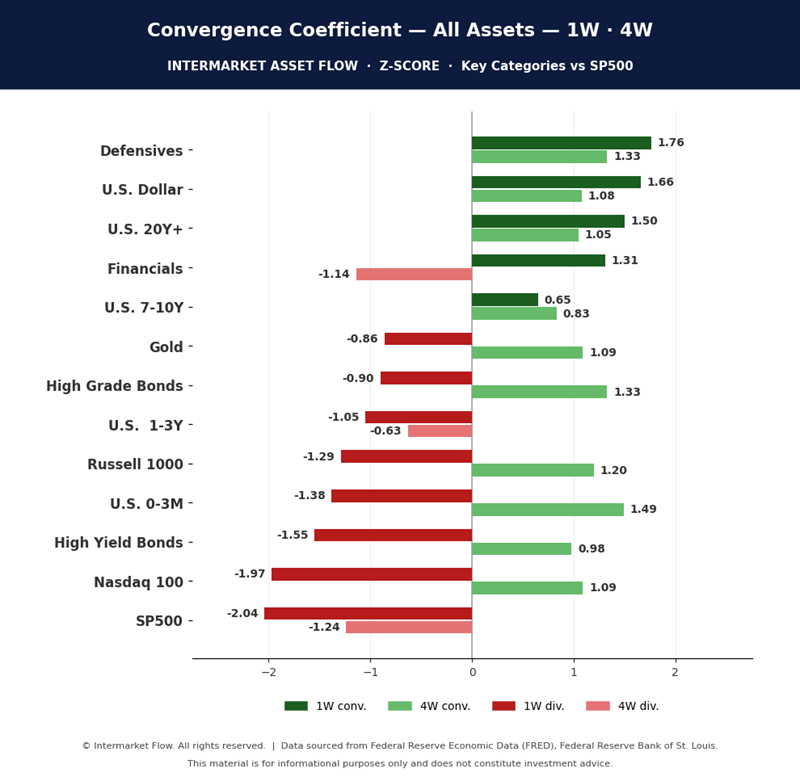
The convergence panel separates price displacement from structural confirmation.
- Nasdaq and the S&P 500 show the deepest weekly divergences, at −1.97 and −2.04, while Russell and High Yield remain negative at −1.29 and −1.55. Equities and credit are therefore not confirming Risk-On.
- Confirmed weakness is concentrated in Defensives, the U.S. Dollar, and U.S. 20Y+, where negative returns align with positive convergence.
- The market remains fragmented: upside displacement in equities, cleaner weakness in defensive assets, low depth, and elevated price sensitivity.
Key Intermarket Signals for Next Week
- Russell and High Yield are the primary Risk-On tests. Without confirmation from breadth and credit, equity strength remains unvalidated.
- Gold and the broader defensive complex are the second key test. Their behavior will show whether capital is beginning to rebuild protection or whether defensive weakness continues.
- At best, the market may be entering the early stage of a regime transition, but it has not even reached Base 1. A genuine change will require intermarket alignment across equities, credit, breadth, volume, and volatility.
Cross-Asset Positioning
Equities
- Signal: Nasdaq and the S&P 500 post outsized weekly gains, while Russell materially lags.
- Validation: Equity volume contracts sharply, volatility expands, and convergence remains deeply negative. Russell’s underperformance confirms that the move lacks breadth.
- Reading: This is upside displacement through a liquidity vacuum, not confirmed Risk-On participation.
- Implication: Prices are advancing because sellers have stepped back, not because buyers are accumulating with conviction.
- Positioning Implication: Reduce beta, avoid chasing breakouts, and treat upside as tactical until breadth and participation improve.
- Invalidation: Russell closes the performance gap while volume improves, volatility moderates, and convergence turns bullish across the equity complex.
Credit and Financials
- Signal: High Yield rebounds while Financials remain flat.
- Validation: High Yield remains negatively divergent, while Financials are flat on the weakest volume reading in the panel. Neither credit nor banks confirms the equity rebound.
- Reading: Credit and Financials are not validating a broader Risk-On transition.
- Implication: Risk appetite is stabilizing at the price level, but capital commitment remains absent.
- Positioning Implication: Avoid adding credit risk until High Yield and Financials show improving participation.
- Invalidation: High Yield develops bullish convergence and Financials advance with improving volume and lower price sensitivity.
Duration
- Signal: Long duration sells off while U.S. 1–3Y Treasuries outperform.
- Validation: U.S. 20Y+ combines negative returns, strong bearish convergence, depressed volume, and the highest volatility reading in the panel.
- Reading: Long-duration liquidation is confirmed, while short duration remains the relative defensive preference.
- Implication: Investors are avoiding duration risk, but low participation prevents classifying the move into U.S. 1–3Y as confirmed accumulation.
- Positioning Implication: Favor liquidity and short duration over long duration.
- Invalidation: U.S. 20Y+ stabilizes, volatility contracts, and positive returns align with improving volume and bullish convergence.
Defensives and the U.S. Dollar
- Signal: The U.S. Dollar and defensive assets record the sharpest negative weekly returns.
- Validation: Both remain under bearish convergence, but their internal dynamics differ: dollar weakness is becoming more volatile, while defensives are declining in a more orderly and compressed structure.
- Reading: This is structural weakness, not forced liquidation.
- Implication: Capital is leaving traditional defensive exposures, but the destination is not yet confirmed.
- Positioning Implication: Avoid premature bottom-fishing and wait for participation to stabilize.
- Invalidation: Returns stabilize, bearish convergence weakens, and any rebound is supported by improving volume rather than another low-participation price displacement.
Final Market Regime Assessment
- Do not confuse equity price displacement with structural strength.
- Avoid chasing the rebound, remain cautious on long duration, and favor liquidity and short duration until breadth, credit, volume, and volatility confirm a genuine regime shift.
- Markets remain thin, shallow, and highly sensitive. Expect disproportionate moves.
- Price alone does not invalidate the thesis. Invalidation requires alignment between return, participation, volatility, and convergence.
- Intermarket will lead the way. Stay focused.
Intermarket Flow
OR
UPGRADE
Free trial has expired.
If you believe this is an error, please contact the administrator.
If you believe this is an error, please contact the administrator.
OR
UPGRADE