
In the previous report, we described the market as follows:
- This is not panic yet.
- It is absence.
- Absence of accumulation.
- Absence of institutional depth.
- Absence of clean defensive rotation.
- Absence of price-volume confirmation.
The latest data suggests even that diagnosis was too narrow.
The market is not merely failing to choose between Risk-On and Risk-Off. Participation is collapsing across both sides of the structure, while prices remain suspended in an increasingly illiquid environment.
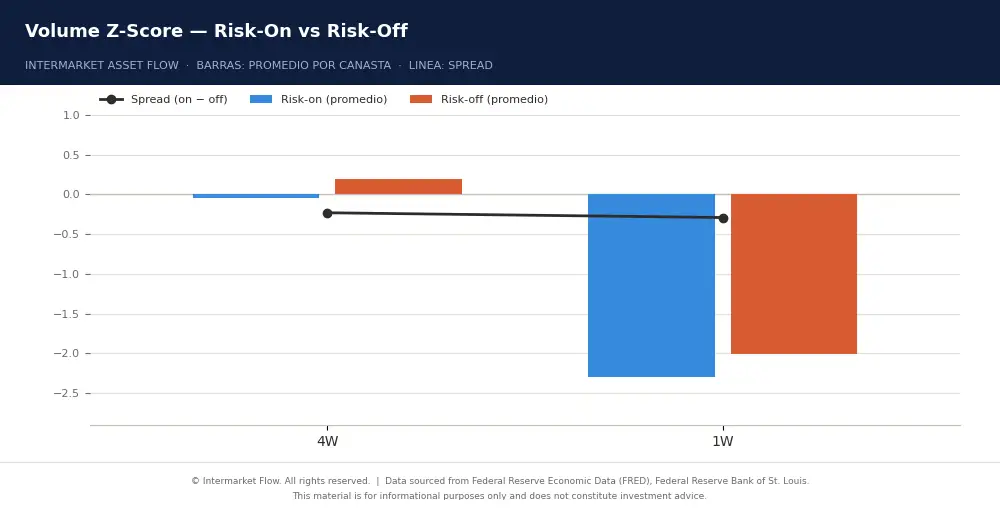
Risk-On vs. Risk-Off: 4W to 1W
How to Read
The bars show average Volume Z-Scores for Risk-On and Risk-Off at 4W and 1W. The line shows the spread between them.
- At 1W, volume in both regimes has collapsed toward −2σ at nearly the same pace. Neither Risk-On nor Risk-Off is being validated.
- Inactivity is the signal: capital is retreating without choosing a destination.
What Is Sustaining Prices?
Two mechanisms may be temporarily holding the market together.
- Passive flows may be supporting index prices despite weak liquidity. This can preserve stability, but with fewer active counterparties, one large order may force abrupt repricing.
- Options positioning may also be suppressing volatility through dealer gamma hedging. But this stability is conditional: a shift in gamma exposure or strike concentration could trigger a sharp technical volatility expansion.
Volatility and the Speed of Volatility
Volatility has compressed sharply over the past month, while the speed of that compression suggests increasing complacency at the index level.
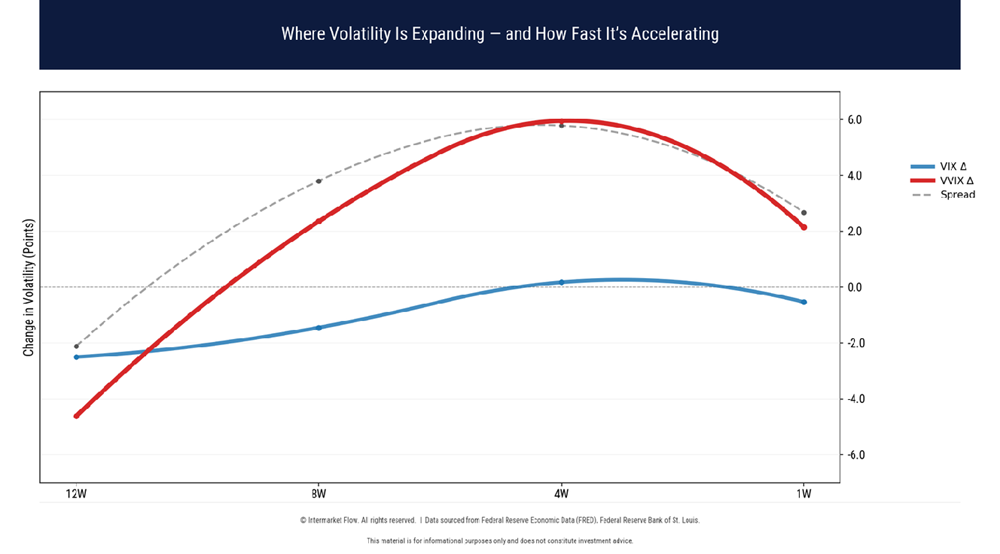
But the aggregate index is not telling the full story.
Hidden Instability Beneath the Index
The index appears stable, but its underlying components are becoming more volatile.
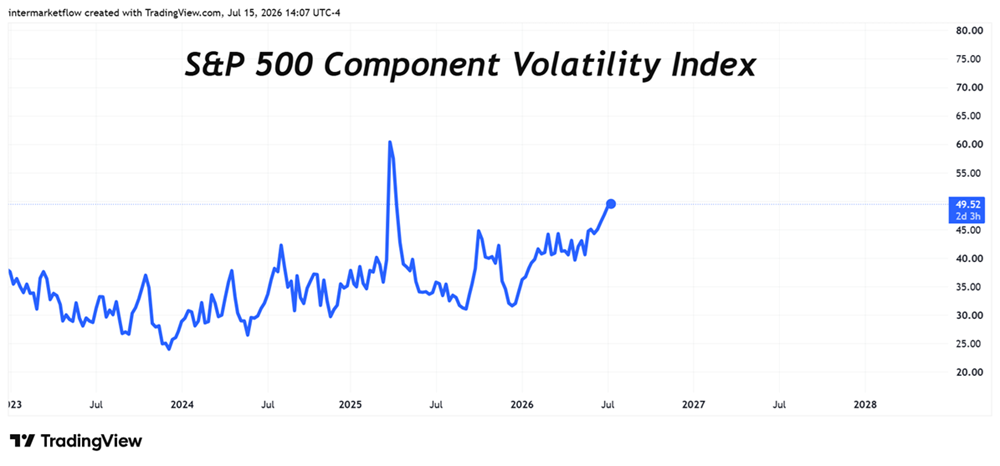
- The apparent calm depends less on broad stability than on diversification, low correlations, and options-market mechanics.
- The index is masking the volatility beneath it. As long as stocks move independently, that volatility remains contained. If correlations rise, it can migrate rapidly into the index.
- The risk is not that volatility appears. It is already there.
Operational Implications
- Index setups based only on compressed volatility are unreliable in this environment.
- The priority is to identify which assets are leading the volatility expansion and whether the move reflects price deterioration, liquidity withdrawal, or both.
- Reduce exposure where volatility increases without volume support.
- At the portfolio level, this is an attractive moment to hedge. Protection remains cheap while dispersion is rising and market depth is deteriorating.
- The key signal is correlation. If individual volatility continues to rise and correlations rise with it, idiosyncratic stress is becoming systemic.
Conclusion
- This is no longer just an absence of accumulation or failed defensive rotation. It is a market-wide collapse in participation.
- Risk-On is not attracting capital. Risk-Off is not attracting capital. Credit is not confirming systemic stress, but it is not absorbing flows either.
- The dollar is rising without strong Dollar Volume, while index volatility remains compressed across an increasingly illiquid structure. Beneath the surface, however, volatility is already expanding at the individual-stock level.
When liquidity disappears, volatility does not need to build gradually. It can remain hidden until correlations rise and the index is forced to discover where the next real bid exists.
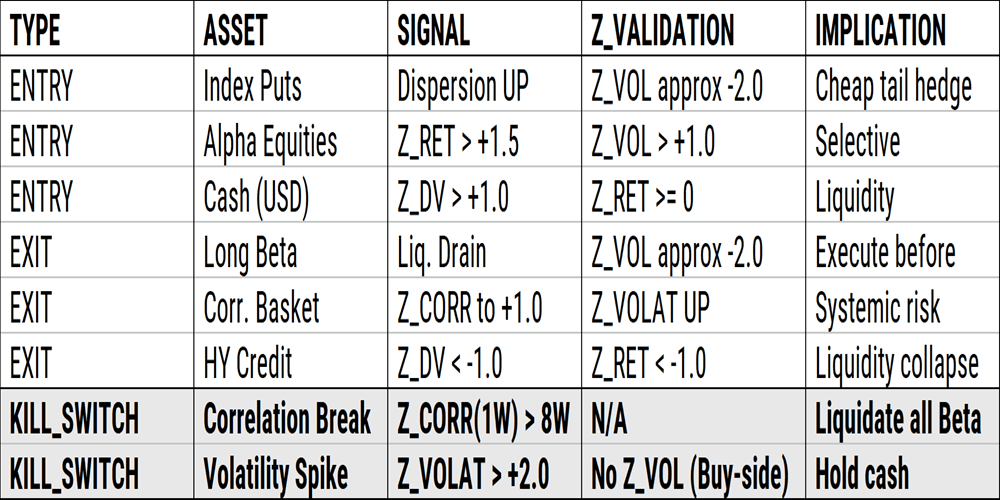
Trader’s Guide
Intermarket Flow
If you believe this is an error, please contact the administrator.